
Suggested reading

Selected non-fiction reviewed in the Socialist Standard
For some fiction and other books we like, go here)
Recent years have seen the publication of an increasing number of books having the effect of exploding long-held myths about such subjects as work, cooperation and competition, human nature, population, resources, and what a future socialist society might look like. Many of these books have been reviewed or otherwise written about in the Socialist Standard. Below is a list of some of those books with brief summaries of contents and links to reviews or articles in the Socialist Standard.
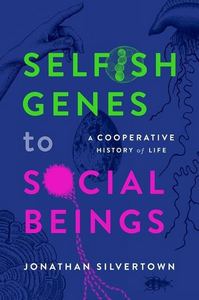 Selfish Genes to Social Beings. A Cooperative History of Life. Jonathan Silvertown. Oxford University Press, 2024
Authoritative expression from a biological scientist of the idea that all life, including human life, has only been possible through cooperation and teamwork and that, in spite of conflicts that exist, it is cooperation rather the selfishness or competition that confers benefit to all. It confirms that humans are ‘an ultra-social species’.
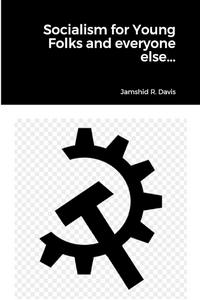 Socialism for Young Folks (and Everyone Else). Jamshid R. Davis. Omnia Sunt Communia Press, 2023.
Socialism seen as a society where distribution of goods and services is not through markets but by free access. Puts centre stage the idea of dispensing with capitalism and establishing a new society based on collective production for direct use.
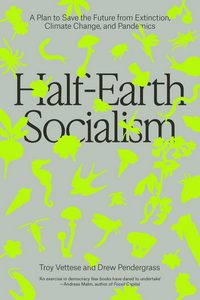 Half-Earth Socialism: a Plan to Save the Future from Extinction, Climate Change and Pandemics. Troy Vettese and Drew Pendergrass. Verso, 2022.
An imaginative look at how a world focused on the common good of humanity and the natural environment might be established and organised.
Beyond Money. A Post-Capitalist Strategy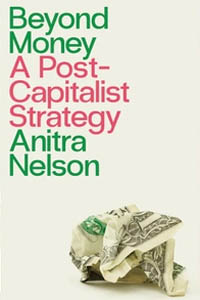 . Anitra Nelson. Pluto Press, 2022.
Puts centre-stage ideas and discussions about how to dispense with capitalism and establish a new society based on collective production for direct use. Argues compellingly that the only way to achieve a post-capitalist future is to abolish money, or it is not post-capitalism at all.
Moneyless Society. The Next Economic Evolution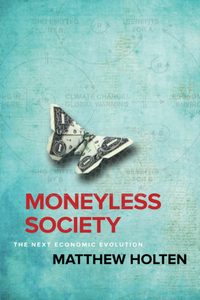 . Matthew Holten. Clearsight, 2022.
Arguments for a society without markets and money signposted in clearly labelled sections and expressed in down-to-earth eminently readable language.
Description of the World of Tomorrow. A World Without Money or Barter or Exchange: a Civilisation of Free Access. Jean-Francois Aupetitgendre and Marc Chinal. Editions Réfléchir n’a Jamais Tué Personne, 2021.
Explains why the current society, based on commerce, exchange, competition, hierarchy and production for profit (ie, capitalism), does not suit human beings and why it must urgently be superseded by a different kind of society one of ‘comfortable abundance’ based not on profit but on mutual cooperation, real democracy and production for need. (French language)
A World Without Money or Politicians . Colin Walpole. 2017.
Argues for getting rid of a money economy and replacing politicians by direct democracy, since ‘money gets in the way of self-fulfilment’.
Life Without Money. Building Fair and Sustainable Economies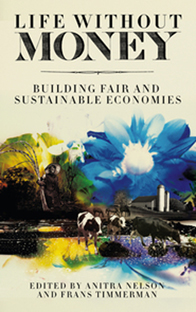 . Anitra Nelson & Frans Timmerman (eds). Pluto Press, 2011.
Sees non-market socialism as meaning a moneyless, marketless, wageless, classless and stateless society that aims to satisfy everyone’s basic needs with power and resources shared in just and equal ways.
Beyond Money: Yenomon. Anitra Nelson. 2022. Video review.
7-minute film echoing the themes of ‘Beyond Money: a Post-Capitalist Strategy’ (see above), i.e. ‘a world without money, a world based on real values, social and ecological values, a world where we co-govern all together deciding what we do, make and get’.
Wageless Life. A Manifesto for a Future Beyond Capitalism . Ian G.R. Shaw and Marv Waterstone. University of Minnesota Press, 2020.
Dramatic statement of the realities of advanced capitalism, described as ‘a war of profit against life on earth’, but does not go as far as advocating the money-free economy that would transform that.
Survival of the Friendliest: Understanding Our Origins and Rediscovering Our Common Humanity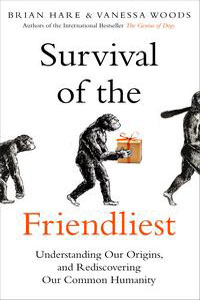 . Brian Hare and Vanessa Woods. Oneworld, 2020.
Worthwhile account of human evolution, where co-operation and friendliness have played a crucial role in making modern-day humans such an intelligent and technologically-advanced species, with the potential to live in a world of equality where all needs are met.
Ultrasocial. The Evolution of Human Nature and the Quest for a Sustainable Future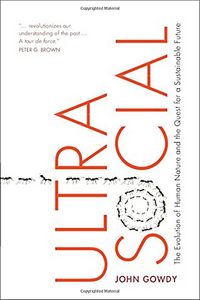 . John Gowdy. Cambridge University Press, 2021.
Gives unqualified and authoritative support to the view that ‘human nature’ is not a fixed entity but eminently flexible and adaptable to circumstances and advocates starting down ‘a new evolutionary path compatible with basic human needs and our place in nature’.
Humankind. A Hopeful History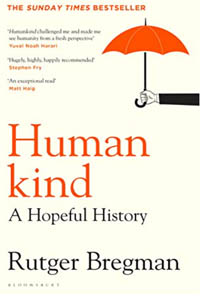 . Rutger Bregman. Bloomsbury, 2020.
Rejects the notion of an innately self-serving, potentially evil human species, explaining behaviour, pro-social or anti-social, as the reaction of hugely adaptable and flexible beings to conditioning and circumstance. Argues that ‘human beings claim togetherness and interaction’ and ‘our spirits yearn for connection just as our bodies hunger for food’.
See the 2022 audio page for some resources on Bregman’s ideas, or jump straight to the talk here.
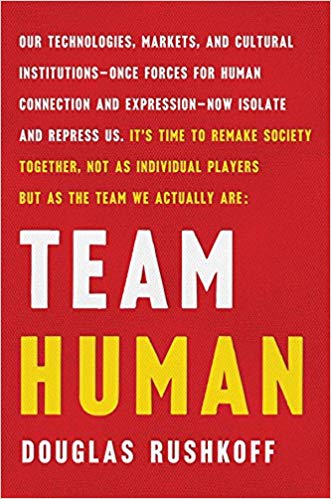 Team Human. Douglas Rushkoff. Norton, 2019.
Calls upon wide ranging research on human evolution, anthropology and psychology to argue that human beings are essentially social creatures and that we achieve our aspirations best when we work together, not as individuals. Link is to talk based on this book.
Automation and the Future of Work . Aaron Benanav. Verso, 2020.
Offers an original and thoroughgoing critique of the current social system and poses a radical solution to its never-ending problems: the abolition of the wages system and a ‘post-scarcity’ society of abundance.
Fully Automated Luxury Communism . Aaron Bastani. Verso, 2019.
Argues that the development of the productive forces via technology makes a society of abundance for all a strong possibility.
A World Without Work. Technology, Automation and How We Should Respond . Daniel Susskind. Allen Lane, 2020.
Compelling arguments that work (but not employment) is a basic human need, ‘a source of meaning, purpose and direction in life’, and that community recognition of that work rather than market wages fulfils the longing for personal fulfilment and social interaction.
Sitopia. How Food Can Save the World . Carolyn Steel. Chatto & Windus, 2020.
A history of food, its consumption and its intersection with the concept of nature and work, showing humankind’s history as largely one of group cooperation and human beings as natural and inventive collaborators. Shows that enough food is already produced to feed everyone on the planet many times over but the system we live under prevents that from happening. Expresses a desire to see a world in which those resources are made available to all but sees that as needing a different social and political structure, described at one point as ‘common ownership’.
Build Bridges Not Walls. A Journey To A World Without Borders . Todd Miller. City Lights Books, 2021.
A powerful set of arguments against the nation state and the system it supports, advocating the abolition of borders and states but not going so far as advocating the abolition of money, wages and the whole of the profit system.
A Radical History of the World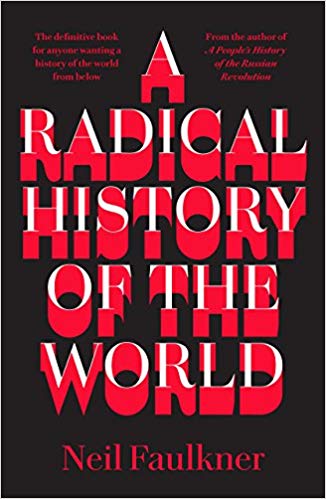 . Neil Faulkner. Pluto Press, 2018.
Shows profound knowledge and understanding of the nature of capitalism, slicing through complexity and challenging the idea that historical judgement has to be ‘neutral’, but seeing change in terms of Trotskyist-style leadership revolution rather than democratically established abolition of the wages system.
Socialism or Your Money Back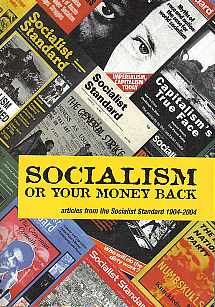 . Articles from the Socialist Standard 1904-2004.
70 articles providing a running commentary from a socialist perspective of the key events of the first 100 years of the Socialist Party.
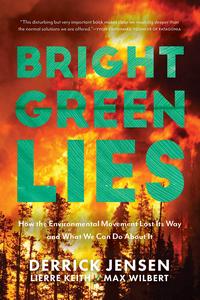 Bright Green Lies. How the Environmental Movement Lost Its Way and What We Can Do About It. Derrick Jensen, Lierre Keith and Max Wilbert, Monkfish Press, 2021
A powerful and thought-provoking indictment of industrial capitalist society, in fact of all the hierarchical human societies that have developed over the last 10-12,000 years. Explains how, since the advent of settled agriculture and the surplus production, oppressive hierarchies, urban settlement and militarism that came with it, the Earth has been massively and increasingly despoiled in the name of human exceptionalism.
After Work. A History of the Home and the Fight for Free Time . Helen Hester & Nick Srnicek. Verso, 2023.
A thoroughly recognisable picture of work under capitalism (‘the majority of us must give up forty hours or more per week in exchange for survival, typically selecting from a narrow range of possible jobs where decisions over what we do on a daily basis ultimately lie outside of our hands’) and a call for people to have, opportunities to develop their individual capacities and also have possibilities for collective human interaction.
Capitalism’s Endgame . Mark Hayes, Phillip Sutton and Lars Torvaldsson. Old Moles Collective. 2023
Capitalism seen as a decadent social system that has long outlived its usefulness and a call for a new socialist society which takes advantage of the conditions of mass sufficiency that now exist.
Hot Planet, Cool Media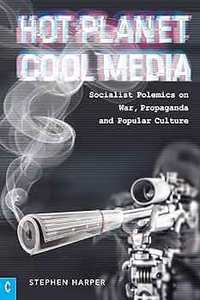 . Stephen Harper. Clairview, 2023
A book of essays that includes powerful arguments for ‘collective and conscious political action to abolish the system that generates problems such as racism, war, alienation and climate change’.
Capitalist China and Socialist Revolution . Simon Hannah. Resistance Books, 2023 (reviewed January 2025)
A realistic account of China which shows it not to be socialist or communist but corresponding to all the definitions of a capitalist state, ‘following capitalist imperatives of growth’ and ‘indeed comparable to a Fascist state’.
Red Memory: the Afterlives of China’s Cultural Revolution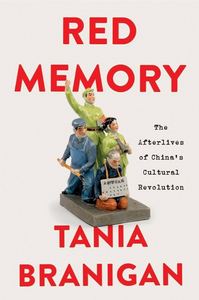 . Tania Branigan. Faber & Faber, 2024 (reviewed July 2024)
A well researched and chilling account of China under the rule of Mao and of how rulers can manipulate the ruled and even impose amnesia.
The Nature of Nature. The Metabolic Disorder of Climate Change . Vandana Shiva. Chelsea Green Publishing, 2024 (reviewed May 2025)
An eloquent treatise on the human relationship with food and a searing indictment of how that is being disrupted by the despoiling of the earth and biosphere that is taking place under capitalism’s ‘money machine’ where the earth is treated as ‘raw material for industrial production’.
Minority Rule. Adventures in the Culture War . Ash Sarkar, Bloomsbury, 2025 (reviewed August 2025)
A wide-ranging and well-informed analysis of the wrongs of capitalism which takes down the myths of race, nation and gender that are used to divide the class of wage and salary earners, the vast majority in society, who seem unwilling to see how they are manipulated and so fail to come together to do anything about it.
Waking Up. A Journey Towards a New Dawn for Humanity , Harald Sandø, 2025 (reviewed August 2025)
A book of science fiction but with a fascinating core that addresses the ills of capitalist society and proposes a new world without money or a market, whose essence is summed up by the words of one of its characters:‘We take care of each other, and in doing that, we take care of ourselves. There’s no struggle, no scarcity. Just collaboration.’
Unchained: Living Without Money . Justin Fairchild, 2025 (reviewed September 2025)
A vivid picture of a new society (to which the author gives the name ‘contributionism’) where ‘cooperation replaces competition, access replaces ownership, purpose replaces profit and which ‘addresses the root issues [of] inequality, alienation, and environmental ruin’.
The Decline and Fall of the Human Empire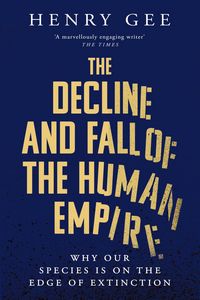 . Henry Gee, Picador, 2025 (reviewed September 2025)
A highly readable (and even occasionally humorous) book by a scientific expert which confirms that, for most of their existence, humans lived a relatively conflict-free life without leaders, states, private property and material inequality but now face ‘a series of political, social, biological and environmental crises unique in their evolutionary history’. Its open-minded approach celebrates migration as a technological plus as well as ‘the reproductive and educational empowerment of women’ and laments that a technology capable of producing abundance causes so many ‘to starve at the banquet’.