
ALB

Forum Replies Created
-
AuthorPosts
-
ALB
Keymaster“…decided that the creation of an elite vanguard party was not the way to build towards socialism.
Yes, that rather would invoke the ire of orthodox trots. It seem to be true, according to this interview he gave last year (scroll down to his last few answers).
Ironically, he seems to have reached the same sort of conclusion as those who were expelled from the SLL in 1960 who set up Solidarity
KeymasterI remember him. He was one of the leading theoreticians of the old Socialist Labour League where quite a few CP intellectuals went after leaving the CP over Hungary. Out of the frying pan into the fire. The SLL was notorious for defending Russia’s nuclear weapons as the “workers’ bomb”.
I thought I had debated him once but it turned out to have been with TomKemp, his fellow editor of the SLL’s theoretical magazine “Labour Review”. In any event, both of them defended the absurd view that Russia was a “degenerate workers state” while its puppet states in Eastern Europe were “deformed workers states”, the difference being that the latter never degenerated from once having been the outcome of a proletarian revolution that had established a genuine workers state.
I didn’t follow what he did later but he was obviously in a different Trotskyist sect than the WSWS lot and their website.
KeymasterBut it’s also half full. Even if the Paris target would not be met if all the planned reductions were successfully implemented, the worst case scenarios of 3 to 4 percent wouldn’t be either.
Capitalist states do seem to be doing something about the threat of global overwarmimg, as was predictable since they were never really going to let Rome burn. That would not be in the overall capitalist interest.
KeymasterKent & Sussex branch report:
On Sunday we distributed about 1800 leaflets, across three areas including the East and West Folkestone County divisions and the Central ward where the town council by-election is taking place.
In all we must have managed to have got out at least at least 9,000 of the 10,000 reminder leaflets printed.
Polling takes place today but the votes won’t be counted until tomorrow morning.
KeymasterKent and Sussex branch members are meeting in central Folkestone tomorrow, Sunday 2 May, at 10.30 to distribute the remaining second leaflet door to door. Local council wards are small enough to leaflet the area twice.
For exact details of where to meet phone or text Rob (scroll up for the number).
-
This reply was modified 5 years, 5 months ago by
ALB.
KeymasterSouth Wales comrades are holding a street stall tomorrow, Saturday 1 May, in Cardiff outside the Capitol Shopping Centre, Queen Street (Newport Road end)from 1pm-3pm.
It seems that decentralisation has gone to heads of the local politicians. Not only have they changed the name of their assembly to Senate but there’s also a Capitol. Next they’ll be calling the First Minister a President.
But it’s only a glorified County Council financed almost entirely by the central government in London.
Still, our declaration of principles, commits us to urging the working class to “organise consciously and politically for the conquest of the powers of government, national and local.”
KeymasterNo politician, no matter how demagogic or potent or capable they are, is going to be able to change what the market is doing.
This is what Biden’s climate envoy, John Kerry, is reported to have told the virtual climate change conference that Biden summoned last week.
He was talking about it becoming profitable to invest in technologies that reduced CO2 emissions like green hydrogen, carbon capture, more efficient batteries, cheaper renewables.
He may or may not be right about what “the market” is doing, but in any event becoming profitable to invest in such technologies is the only thing that is going to get capitalism to do something about global over-warming.
But what he said is also true outside the context of climate change. Isn’t that what we say about the limitations of what governments can do, given capitalism?
KeymasterCame across this article from 1926 on sport showing we have been consistent if nothing else:
KeymasterPostal votes have already been cast in this election.
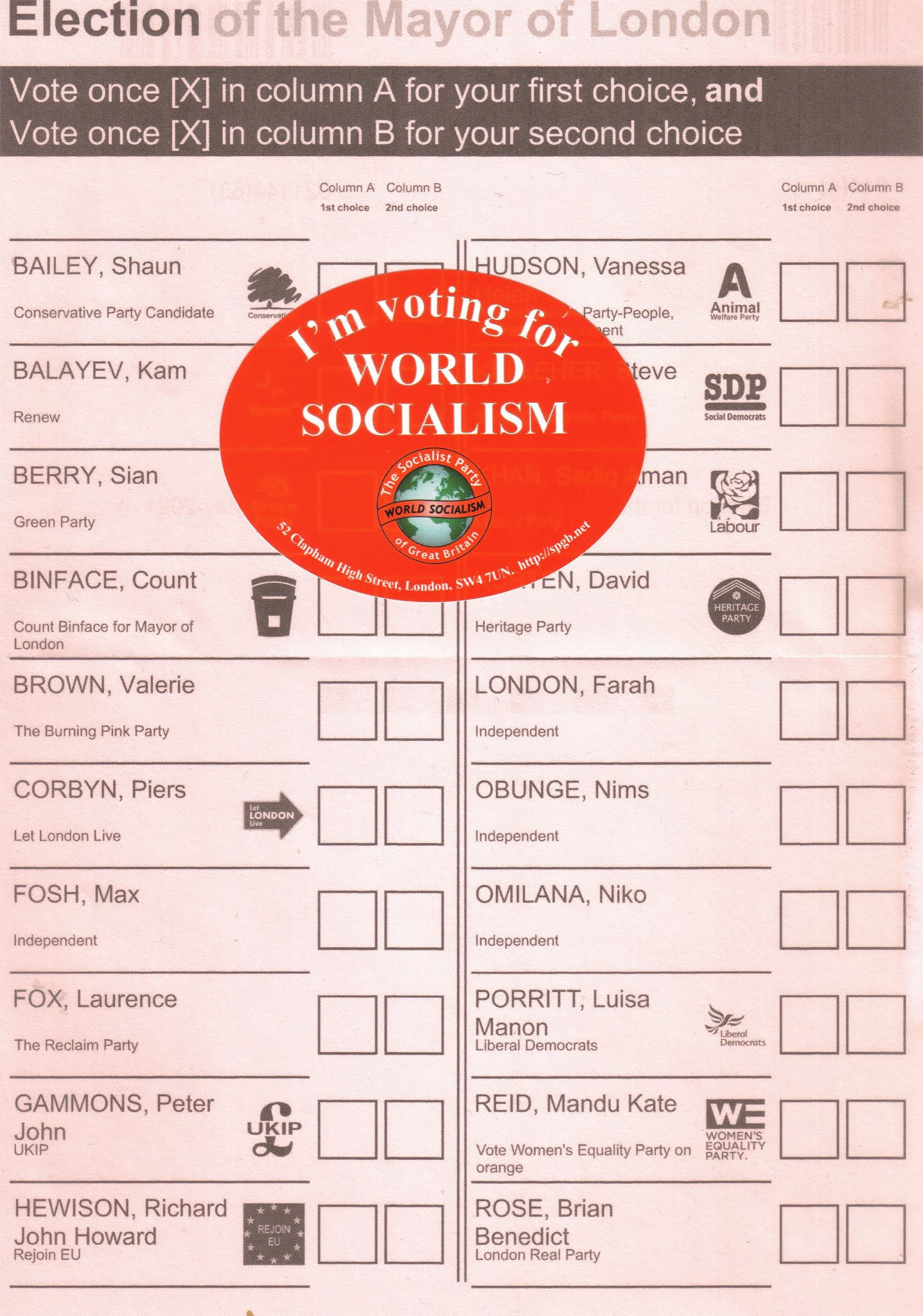
Copies of the sticker are available on request from spgb[at]worldsocialism.org
KeymasterJoke candidates like him are presumably trying to make some serious point: I don’t know, but that politics is a farce or that political promises are meaningless or that elections don’t change anything or something like that . It’s on that basis that they get votes from who agree with their point.
But what about this stunt by the Monster Raving Looney Party? Putting up 13 candidates for one seat in this council by-election in Kingston on 6 May.
Is this beyond a joke as they are no longer seeking protest votes but turning an election into a farce?
KeymasterSo that will get him expelled from the Labour Party or have the “Socialist Appeal” trots decided to bore from within anti-lockdown groups? Or maybe he thought Piers was his brother.
KeymasterJust checked. She is XR.
I also looked up what we said at the time of the referendum on whether or not there should be a directly-elected mayor of London. This is what we said in the editorial of the April 1998 issue of the Socialist Standard which was also printed as a leaflet entitled “Who needs a City Boss?”
Particularly relevant in the context of her proposal to replace the present structure of local regional government in London by citizens’ assemblies is this passage:
“We in the Socialist Party are well aware that in the end whatever arrangements are adopted for local government in London won’t make much difference. This is because such arrangements are to be implemented within the context of the profit system, whose economic mechanisms require all levels of government, however structured, to trim their spending so as not to endanger profit levels whatever people may want–or vote for.”
In other words, citizens’ assemblies might be more participative but that won’t make much difference under capitalism.
KeymasterShe does seem to be only one of 16 candidates standing to talk of “class” and “revolution”. But I think she has some link with XR.
But otherwise what a bunch of self-publicists who have up to £20,000 to spend (£10,000 deposit and up to another £10,000 to pay for the election booklet delivered free to all households).
Then there’s Piers Corbyn. I wonder if he will pick up votes intended for his brother. As a one-time member of the IMG he may be the only ex-Trot standing.
-
This reply was modified 5 years, 5 months ago by
KeymasterImposs1904 has just put this item from 2001 on his blog.
It’s taken those in charge of capitalist states twenty years to realise this and begin to try to do something about.
Whatever we think of what they are doing we can no longer say that they are not doing anything at all about it. The “worst case” scenarios that are given such publicity are not going to happen.
KeymasterIt wasn’t even a nine-day wonder and we’ve arranged for this to be the theme of next month’s editorial in the Standard.
-
This reply was modified 5 years, 5 months ago by
-
AuthorPosts