
Young Master Smeet

Forum Replies Created
-
AuthorPosts
-
Young Master Smeet
ModeratorOf course, why would an Admiral want to have a global reach?
ModeratorIn some ways his analysis is hopeful, because it would mean that Putin has already kind of got what he wants via breaking Russia from the global system: maybe a frozen conflict might ensue (which would be a return to the status que pre-war, with the battle lines just moved a bit).
Also, the thesis is kind of proven by the seizure of oligarch assets: the lesson is, if you don’t control a territory and its state, your wealth is at risk.
ModeratorThis seems recent:
https://jacobin.com/2022/10/russia-ukraine-war-explanation-class-conflictOctober 7, 2022 at 8:25 am in reply to: Members need to revise their old “medieval bad, Renaissance good” prejudice. #234371ModeratorIt’s also worth thinking about things like the Central African kingdoms:
Such as the Empire of Ghana or the Kanem-Bornu Empire, etc. which were sophisticated polities with iron working. They were not, contrary to the European mythology of the ‘Dark Continent’ a far away mysterious place, the spread of Islam shows the extent to which they were connected with other parts of the world (famously, a Ghanaian Emperor making Haj trashed the then world economy he brought so much gold with him).October 6, 2022 at 7:38 am in reply to: Members need to revise their old “medieval bad, Renaissance good” prejudice. #234295ModeratorThe Pursuit of the Millenium is a good recounting of radical sects, false messiahs and pseudo-Baldwins throughout the middle ages, which is very instructive.
Speaking of Jones, his ‘Chaucer’s Knight’ is an entertaining (but slightly reaching) reading of the Knight’s tale: but I’d also recommend taking some time struggling with Chaucer for a slice of intellectual life in the middle ages.
Seb Falks the Light ages is a good micro-history about monastic astronomy, including things like debates over when the day starts.
A brief history of commercial capitalism “Rather than a picture centred solely on Europe, we enter a diverse and vibrant world. Banaji reveals the cantons of Muslim merchants trading in Guangzhou since the eighth century, the 3,000 European traders recorded in Alexandria in 1216, the Genoese, Venetians and Spanish Jews battling for commercial dominance of Constantinople and later Istanbul. We are left with a rich and global portrait of a world constantly in motion, tied together and increasingly dominated by a pre-industrial capitalism. The rise of Europe to world domination, in this view, has nothing to do with any unique genius, but rather a distinct fusion of commercial capitalism with state power.” (I need to get round to writing up a review for the standard).
ModeratorCraig Murray covers this quite well:
“Anyone who knows the former Soviet space well understands the crucial difference between “grazdanstvo” – citizenship – and “narodnosc” – nationality. It featured on all identity documents, including passports, in the Soviet Union and on post Soviet national passports, at least until countries joined the EU.”
“There may have been a slight Russian speaking majority. 14.8% of those, Ukraine wide, who identified their nationality as Ukrainian, gave Russian as their first language. This was higher in the East and lower in the West. But those who self-identify as Ukrainian but speak Russian as their first language, are no different to English speaking Scots. Russian speaking was advantageous in the Soviet Union.”
etc.
ModeratorPutin’s full speech
“To emphasise, one of the reasons for the centuries-old Russophobia, the Western elites’ unconcealed animosity toward Russia is precisely the fact that we did not allow them to rob us during the period of colonial conquests and forced the Europeans to trade with us on mutually beneficial terms. This was achieved by creating a strong centralised state in Russia, which grew and got stronger based on the great moral valuesof Orthodox Christianity, Islam, Judaism and Buddhism, as well as Russian culture and the Russian word that were open to all.”Well, at least he’s clear about his goals.
Obviously, this is meant to be scary:
“The United States is the only country in the world that has used nuclear weapons twice, destroying the cities of Hiroshima and Nagasaki in Japan. And they created a precedent.
“Recall that during WWII the United States and Britain reduced Dresden, Hamburg, Cologne and many other German cities to rubble, without the least military necessity. It was done ostentatiously and, to repeat, without any military necessity. They had only one goal, as with the nuclear bombing of Japanese cities: to intimidate our country and the rest of the world.” (also, kinda true).
-
This reply was modified 3 years, 12 months ago by
Young Master Smeet.
ModeratorUK pension funds sell assets and tap employers in rush for cash
gulp.
“UK pension schemes are dumping stocks and bonds to raise cash and seeking bailouts from their corporate backers as the crisis in the industry continues to rage a week after the government’s “mini” Budget.”
ModeratorFun with fictitious capital:
Pension collapse?So, as I understand this, the pound value/interest rate rises on various financial instruments meant that the financial instruments held by pension funds effectively fell (since their value is in effect a multiplier of their expected income, so as more lucrative bonds came on stream, the value of their holding notionally fell) which meant they would have had to sell off assets in order to fulfil their obligations under financial rules.
So, the Bank of England had to intervene to protect the people in the “liability-driven investors” sector.
ModeratorI believe it’s been revealed that the Queen has had several close shaves over recent years: the state of her health appears to have been known at top media and political circles: it does look like the punishment beating of Charles takes on a new light, the Times must have known he was on the cusp of office and wanted to fire a shot across his bows: lets see, now irremovably ensconced in office, if we does do a bit of revenge wreaking…
ModeratorPart of the problem seems to have been it was a ragbag of a constitution, skimming through it, I’m sure I saw it abolishing slavery twice: some parts looked good, a right to work, a right to food, water and housing, but it was all about the state being empowered: I’ll be interested to hear the actual reasons why it was defeated, but I suspect confusion would have been one of them.
ModeratorThe Russian propaganda channel has advertised that Russia has adopted a raft of restrictive legislation: it might be signalling a willingness to be in this for the long haul, especially a law for effective military requisition of goods.
https://www.rt.com/russia/558973-criminal-code-amendments-treason/
Russia has introduced more severe punishments for actions that it considers detrimental to its national interests, such as joining the enemy during wartime or fighting against the country in foreign armed conflicts. The legislation was signed into law by President Vladimir Putin on Thursday.
https://www.rt.com/business/558980-putin-law-domestic-firms-military/
According to the legislation, Russian companies are now banned from refusing military contracts while such operations are ongoing. Mentioned in the document as covered under the provision are contracts for the purchase of goods and services for army use, as well as those aimed at creating stockpiles of products, raw materials and semi-finished goods for defense orders.
https://www.rt.com/russia/559000-media-law-retaliation-foreign/
According to the law, “if a ban (restriction) is imposed on the activity of a Russian media outlet within the territory of a foreign state,” the prosecutor general and deputies may apply similar measures to that country’s media outlets operating in Russia, resulting in “the termination of the correspondents’ accreditation,” revoking of registration or licenses, and the closure of offices.
ModeratorWell, these sorts of systems are necessary to some extent in any widescale organisation, computerisation doesn’t add magic, but it does add interconnexion and co-ordination: if we’re going to have trainlines running or nuclear power plants, we will have to have vertically organised command control systems to do so, and the same could be applied to the whole logistics chain. After all, we will have Amazon’s systems to use for ourselves once we change over, absent the compulsion. That plural and myriad organisations can organise themselves means they can link up and effectively function together.
ModeratorThe paper also references Stafford Beer, so they must have the viable system model in mind. so subordinate units would still have relative autonomy within the needs of the wider system.
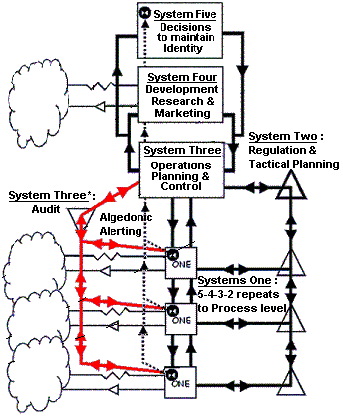
Beer’s concept was structures should be recursive, so global planning is possible, but in a steady state sub-systems would run pretty much without interference. In the chart above, system 5 would be the population as a whole, through worldwide bodies.
-
This reply was modified 4 years, 3 months ago by
ModeratorWell, we will need society-wide planning, if we want to build, say, a railway across the Bering Straight, or to move everyone into Texas while we re-wild the earth, and we’ll need some sort of co-ordination against external shocks. Lawrence’s model includes a role for the FAO as some sort of worldwide co-ordinating body, and similar other such bodies, so there is a role for this sort of planning.
-
This reply was modified 3 years, 12 months ago by
-
AuthorPosts