
P R E F A C E
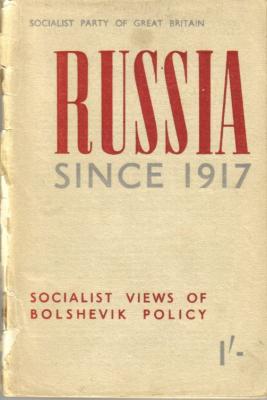
This pamphlet consists of articles published originally on the Socialist Standard. It is a record, in collected form, of the attitude of the Socialist Party of Great Britain to events in Russia since 1917. In March of that year the Czarist regime collapsed and was followed, after short-lived stop-gap Ministry, by the Kerensky Government which was a coalition of various reformist parties. This Government was opposed by the Bolsheviks who, under the leadership of Lenin and Trotsky, overthrew it and seized power in October, 1917.
In the articles themselves, no attempt has been made to interfere with the original texts. The articles stand just as they were written. We have nothing to fear from letting our original words stand. There are, it is true, passages in some of the earlier articles which, were we writing to-day in the light of information now available, we would phrase differently; but these are points of detail. In essentials, these articles stand as overwhelming testimony to the soundness of the Marxist position, the position of the Socialist Party of Great Britain.
A word of explanation may be needed about the first of the articles reprinted below – “A Russian Challenge.” In February, 1915, a conference was called by the social-democratic parties of the Allied countries, then at war with Germany and her partners, for the purpose of discussing war aims and the prosecution of the war. The Russian Social Democratic Labour Party (Bolshevik Party), which opposed the war, was not invited. Unable to get their views published in the journals of the parties supporting the war, they approached the S.P.G.B., and their statement appeared in the Socialist Standard of March, 1915. It is reproduced here as an indication that our opposition to Bolshevik policies was not the outcome of prejudice; we were at all times ready to give them credit when their actions in line with the interests of the working class. Under each title the date of publication in the Socialist Standard is given in brackets.
The Executive Committee of the Socialist Party of Great Britain
June, 1948
CONTENTS
1. A Russian Challenge
2. Prelude to Bolshevism
3. The Russian Situation
4. The Revolution in Russia
5. A Socialist View of Bolshevik Policy
6. The Super Opportunists
7. The Passing of Lenin
8. Trotsky states His Case
9. Russia: Land of High Profits
10. Changing Russia
11. The “Terrorist” Trial
12. The New Constitution
13. Birds of a Feather
14. War Overtakes Russia
15. Inglorious End of the Comintern
16. Is Russia Socialist?
17. “Local Boy Makes Good”
18. Russia and Democracy
19. From Comintern to Cominform
20. The Daily Worker and Lenin on Equal Pay
21. Russian Imperialism
Postscript
1) A RUSSIAN CHALLENGE
(March 1915)
We have received the following and publish it in order to show the trickery resorted to by the pseudo-Socialists responsible for the London Conference in endeavouring to exploit the Russian Socialists , whose challenge they dare not face.
A DECLARATION TO THE LONDON CONFERENCE
Comrades, – Your Conference calls itself a conference of the Socialist parties of the allied belligerent countries, Belgium, England, France and Russia.
Allow me first of all to draw your attention to the fact that the Social-Democracy of Russia, as an organised body, as represented by its Central Committee and affiliated to the International Socialist Bureau, has received no invitation from you. The Russian Social-Democracy, whose views have been expressed by the members of the Russian Social-Democratic Labour Group in the Duma, now arrested by the Tsar’s Government (Petrovsky, Muranoff, Badaoff, Samoiloff representing the workers of Petrograd, Yokaterinoslaff, Kharkoff, Kastroma and Vladimir districts) have nothing in common with your conference. We hope that you will state so publicly, as otherwise you may be accused of distorting the truth.
Now allow me to say a few words with regard to your conference, i.e., to tell you what the class-conscious Social-Democratic workers of Russia would expect from you.
We believe that before entering upon any deliberations with regard to the reconstruction of the International, before attempting to restore international bonds between Socialist workers, it is our Socialist duty to demand:
(1) That Vandervelde, Guesde and Sembat immediately leave the Belgian and French bourgeois ministries.
(2) That the Belgian and French Socialist parties break up the so-called “block national” which is a disgrace to the Socialist flag and under cover of which the bourgeoisie celebrates its orgies of chauvinism.
(3) That all Socialist parties cease their policies of ignoring the crimes of Russian Tsarism and renew their support of that struggle against Tsarism which is being carried on by the Russian workers in spite of all the sacrifices they have to make.
(4) That in fulfillment of the resolutions of the bale conference we hold out our hands to those revolutionary Social-Democrats of Germany and Austria who are prepared to carry on propaganda for revolutionary action as a reply to war. The voting for war credits must be condemned without any reserves.
The German and Austrian Social-Democrats have committed a monstrous crime against Socialism and the International by voting war credits and entering into domestic truce with the Junkers, the priests and the bourgeoisie, but the action of the Belgian and French Socialists has by no means been better. We fully understand the conditions are possible when Socialists as a minority have to submit to a bourgeois majority, but under no circumstances should Socialists cease to be Socialists or join in the chorus of bourgeois chauvinism, forsake the workers’ cause and enter bourgeois ministries.
The German and Austrian Social-Democrats are committing a great crime against Socialism when, after the example of the bourgeoisie they hypocritically assert that the Hohenzollerns and the Hapsburgs are carrying on the war of liberation “against Tsarism.”
But those are committing a crime no less stupendous who assert that Tsarism is becoming democratised and civilized, who are passing over in silence the fact that Tsarism is strangling and ruining unhappy Galicia just as the German Kaiser is strangling and ruining Belgium, who keep silent about the facts that the Tsar’s gang has thrown into gaol the parliamentary representatives of the Russian working class, and only the other day condemned to six years penal servitude a member of Moscow workers for the only offence of belonging to our party, that Tsarism is now oppressing Finland worse than ever, that our Labour press and organisations in Russia are suppressed, that all the milliards necessary for the war are being wrung by the Tsar’s clique out of the poor workers and starving peasants.
On behalf of the Central Committee of the Russian Social-Democratic Labour Party,
London, February 14th, 1915. M. MAXIMOVICH.*
* The Russian Social-Democratic Labour Party, also known as the Bolshevik Party, later changed its name to Communist Party.
“ M. Maximovich” who signed the statement is Maximovich Litvinoff, Commissar for Foreign Affairs 1930-1939.
************************************************************
2) PRELUDE TO BOLSHEVISM
(MAY 1917)
The revolution in Russia and the attitude now adopted by the war party in the country toward the new government of Russia affords an interesting study to the detached onlooker. For thirty months the “speedy prosecution of the war” party have referred in glowing terms to “our gallant ally, Russia,” and a lickspittle Press has given her the necessary puffs periodically. Now much of it is changed; with the revolution, lo and behold! we are informed that the Tzar was weak – was influenced by the German-born Tzaritza – the Court corrupt, and those in control were trying to bring about a separate peace with Germany. Strange, is it not, that when previously rumors were in circulation here with regard to a separate peace, the war party repudiated any such intention on the part os “our gallant ally.” Today Parliament and Press are applauding the overthrow of the Tzar and his Government, whom they have been allied with so long, and telegrams of congratulation are sent to the new President of the Duma.
All the information available, both past and present, shows quite clearly that the upheaval in Russia is not a revolution of the working class, clearly seeing its slave position under the old order and setting to work in an organised fashion to emancipate itself. Far from this is the truth, we are sorry to say. It is but another example of the capitalists using the discontent and numbers of the working class in Russia to sweep away the feudal rules and restrictions so strongly symbolized in the Czar and the Council of Nobles, and to establish a system of government in line with modern capitalist needs and notions.
Hence the welcome given to the revolution, not only by the capitalist governments in their official capacity, and also by their various hangers-on, like Hyndman, Kropotkin, the B.S.P., I.L.P., etc.
According to the report in the Daily Telegraph of 18th April, 1917, the Duma gave a great welcome to the decoy ducks of the British Government, Messrs. W. Thorne, G. O’Grady and W. S. Sanders. These individuals were sent out by the Government as representatives of the “Labour” movement here, although not a single organisation of workers was consulted as to their views on the matter, nor was their choice asked in reference to a representative. The “Labour” organisations have been completely ignored in the matter, and the individuals referred to have been chosen by the Government because of their peculiar fitness to perform the dirty work required to be done.
************************************************************
3) The Russian Situation
(JANUARY 1918)
The doings of the Bolsheviks is the topic of the moment. They dwarf all other events connected with the war. We are not in a position to say much regarding the position of affairs in Russia, for we have little information regarding it beyond the lying messages of our masters’ lickspittles.
. . . . . . . . .
Whatever may be the final outcome, the Bolsheviks have at all events succeeded in doing what all the armies, all the diplomats, all the priests and primates, all the perfervid pacifists of all the groaning and bleeding world have failed to do – they have stopped the slaughter, for the time being, at all events, on their front.
How much more than this they ever intended to do the future may reveal. They may have higher aims, yet to be justified by success or condemned by failure; but it is an astounding achievement that these few man have been able to seize opportunity and make the thieves and murderers of the whole world stand aghast and shiver with apprehension. The British Ambassador would not recognise them, but the British Ambassador is coming home, we are told, and some one “in marked sympathy with the Bolshevik Government” is to be appointed in his place. The Germans arrest Socialists all over Germany, and are at once reduced to denying the fact when Bolsheviks declare that Socialists everywhere are under their protection. The Bolsheviks publish their demands, and immediately the Allies’ war aims are whittled of most of their truculence and proclaimed from the housetops. Verily, not all the decisions of capitalist hirelings can hide the fact that all the belligerents are uneasy in the face of Bolshevik success.
************************************************************
4) The Revolution in Russia: Where it Fails
(AUGUST 1918)
By far the most important event in the social sense, which has occurred during the world war has been the upheaval in Russia, culminating in the revolution of March and November, 1917. For the working class these events are of supreme interest and worthy of close and deep study, not only for the purpose of keeping in touch with events as they occur, but also for learning the lessons these may impart.
Just here, however, the working class of Great Britain are faced with a most formidable obstacle in the way of their gaining even a slight knowledge of the happenings, or reaching a position where a full consideration could be given to the facts of the revolution. This obstacle is the Defence of the Realm Act.
By operations of this Act the master class sift all news coming into the country, by either Press or post, and take care that only matters allowed to be published are those that suit the interests of this class in one form or another. Thus, quite apart from their ownership of the General Press, they are able to prevent groups or individuals in this country obtaining information that might be useful to the working class. In other words, the only information or statements anyone outside of government circles can obtain here is just what it suits the master class to allow them to have.
In spite of this simple and glaring fact the I.L.P. have not hesitated in to denounce the action of November, usually called the “Bolshevik Revolution,” while the S.L.P. has acclaimed it as a great Socialist revolution. Point is added to these facts by the appearance of two pamphlets written not only by Russians, but by men claiming to be Bolsheviks. Here, if anywhere, one might imagine, will be found useful information, concrete facts, detailed accounts of events, that would be useful in guiding us to a sound judgement. Unfortunately, nothing whatever is told in either pamphlet, apart from expressions of opinion, except the statements already given in the capitalist Press, which for the reasons above must be taken with the utmost caution.
The first pamphlet is entitled: War or Revolution, is written by Leon Trotsky, and is published by the S.L.P. at Glasgow. No date of its writing is given, but from internal evidence it was seemingly written in 1915—before the fall of the Czar—and appears to have been originally published in America.
While claiming to be a Marxist Trotsky appears surprised at the actions of the so-called Socialist International in voting war credits and supporting the war. To any serious Marxian student this was only to be expected. The Socialist Party stands firm and solid on the line of the class war. Only here is he impregnable. Only on this basis can the workers organise successfully for the overthrow of capitalism. For years past the S.P.G.B. alone in this country, and the Marxist groups in other countries, have pointed out that sections from England, France, Germany, Italy, Austria, etc., that formed the majority of the International, either had abandoned, or had never taken up, a stand upon the class war, and were therefore really not Socialists in the proper sense of the word. Their actions when the war began and since have simply emphasised the truth of our former case. That it took this world-slaughter to enlighten Trotsky as to the real position of these sections shows how little he grasped their actual attitude before. He is equally mistaken in his judgement of events in England, for on p.16 he says:
“In England the Russian Revolution [1905] hastened the growth of independent Socialism.”
Quite apart from the fact that the 1905 upheaval in Russia was a capitalist and not a Socialist movement, this statement is absolutely incorrect. A movement that is not independent cannot be Socialist, and the Russian episode had no measurable effect upon either the Labour or the Socialist movement in this country. The real break with the old compromising policy that had saturated the movement in England, took place in 1904—a year before the Russian outbreak—when the Marxists formed up in the Socialist Party of Great Britain.
Equally mistaken is Trotsky’s statement on the same page that “six or seven years ago [that is six or seven years before 1915] in England, the Labour Party, after separating from the Liberal Party, entered into the closest association with it again.” As every student of the history of the Labour Party knows, that party has never been out of the “closest association” with the Liberal Party since the day it formed. Just as incorrect is the phrase in the concluding section (p.27) where the author say: “Socialist reformism has actually turned into Socialist imperialism.”
Reformism and Imperialism are capitalist, and can by no stretch of the imagination be called Socialist. Such misuse of the latter word, especially by one claiming to be a Socialist, is a direct assistance to the master class in their endeavours to further confuse the minds of the working class by misrepresentation of various kinds.
The second pamphlet was written by M. Litvinoff in March 1918, but it adds nothing to our knowledge of affairs in Russia, as it simply consists of a selection of the statements that have appeared in the capitalist Press of this country. In some instances these statements are exceedingly useful against agents of the master class like Kerensky, and we have used these admissions ourselves in the SOCIALIST STANDARD when Kerensky was in power. Some of the other statements are significant in their bearing on the actions of the workers in Russia in a manner unsuspected of Litvinoff.
One feature of extreme and peculiar importance in these movements is treated by both the above writers in exactly the same manner, i.e., with silence. This feature is the economic and social position of the working class in Russia. For a matter of such importance to be neglected by both writers, shows either a lack of knowledge of the Russian situation or a deliberate attempt to conceal such knowledge from their readers. As two such Russians are either unable or unwilling to supply this information the only thing left is to take that available before the war and try to apply it to the solution of the present situation. Clearly this can only be a provisional judgement while awaiting reliable news of the revolutions and of the present position of the workers in Russia.
Even to-day Russia is largely an agricultural country, some authorities stating that 80 per. cent of the population are engaged in that calling. Their system, however, has certain peculiar features that would take a large volume to describe.
In the main the agricultural population is divided up in village groups or communities largely based on what is called the “Mir.” Each peasant is allotted a certain amount of land, depending on the number of his family. The holdings are changed periodically so as to prevent any one individual retaining the best land. If the population increases beyond the limits of the land controlled by the “Mir,” a group forms up and moves out to new lands in a manner so well described by Julius Faucher in his brilliant essay on The Russian Agrarian System. As this group is related to the old “Mir,” communication and intercourse are kept up and a division of a race may have a whole series villages spread out over a certain area, and having a more or less loose connection with each other. The land, however, is not owned by the village group. In the ultimate it is owned by the Czar in his capacity as “Father of the People” though large number of estates have been granted to the Nobles for their military and other services rendered to the Crown.
This ownership, whatever particular form it may take, is admitted by all the “Mir” by the payment of a charge for the land, usually termed a tax. This tax is paid to the Noble where he holds an estate and to the Czar where the latter is personal owner.
Into the developments, complications, abuses and rogueries that have resulted from this system we have not the space to go. One illustration can be found in Carl Joubert’s Russia as it really is and Stepaniak in his Russian Peasantry, has given a masterly description of its workings. It will be sufficient to point out that apart from minor modifications three broad divisions have developed.
In the wild forest regions of the North, the people are still in the upper stage of Barbarism, being a mixture of hunters and pastoral workers, who know practically nothing of the affairs of the outer world. In the middle regions the spread of the use of money and the effects that follow have resulted in more modern methods of working the estates. Owing to the heavy tax imposed large numbers of peasants have been unable to pay this charge after a poor season, with the inevitable result that they fall into the hands of money-lenders—who in numerous cases are actual members of the “Mir”—or they have to give up their holdings and either work for the money-lender or drift into the towns in search of work.
In the South or “Black Belt” region, largely owing to the fertility of the soil, old-fashioned methods still persist and the peasants make desperate struggles to retain their holdings, but were slowly losing their grip before the war.
The abolition of serfdom on private estates in 1861 and on the Czar’s estates in 1871, was loudly announced as a great emancipation of the peasants. Under these decrees the peasants were supposed to be placed in a position were they could purchase their holdings, either individually or as a village group or Mir. The Nobles, of course, still retained the bulk of the estates granted to them, and it was intended that the big landlords would be balanced in the social system by the large number of small owners or peasant proprietors that would be sure to follow the great act of “emancipation”. In the vast majority of cases, of course, the whole thing was a fraud and the landlords and moneylenders being the only ones, as a rule, able to purchase land, we have the paradox that the measure introduced to extend peasant proprietorship has resulted in the concentration of large estates in fewer hands than before. This has increased the number of landless peasants which recent estimates have placed at about one-third of the agricultural population, while even those who favour the system do not claim that more than another third have become owners of the land, either individually or through their village groups. The local affairs of the Mir are managed by the open general meetings, and these meetings elect the Elder or Mayor, who is the spokesman and delegate before the authorities. As stated above, the moneylender of the village is often a member of the Mir, and owing to his economic hold on the peasants he is often elected as the Elder.
It was, and is, people of this type that Kerensky represents. The Mir, of course, is under general Government control, usually through a “superintendent” or police officer.
In the Western area and the Southern Oil Belt industrial towns of the usual capitalist type, have developed in late years, and contain a number of genuine proletarians or wage slaves.
Is this huge mass of people, numbering about 160,000,000 and spread over eight and a half millions of square miles, ready for Socialism? Are the hunters of the North, the struggling peasant proprietors of the South, the agricultural wage slaves of the Central Provinces, and the industrial wage slaves of the towns convinced of the necessity, and equipped with the knowledge requisite, for the establishment of the social ownership of the means of life?
Unless a mental revolution such as the world has never seen before has taken place, or an economic change has occurred immensely more rapidly than history has recorded, the answer is “No!”
And it is extremely significant that neither Trotsky nor Litvinoff say a single word on this aspect of the situation. In fact, as far as one can judge, the best, but all too brief, account of the present position in certain parts of Russia is given by Mr. Price in his articles in the Manchester Guardian during November and December, 1917.
Leaving aside the subsidiary differences in the economic positions of the different provinces, the one great fact common to the mass of the peasantry is their desire to be rid of the burden of the tax they have to pay for their land, whether to the local lord or to the Government, so that they may gain a livelihood from their holdings. This applies to both the individual and the group holders. Hence the peasants’ movements are not for social ownership, but merely for the abolition of the tax burden and their right to take up new land as the population increases. In other words, they only wish to be free the old system of individual or group cultivation from governmental taxes and control. The agricultural and industrial wage-workers would be in a similar position economically as the same class of workers in Western Europe, if allowance is made for the lesser capitalist development of Russia.
What justification is there, then, for terming the upheaval in Russia a Socialist Revolution? None whatever beyond the fact that the leaders in the November movement claim to be Marxian Socialists. M. Litvinoff practically admits this when he says (p.37):
“In seizing the reigns of power the Bolsheviks were obviously playing a game with high stake. Petrograd had shown itself entirely on their side. To what extent would the masses of the proletariat and the peasant army in the rest of the country support them?”
This is a clear confession that the Bolsheviks themselves did not know the views of the mass when they took control. At a subsequent congress of the soviets the Bolsheviks had 390 out of a total of 676. It is worthy of note that none of the capitalist papers gave any description of the method of electing either the Soviets or the delegates to the Congress. And still more curious is it that though M. Litvinoff says these delegates “were elected on a most democratic basis”, he does not give the slightest information about this election. This is more significant as he claims the Constituent Assembly “had not faithfully represented the real mind of the people”.
From the various accounts and of the capitalist Press (and, as stated above, M. Litvinoff does not supply us with any other information) it seem the Bolsheviks form the driving force, and perhaps even the majority, of the new Government, sometimes called the Soviet Government and sometimes the “Council of Peoples’ Commissaries”. The Soviet Government certainly appears to have been accepted, or at least acquiesced in, by the bulk of the Russian workers. The grounds for this acceptance are fairly clear. First the Soviet Government promised peace; secondly they promised a settlement of the land question; thirdly they announced a solution of the industrial workers grievances. Unfortunately various and often contradictory accounts are given of the details of this programme, and Litvinoff’s statements are in vague general terms that give no definite information on the matter. Until some reliable account of the Soviet Government’s programme is available detailed judgement must remain suspended. That this mixed Government should have been tacitly accepted by the Russian workers is no cause for surprise. Quite the contrary. They (the Soviet Government) appear to have done all that was possible in the circumstances to carry their peace proposals. And we are quite confident that if the mass of the people in any of the belligerent countries, with the possible exception of America, were able to express their views, free from consequences, on Peace or Continuance of War, an overwhelming majority would declare in favour of Peace.
As is admitted by the various sections of the capitalist Press, the Soviet representatives at the Brest-Litovsk Conference stood firm on their original proposals to the last moment. That they had to accept hard terms in the end is no way any discredit to them, but it was a result of conditions quite beyond their control. If they had done no more than this, if they had been compelled to give up office on their return, the fact that they had negotiated a stoppage of the slaughter and maiming of millions of the working class would have been a monument to their honour, and constituted an undeniable claim to the highest approbation of the workers the world over.
Of course the capitalist Press at once denounced the signing of the Peace treaty as “dastardly treachery”, and so on. We can quite easily understand that the agents of the foullest and most hypocritical ruling class the world has ever seen, steeped to their eyes in their own cruel treacheries, should have been astounded at the Soviet Government keeping its pledge to the Russian people, instead of selling them out to the Allied Governments.
Then follow the usual stereotyped “outrages” and “crimes” that the master class agents never fail to provide when an opponent dares to stand in their path. Unfortunately for these capitalist agents, their own correspondents are allowed to move freely over the country, and often “give the game away” by describing improvements both in ordinary administration and economic conditions under the new rule. And Mr. Litvinoff scores neatly here over the capitalist Press by comparing the alleged “outrages” with the actions of the master class against the workers after the fall of the Paris commune. A still more striking illustration is given by the Mr. Price from Russia itself, in his article in the Manchester Guardian for November 28th , 1917, where he describes the cold-blooded slaughter of 500,000 Khirgiz Tartars by the Czar’s Government in 1916. And he caustically remarks:
“While Western Europe has heard about Armenian massacres, the massacre of the Central Asian Moslems by the Tsar’s agents has been studiously hidden.”
Indeed, if the Soviet Government were to start on a campaign of deliberate slaughter, it would take them many busy years to even approach the huge number of victims of the last Czar’s reign. But so far all the evidence points to the allegations of Bolshevik butcheries being but a tissue of lies fabricated to suit bourgeois purposes.
And what of the future? It is impossible to offer any close forecast in the face of our lack of knowledge. We do not know what the Soviet Government has promised the peasants. We are ignorant of what measures they are putting into operation to solve the complicated land question. Despite the existence of the Mir organisation it will be easier for the Russian government to arrange for the management of the factories and industries of the towns than to settle the various and widely divergent, detailed demands of the peasants of the different provinces. There is no ground whatever for supposing that they are ready or willing to accept social ownership of the land, along with the other means of production. Are the Bolsheviks prepared to try to establish something other than this? If so does it not at once flatly contradict M. Litvinoff’s claim that they are establishing Socialism?
And grim shadows are spreading from both sides. On one side the Germans are trying to exploit and plunder as much as possible why they have the chance; on the other side the Japanese, assisted by British and American forces are entering on an exactly similar expedition, with the same objects in view. Also it has been reported that the Allied forces landing on the Murman coast are either under the command of or are accompanied by a notorious Czarist officer, General Gourko, who is working hard for the restoration of the Romanoffs.
With the mass of the Russian people still lacking the knowledge necessary for the establishment of socialism, with both groups of belligerents sending armed forces into the country, with the possible combination of those groups for the purpose of restoring capitalist rule, even if not a monarchy, in Russia, matters look gloomy for the people there. If the capitalist class in the belligerent countries succeed in this plan, the Soviet Government and its supporters may expect as little mercy as—nay, less than—the Khirgiz Tartars received. It may be another Paris Commune on an immensely larger scale.
Every worker who understands his class position will hope that some way will be found out of the threatened evil. Should that hope be unrealised, should further victims be fated to fall to the greed and hatred of the capitalist class, it will remain on record that when members of the working class took control of affairs in Russia, they conducted themselves with vastly greater humanity, managed social and economic matters with greater ability and success and with largely reduced pain and suffering, than any section of the cunning, cowardly, ignorant capitalist class were able to do, with all the numerous advantages they possessed.
(Socialist Standard, August 1918)
************************************************************
5) A Socialist View of Bolshevik Policy
(July 1920)
Where We Stand
Ever since the Bolshevik minority seized the control of affairs in Russia we have been told that their “success” had completely changed Socialist policy. These “Communists” declare that the policy of Marx and Engels is out of date. Lenin and Trotsky are worshipped as the pathfinders of a shorter and easier road to Communism.
Unfortunately for these “Bolsheviks,” no evidence has yet been supplied to show wherein the policy of Marx and Engels is no longer useful, and until that evidence comes the Socialist Party of Great Britain will continue to advocate the same Marxian policy as before. We will continue to expose and oppose the present system and all its defenders and apologists. We shall insist upon the necessity of the working class understanding Socialism and organising with a political party to obtain it.
Socialism Far Off in Russia
When we are told that Socialism has been obtained in Russia without the long, hard and tedious work of educating the mass of workers in Socialism we not only deny it but refer our critics to Lenin’s own confessions. His statements prove that even though a vigorous and small minority may be able to seize power for a time, they can only hold it by modifying their plans to suit the ignorant majority. The minority in power in an economically backward country are forced to adapt their program to the undeveloped conditions and make continual concessions to the capitalist world around them. Offers to pay war debts to the Allies, to establish a Constituent Assembly, to compensate capitalists for losses, to cease propaganda in other countries, and to grant exploitation rights throughout Russia to the Western capitalists all show how far along the capitalist road they have had to travel and how badly they need the economic help of other countries. It shows above all that their loud and defiant challenge to the capitalist world has been silenced by their own internal and external weaknesses as we have so often predicted in these pages.
Lenin’s Confessions
The folly of adopting Bolshevik methods here is admitted by Lenin in his pamphlet The Chief Tasks of Our Times (p. 10). “A backward country can revolt quicker, because its opponent is rotten to the core, its middle class is not organised; but in order to continue the revolution a backward country will require immediately more circumspection, prudence, and endurance. In Western Europe it will be quite different; there it is much more difficult to begin, but it will be much easier to go on. This cannot be otherwise because there the proletariat is better organised and more closely united.”
Those who say “Russia can fight the world”, are answered by Lenin:
“Only a madman can imagine that the task of dethroning International Imperialism can be fulfilled by Russia alone.”
Lenin admits that “France and England have been learning for centuries what we have only learnt since 1905. Every class-conscious worker knows that the revolution grows but slowly amongst the free institutions of a united bourgeoisie, and that we shall only be able to fight against such forces when we are able to do so in conjunction with the revolutionary proletariat of Germany, France, and England. Till then, sad and contrary to revolutionary traditions as it may be, our only possible policy is to wait, to tack, and to retreat.”
State Capitalism for Russia
We have often stated that because of a large anti-Socialist peasantry and vast untrained population, Russia was a long way from Socialism. Lenin has now to admit this by saying: “Reality says that State Capitalism would be a step forward for us; if we were able to bring about State Capitalism in a short time it would be a victory for us. How could they be so blind as not to see that our enemy is the small capitalist, the small owner? How could they see the chief enemy in State Capitalism? In the transition period from Capitalism to Socialism our chief enemy is the small bourgeoisie, with its economic customs, habits and position” (p. 11).
This reply of Lenin to the Communists of the Left (Bucharin and others) contains the further statement that, “To bring about State Capitalism at the present time means to establish the control and order formerly achieved by the propertied classes. We have in Germany an example of State Capitalism, and we know she proved our superior. If you would only give a little thought to what the security of such State Socialism would mean in Russia, a Soviet Russia, you would recognise that only madmen whose heads are full of formulas and doctrines can deny that State Socialism is our salvation. If we possessed it in Russia the transition to complete Socialism would be easy, because State Socialism is centralisation control, socialisation—in fact, everything that we lack. The greatest menace to us is the small bourgeoisie, which, owing to the history and economics of Russia, is the best organised class, and which prevents us from taking the step, on which depends the success of Socialism.”
Here we have plain admissions of the unripeness of the great mass of Russian people for Socialism and the small scale of Russian production.
If we are to copy Bolshevist policy in other countries we should have to demand State Capitalism, which is not a step to Socialism in advanced capitalist countries. The fact remains, as Lenin is driven to confess, that we do not have to learn from Russia, but Russia has to learn from lands where large scale production is dominant.
Lenin and the Trusts
“My statement that in order to properly understand one’s task one should learn socialism from the promoters of Trusts aroused the indignation of the Communists of the Left. Yes, we do not want to teach the Trusts; on the contrary, we want to learn from them.” (p. 12) Thus Lenin speaks to his critics. Owing to the untrained character of the workers and their failure to grasp the necessity of discipline and order in large scale production, Lenin has to employ “capitalist” experts to run the factories. He tells us: “We know all about Socialism, but we do not know how to organise on a large scale, how to manage distribution, and so on. The old Bolshevik leaders have not taught us these things, sand this is not to the credit of our party. We have yet to go through this course and we say: Even if a man is a scoundrel of the deepest dye, if he is a merchant, experienced in organising production and distribution on a large scale, we must learn from him; if we do not learn from these people we shall never achieve Socialism, and the revolution will never get beyond the present stage. Socialism can only be reached by the development of State Capitalism the careful organisation of finance, control and discipline among the workers. Without this there is no Socialism.” (p. 12.)
That Socialism can only be reached through State Capitalism is untrue. Socialism depends upon large-scale production, whether organised by Trusts or Governments. State capitalism may be the method used in Russia, but only because the Bolshevik Government find their theories of doing without capitalist development unworkable—hence they are forced to retreat along the capitalist road.
The Internal Conflict
Lenin goes on: “The workers who base their activities on the principles of State Socialism are the most successful. It is so in the tanning, textile, and sugar industries, where the workers, knowing their industry, and wishing to preserve and to develop it, recognise with proletarian common sense that they are unable at present to cope with such a task, and therefore allot one third of the places to the capitalists in order to learn from them.”
This concession is another example of the conflict between Bolshevik theory and practice, for the very argument of Lenin against Kautsky and others was that in Russia they could go right ahead without needing the capitalist development such as it exists in other countries.
The whole speech of Lenin is directed against the growing body of workers in Russia who took Lenin at his word. These people fondly imagined that after throwing over Kerensky they could usher in freedom and ignore the capitalist world around them. They thought that factory discipline, Socialist education, and intelligent skilled supervision were simply pedantic ideas.
A further quotation from Lenin will make this clear: “Naturally the difficulties of organisation are enormous, but I do not see the least reason for despair and despondency in the fact that the Russian Revolution, having first solved the easier task—the overthrow of the landowners and the bourgeoisie, is now faced with the more difficult Socialist task of organising national finance and control, a task which is the initial stage of Socialism, and is inevitable, as is fully understood by the majority of class-conscious workers.”
He also says: “It is time to remonstrate when some people have worked themselves up to a state in which they consider the introduction of discipline into the ranks of the workers as a step backwards.” And he points out that “by the overthrow of the bourgeoisie and landowners we have cleared the way, we have not erected the structure of Socialism.”
How far they have cleared the capitalists out of the way is uncertain, as they are a long way from self-reliance. The long road ahead is admitted by Lenin in these words: “Until the workers have learned to organise on a large scale they are not Socialists, nor builders of a Socialist structure of society, and will not acquire the necessary knowledge for the establishment of the new world order. The path of organisation is a long one, and the tasks of Socialist constructive work require strenuous and continuous effort, with a corresponding knowledge which we do not sufficiently possess. It is hardly to be expected that the even more developed following generation will accomplish a complete transition into Socialism.” (p. 13.)
The Rule of the Minority
The denunciation of democracy by the Bolshevik leaders is quite understandable if we realise that only the minority in Russia are Communists. Lenin therefore denies control of affairs to the majority, but he cannot escape from the compromise involved in ruling with a minority. Not only is control of Russian affairs out of the hands of the Soviets as a whole, but not even all the members of the Communist Party are allowed to vote. Zinoviev, a leading Commissar, in his report to the First Congress of the Third International said:
“Our Central Committee has decided to deprive certain categories of party members of the right to vote at the Congress of the party. Certainly it is unheard of to limit the right voting within the party, but the entire party has approved this measure, which is to assure the homogenous unity of the Communists So that in fact, we have 500,000 members who manage the entire State machine from top to bottom.” (The Socialist, 29.4.20. Italics not ours.)
So half a million members of the Communist Party (counting even those who are refused a vote within the party) control a society of 180 million members. It is quite plain why other parties’ papers were suppressed: obviously they could influence the great majority outside the Communist Party. The maintenance of power was assured by the Bolshevik minority through its control of political power and the armed forces.
************************************************************
6) The Super Opportunists
(August 1920)
A Fatuous Policy
The Bolshevik leaders are opportunists. They start out with a definite programme and policy but change it completely when they find the world’s workers do not support them. Lenin, Trotsky, Radek, and the other officials denounced Kautsky, Henderson, Longuet, and others for their reformist policy, but we now have Lenin and Zinoviev advising the Socialist workers of England to take parliamentary action and join the Labour Party.
The report of the Executive of the Communist Party of Russia to the 1920 congress of the Third International lays down the position that we should get inside the Parliamentary Labour parties. This advice is anti-Socialist, as anybody with a knowledge of the history and composition of the Labour parties know.
The Bolshevik leaders told us that the workers of the world were ripe for revolution and their support of Bolshevism was expected and depended upon. Now that it is plain that workers do not understand socialism and fight for it, Lenin is pandering to the ignorance of the world’s workers. In defence he says that by supporting the pro-capitalist Labour Party and helping to establish a Labour Party government, the workers will learn the uselessness of the Labour parties.
The Logical Conclusion
If that policy is to be adopted, then it is necessary for the workers to follow every false road, to support every reactionary measure, and to join every movement and learn from their mistakes—in other words, exhaust every possible evil before they try the right road. If this policy is right why did not Lenin support Kerensky’s policy of capitalism for Russia and let the workers painfully learn its uselessness? Such nonsense as supporting parties and Governments to gain power to learn their misdeeds is not the road to Socialism, it is the path to apathy and despair, and lengthens capitalism’s life.
The Opportunist Weathercocks
After spending much ink and eloquence in denouncing parliamentary action Lenin tells us in his interview in the Manchester Guardian that it is necessary in modern capitalist countries.
In his telegram to the British Socialist Party Lenin calls upon them to support parliamentary action by means of a Labour party. After all the attempts of Lenin to show that Marx and Engels believed in smashing the State power, Trotsky tells us in A Paradise for the Workers that we have to get control of the State power and use it instead of abolishing it. Radek, in his Communism—From Science to Action, denounced parliamentary action and majority rule, but in a recent letter to a German Communist he completely changes round and advises parliamentary action.
Lenin, in his letter to the German party, supports Parliamentary Action and the winning of the masses in defiance of all his previous advice and previous praise of the Spartacan minority action. The Amsterdam Bureau of the Third International was abolished because it told the English Socialists not to engage in Parliamentary Action or to support the Labour Party. All this demonstrates the absence of any principle and simply to veer with the changing winds.
We have been denounced for our attitude of insisting upon the need of Socialists making a revolutionary use of parliaments. Our position, however, was based upon Socialist principles and a recognition of the facts of history, not a desire to pander to popular prejudices such as support of a dangerous and fraudulent Labour party.
We have opposed Kautsky’s reformism and opportunism because it is not Socialism and is against the principle of the Class Struggle. We are equally opposed to dangerous teachings if they come from Lenin, Radek, or any other man who sets himself up as a teacher of socialism. Our position is that taken up by Marx and Engels and made plain by them in their writings. Engels says in his last (1890) preface to the Communist Manifesto that we must gain the minds of the masses. Bolshevism, however, has depended for its triumph upon the minority, who ignored the majority of workers. So true is this that Radek in his pamphlet ridicules anything else in minority action for Socialism.
Bertrand Russell, who accompanied the Labour delegation to Russia in June, records his interview with Lenin in the Nation (July 10th and 17th), and Lenin there admits the opposition of the peasantry. Lenin in reply to Kautsky (The Dictatorship and the Betrayer Kautsky) does not attempt to deny Kautsky’s charge that the Menshevik and Social-Revolutionary delegates to the Soviets were suppressed in order to maintain Bolshevik majorities. Russell states the Soviets are moribund and that any other delegates than Bolshevik ones are denied railway passes and so cannot attend the Soviet meetings. He also says that the All Russian Soviet meets seldom, that the recall is exercised for minor offences, such as drunkenness, and that the delegates continually ignore their constituents. We do not accept Russell as an authority, but much of his report agrees with Bolshevik writings.
We have always contended that the Bolsheviks could only maintain power by resorting to capitalist devices. History has shown us to be correct. The January 1920 Congress of the Executive Communists in Russia abolished the power of workers control in factories and installed officials instructed by Moscow and given controlling influence. Their resolutions printed in most of the Labour papers and the Manchester Guardian here show how economic backwardness has produced industrial conscription with heavy penalties for unpunctuality, etc. The abolition of democracy in the army was decreed long ago, but now that the army is being converted into a labour army it means rule from the top with an iron hand.
Russia has agreed to repay foreign property-owners their losses and allied Governments their “debts.” This means continued exploitation of Russian workers to pay foreign exploiters.
With all the enthusiasm of the Communists they find themselves faced with the actual conditions in Russia and the ignorance of the greater part of its population.
There is no easier road to Socialism than the education of the workers in Socialism and their organisation to establish it by democratic methods. Russia has to learn that.
************************************************************
7) The Passing of Lenin
(March 1924)
One of the significant facts brought into prominence by the great war was the intellectual bankruptcy of the ruling class of the Western World. A gigantic field of operations and colossal wealth at their disposal, failed to bring out a single personality above the mediocre, from England and Germany down the list to America and Roumania. The only character that stood, and stands, above the Capitalist mediocrities, was the man lately buried in Moscow – Nikolai Lenin.
The senseless shrieks of the Capitalist henchman against Lenin was itself evidence of their recognition of their own inferiority. All the wild and confused tales that were told by the agents of the master class (from Winston Churchill to Mrs. Snowden) to suggest that Lenin was “the greatest monster of iniquity the world has ever seen,” largely defeated their object, to every person capable of thinking clearly, by their sheer stupidity and extravagance.
One result of this tornado of lies was to cause a corresponding reaction on the other side. The various groups of woolly headed Communists, inside and outside of Russia, began to hail Lenin a new “Messiah” who was going to show the working class a new quick road to salvation. Thus does senseless abuse beget equally senseless hero-worship
From sheer exhaustion the two-fold campaign has died down in the last year or two, even the “stunt” press only giving small space to Lenin and Russia.
Lenin’s sudden death, despite his long illness, has brought forward a flood of articles and reviews entirely different in tone from those that greeted his rise to power.
The shining light of modern Conservatism – Mr. J. L. Garvin – does not know whether Lenin was famous or infamous, whether he was a great man or a great scoundrel, so, wisely, leaves the verdict to posterity to settle.
A Fabian pet, Mr. G. D. H. Cole, in the New Statesman, for the 2nd February, makes the claim that Lenin’s great work was the “invention of the Soviet”! It is difficult to understand how the editor of a journal, supposed to be written for “educated” people, should have allowed such a piece of stupid ignorance to have passed his scrutiny. The word “Soviet” – that seems to have mesmerised some people – simply means “Council.” Every student of Russia knows that the “Council” has been an organic part of the Russian Constitution since the middle of the 16th century. But there may be another explanation of Mr. Cole’s attitude. As one of the leaders of that hopeless crusade to turn back the hands of the clock (known as “The Guild System”) he sees around him the ruins and the rubbish of the various experiments in this system and maybe he hopes by claiming Russia as an example of “Guildism” to arouse some new enthusiasm for further useless experiments. His hopes are built on shifting sands.
Michael Farbman, in the Observer, Jan. 27th, 1924, takes a more daring and dangerous line. He claims to understand Marx and Marxism, and yet makes such statements as:-
“When Lenin inaugurated the Dictatorship of the Proletariat he obviously was unhampered by the slightest hesitation or doubt as to the efficacy of Marxian principles. But the longer he tested them as a practical revolutionist and statesman the more he became aware of the impossibility of building up a society on an automatic and exclusively economic basis. When he had to adopt an agrarian policy totally at variance with his Marxian opinions, and when later he was compelled to make an appeal to the peasants’ acquisitive instincts and go back to what he styled ‘State Capitalism,’ he was not only conscious that something was wrong with his Marxian gospel, but frankly admitted that Marx had not foreseen all the realities of a complex situation. It is probably no exaggeration to say that the greatest value of the Russian Revolution to the world Labour movement lies in the fact that it has replaced Marxism by Leninism.”
The above quotation has been given at length because it not only epitomises Mr. Farbman’s attitude but also that of many so-called “Socialists.”
It will, therefore, be a matter of astonishment to the reader unacquainted with Marx’s writings and theories to learn that almost every sentence in that paragraph either begs the question or is directly false.
In the first sentence we have two assertions, One that Lenin established the “ Dictatorship of the Proletariat,” the other that this is a “Marxian principle.” Both statements are deliberately false.
Lenin never established any “Dictatorship of the Proletariat” – whatever that may mean – but only the Dictatorship of the Communist Party which exists today. In the whole of Marx’s writing that he himself saw through the press the phrase Dictatorship of the Proletariat does not occur once! This, of course, Mr. Farbman knows well.
The next sentence contains a phrase that Mr. Farbman may know the meaning of, but which is idiotic nonsense from a Marxian standpoint. To talk of a Society “on an automatic and exclusively economic basis” is utterly in opposition to all Marxian teachings.
If Lenin ever made the statement attributed to him in the sentence that follows – “that Marx had not foreseen all the realities of a complex situation” – which is at least doubtful as no reference is given, that would only show Lenin’s misreading of Marx.
But the last sentence is a gem. Not only has the Russian revolution not displaced Marxism by Leninism (for as showed above Marxism never existed there) – it has displaced Leninism by Capitalism.
To understand Lenin’s position, both actually and historically, it is necessary to examine the conditions under which he came to the front. Early in 1917 it was clear to all observers that the corruption, treachery and double-dealing of the Czar and his nobles had brought about the collapse of the Army. (See M, Phillips Price The Soviet, the Terror and Intervention, p. 15; John Reed, Ten Days that Shook the World, etc,).
This was the most important factor in the whole Russian upheaval, and is the pivot upon which all the rest turns.
The Romanoffs and their crew had fallen from power when an efficient armed force was no longer at their disposal. Kerensky, who replaced them, tried to keep the war going without men or munitions. Lenin obtained permission to leave Switzerland for Russia and tried to stir up a revolt in March, 1917, but this failed, and he had to fly to Finland. Confusion grew, and finally it was decided to take steps to call a Constituent Assembly to draw up a new Constitution for Russia. The Bolsheviks hailed this move and loudly protested against the dilatoriness of Kerensky, who was afraid of losing office. At the same time the various Councils of peasants, workers and soldiers began to send representatives to Petrograd for an All-Russian Congress. At once a struggle began between the Kerensky section – or Mensheviks – and the Lenin section – or Bolsheviks – to obtain the majority of representation in this Assembly. For days the struggle continued and almost to the last moment the issue was in doubt, but the superior slogan of the Bolsheviks – “Peace, Bread, Land” – finally won a majority over to their side.
A day or two before this Lenin had come out of his hiding place and placed himself at the head of the Bolsheviks.
The first thing Lenin did when in office was to keep his promise. He issued a call for peace to all the belligerents on the basis of’ “no annexations, no indemnities.” This astonished the politicians of the Western Nations to whom election promises are standing jokes.
It was at this point that Lenin made his greatest miscalculation. He believed that the working masses of the western world were so war weary that upon the call from one of the combatants they would rise and force their various Governments to negotiate peace. Unfortunately these masses had neither the knowledge nor the organisation necessary for such a movement, and no response was given to the call, except the snarling demands of the Allies that Russia should continue to send men to be slaughtered. This lack of response was a terrible disappointment to Lenin, but, facing the situation, he opened negotiations for a separate peace with Germany. And here he made a brilliant stroke. To the horror and dismay of all the diplomatic circles in Europe he declared that the negotiations would be carried on in public, and they were. Thus exposing the stupid superstition still so beloved of Communists here, that it is impossible to conduct important negotiations in public.
Of course the conditions demanded by the Germans were hard. Again and again Lenin’s followers demanded that war should be re-opened rather than accept these conditions. Radek reports a conversation (Russian Information and Review, January 26th, 1924):-
“The mujik must carryon the war. ‘But don’t you see that the mujik voted against the war,’ Lenin answered. ‘Excuse me, when and how did he vote against it?’ ‘He voted with his feet; he is running away from the front.’”
Large tracts of territory were detached from the Bolshevik control, and the greatest blow was the separation of the Ukraine, whose splendid fertile soil would have been of immense value for the purpose of providing food.
Still the problems to be handled were enormous. The delegates to the Constituent Assembly had gathered in Petrograd, but Lenin, who shouted so loudly for this Assembly when out of office, was not running the risk of being deposed now he was in office. He had the gathering dispersed, and refused to let the Assembly meet. Sporadic outbreaks among the peasantry were a source of continual trouble, particularly as the Bolsheviks had only a poor force at their disposal. The signing of the Armistice however solved this problem. The Communists are fond of claiming that Trotsky organised the “Red Army.” This claim is absurd, for Trotsky knew nothing of military matters. The upheaval in Germany, after the signing of the Armistice, threw hundreds of German officers out of work and Lenin gladly engaged their services, at high salaries, to organise the army. By the offer of better food rations, better clothing and warmer quarters plenty of men offered themselves for enlistment. The main difficulty however was not men but munitions.
Lenin and his supporters expected that the victorious Allies would turn their combined forces on Russia. But the Allies were so engrossed in trickery, double-dealing and swindling each other over the sharing of the plunder that they largely ignored Russia. Still to show their good will and kind intentions they subsidised a set of thieving scoundrels – Koltchak (assisted by that British hero “Colonel” John Ward), Deniken, Wrangel, Yudenitch, etc., to invade Russia for the purpose of taking it out of the control of the Russians.
It was a most hopeful undertaking, this sending in of marauding bands! The peasant, who had just got rid of his age-long enemy the landlord (sometimes rather summarily) was expected to assist in restoring that gentleman. To help them in reaching a decision, these marauding bands, with strict impartiality, plundered friend and foe alike. The only result of these various raids was to unify the mass of the people in Russia in accepting the Bolshevik rule. Slowly the Russians began to gather arms. Their army was already in good order, and although the enormous distances and lack of transport prevented them reaching many places, yet whenever the Red Army met the looting bands mentioned above the latter were defeated, with monotonous regularity.
Of course compared with the battles on the western front these engagements were mere hand skirmishes, as neither side had any heavy artillery, high-velocity shells, poison gas, nor bombing aeroplanes.
A greater enemy to Leninism than any of these gangs, however, and one which had been exerting its influence for some time, now greatly increased its pressure, this was the individualistic conditions of the peasant, combined with the wants of the townsmen. Various decrees had been passed forbidding private trading in the towns and villages (apart from special licences) but the Bolsheviks had never dared to enforce these decrees in face of the food shortage. The result of this increased pressure was the famous “New Economic Policy,” that caused such consternation in the ranks of the Communist parties. In this country Miss Sylvia Pankhurst nearly died of disgust when the news arrived.
But once more Lenin was right. He recognised the seriousness of the conditions and tried to frame a policy to fit them. His own words describe the situation with great clearness:-
“Yet, in 1921, after having emerged victoriously from the most important stages of the Civil War, Soviet Russia came face to face with a great – I believe, the greatest – internal political crisis which caused dissatisfaction, not only of the huge masses of the peasantry, but also of large numbers of workers.
“It was the first, and I hope the last, time in the history of Soviet Russia that we had the great masses of the peasantry arrayed against us, not consciously, but instinctively, as a sort of political mood.
“What was the cause of this unique, and, for us, naturally disagreeable, situation? It was caused by the fact that we had gone too far with our economic measures, that the masses were already sensing what we had not properly formulated, although we had to acknowledge a few weeks afterwards, namely, that the direct transition to pure Socialist economy, to pure Socialistic distribution of wealth, was far beyond our resources, and that if we could not make a successful and timely retreat, if we could not confine ourselves to easier tasks, we would go under.” (Address to the Fourth Congress of the Communist International.) (Italics ours.)
The most significant phrase in the above statement – the one we have underlined – now admits at last that Marx was right, and that the whole of the Communist “Theories and Theses” are rubbish from top to bottom.
Mr. Brailsford, the £1,000 a year, editor of The New Leader, in the issue for January 25th, 1924 says:-
“Alone in the earthquakes of the war period, this Russian revived the heroic age, and proved what the naked will of one man may do to change the course of history.”
What knowledge! What judgement! What intelligence! Where has the “course of history” changed one hair’s breadth owing to Russia? And the above specimen of ignorance, that would disgrace a school child, is considered worth £1,000 a year by the I.L.P.! Doubtless the measure of their intelligence.
The chief points of Lenin’s rule can now be traced out. He was the product of the “course of history” when the breakdown occurred in Russia. At first – nay even as late as the publication of Left-Wing Communism (p.44) – Lenin claimed that it was “a Socialist Revolution.” He also claimed that the Bolsheviks were establishing “Socialism” in Russia in accord with Marxian principles. Some of the shifts, and even deliberate misinterpretations of Marx’s writings that Lenin indulged in to defend his unsound position have already been dealt with in past issues of the SOCIALIST STANDARD and need not detain us here. To delay the victorious Allies taking action against Russia, large sums were spent on propaganda in Europe by the Bolsheviks. “Communist” Parties sprang up like mushrooms, and now that these funds are vanishing, are dying like the same vegetable. Their policy was to stir up strife. Every strike was hailed as the “starting of the revolution.” But somehow they were all “bad starts”!
When the Constituent Assembly was broken up by Lenin’s orders he had the Russian Soviet Constitution drawn up. He realised that if the Bolsheviks were to retain control this new Constitution must give them full power. We have already analysed this Constitution in detail, in a previous issue, but a repetition of one point will make the essential feature clear. Clause 12 says:-
“The supreme authority in the Russian Soviet Republic is vested in the All Russia Congress of Soviets, and, during the time between the Congresses, in the Central Executive Committee.”
Clause 28 says:-
“The All Russia Congress of Soviets elects the All Russia Central Executive of not more than 200 members.”
Innocent enough, surely! But – yes there is a but – the credentials of the delegates to the All-Russia Congress are verified by the officials of the Communist Party and at every congress it turns out – quite by accident of course – that a large majority of the delegates are members of the Communist Party. The others are listened to politely, allowed to make long speeches, and then voted down by the “Block.” This little fact also applies to all “The Third Communist International Congresses,” and to all “The International Congresses of the Red Labour Unions.” No matter how many delegates the other countries may send, the Russian delegation is always larger than the rest combined.
By this “Dictatorship of the Communist Party” Lenin was able to keep power concentrated in his own hands.
Lenin made desperate efforts to induce the town workers to run the factories on disciplined lines, but despite the most rigid decrees these efforts were a failure. The Russian townsmen, like the peasant, has no appreciation of the value of time, and it is impossible to convert a 17th century hand worker into a modern industrial wage slave by merely pushing him into a factory and giving him a machine to attend. Lenin’s experience proves the fallacy of those who proclaim that modern machines, because they are made “fool-proof” in some details, can be operated by any people, no matter how low their stage of development.
Another idea was tried. A number of minor vultures on the working class, of the I.W.W. and Anarchist “leader” type, had gone to Russia to see what could be picked up. There were 6,000,000 unemployed in America. Lenin called upon these “leaders” to arrange for the transport of numbers of mechanics and skilled labourers to form colonies in Russia, with up-to-date factories and modern machinery. These “leaders” pocketed their fees and expenses, but the colonies have yet to materialise.
Such was the position up to the time of Lenin’s illness.
What then are Lenin’s merits? First in order of time is the fact that he made a clarion call for a world peace. When that failed he concluded a peace for his own country. Upon this first necessary factor he established a Constitution to give him control and, with a skill and judgement unequalled by any European or American statesman, he guided Russia out of its appalling chaos into a position where the services are operating fairly for such an undeveloped country, and where, at least, hunger no longer hangs over the people’s heads. Compare this with the present conditions in Eastern Europe!
Despite his claims at the beginning, he was the first to see the trend of conditions and adapt himself to these conditions. So far was he from “changing the course of history” as Brailsford ignorantly remarks that it was the course of history which changed him, drove him from one point after another till today Russia stands halfway on the road to capitalism. The Communists, in their ignorance, may howl at this, but Russia cannot escape her destiny. As Marx says:-
“One nation can and should learn from others. And even when a society has got upon the right track for the discovery of the natural laws of its movement – and it is the ultimate aim of this work to lay bare the economic law of motion of modern society – it can neither clear by bold leaps nor remove by legal enactments the obstacles offered by the successive phases of its normal development. But it can shorten and lessen the birth pangs.” (Preface Vol, I. Capital.)
The Bolsheviks will probably remain in control for the simple reason that there is no one in Russia capable of taking their place. It will be a question largely as to whether they will be able to stand the strain for the task is a heavy one, and they are by no means overcrowded with capable men. But this control will actually resolve itself into control for, and in the interests of, the Capitalists who are willing to take up the development of raw materials and industry in Russia. The New Economic Policy points the way.
The peasant problem will take longer to solve because of the immense areas, and lack of means of communication. Until the capitalists develop roads and railways the peasants will, in the main, follow their present methods and habits. When these roads and railways are developed, modern agriculture will begin to appear worked at first with imported men and machines. But then Russia will be well on the road to fully developed Capitalism.
The Communists claim that Lenin was a great teacher to the working class the world over, but with singular wisdom they refrain from pointing out what that teaching was. His actions from 1917 to 1922 certainly illustrate a certain lesson that is given above, but the teacher of that lesson was Karl Marx.
(April 1924)
************************************************************
8) Trotsky states His Case
(December 1928)
(The Real Situation in Russia, by Leon Trotsky. Translated by Max Eastman. 364 pages. 7s. 6d. George Alien & Unwin.)
This book consists for the most part of the statement submitted by Trotsky (and 12 other minority members) to the Central Committee of the Russian Communist Party in September, 1927. The document was suppressed by Stalin and his supporters, and the opposition group—both in the Central Committee and in the country at large—was broken up by the imprisonment, persecution and exile of its prominent members. As might have been expected a copy of the statement was smuggled out of Russia, and now appears in an English edition. It is translated by Max Eastman, who is an American admirer of Trotsky, and was himself recently in Russia.
Trotsky describes in considerable detail the serious problems which face the workers in Russia under Stalin’s Government, the charges which his group level at the dominant section in the Communist Party, and the remedies which they propose.
The richer peasants in the country, and the trading and money lending capitalists in the towns are increasing in wealth and are becoming a more powerful factor politically. One-fifth of all trade, 50 per cent, of retail trade and more than 20 per cent, of industrial production is in private hands (page 27). The profits of the trading capitalists, the middle men, are big and growing while the workers’ share in the national income has been falling since 1925. The introduction of methods of rationalisation into State industry results in an increase of unemployment, a general intensification of labour, and a lowered standard of living.
The fear of unemployment is such that the workers resist the efforts of the Government to increase production in the factories by machinery and more efficient methods.
Among the 3½ million rural wage workers the rates of pay are often below the legal minimum even on the Soviet State farms. Housing for the town workers grows steadily worse.
Workers’ control is more than ever a mere catch-word without real application. “Never before have the trade unions and the working mass stood so far from the management of the Socialist industry as now” (page 57).
The immense majority of delegates to Trade Union Conferences are people entirely dissociated from actual participation in industry. Factory committees are mistrusted and discontent is driven underground because the man who voices a complaint knows that he will lose his job. Men and women are not equally paid.
Capitalism on the land
During the previous four years Trotsky alleges that from 35 per cent, to 45 per cent, of the landless rural workers and small peasants were unable to continue making a living, while the rich class of peasants (more than 28 acres) increased in number by from 150 per cent. to 200 per cent. (p. 61). In a typical district 15 per cent. of the peasants own 50 per cent. of the land machinery, cattle, etc. Renting of land is on the increase, and the army of landless rural labourers is continually being recruited from the poor peasantry.
The new bureaucracy
Under Bolshevik administration there has grown up a new bureaucracy, divorced from working class life and not subject to any effective control from below. “The city Soviets have been losing in these recent years all real significance.” “The Soviets are having continually less and less to do with the decision of fundamental, political, economic, and cultural questions. They are becoming mere supplements to the executive committees and the praesidiums. . . . The discussion of problems at the full meeting of the Soviets is a mere show discussion” (pages 98 and 99). Elected delegates are promptly removed from office if they express on behalf of the workers any criticism of the official element.
The composition of the Communist Party is deteriorating. At the beginning of 1927 only one-third of the members were shop and factory workers, while two-thirds were peasants, officials, etc. In 18 months over 100,000 industrial workers were lost to membership and an equal number of peasants admitted. The majority of these were “middle” peasants, the percentage of farm labourers being insignificant.
Inside the Communist Party “the genuine election of officials is in actual practice dying out” (page 115). Terms of office are being increased to two or more years. The Party machinery is used to secure the dismissal from their employment of workers who criticise the leadership.
Communist Party groupings
There are, in Trotsky’s analysis, three main groups. First, a right wing group, which combines the aims of the middle peasants with those of the Trade Union leaders and the better paid clerical and other workers. Secondly, there is the ruling section of the Communist Party, the members of the Government and the administration. Their object is to avoid if possible any change in the present balance of forces such as will disturb their own position.
And, thirdly, there is the Trotsky group, which claims to represent the mass of the industrial workers.
Lenin worship
Quite a large part of the book is given up to the personal issues between Trotsky and the members of the Government. Each section and all of the individual disputants try desperately hard to prove not only that their views are in accord with Lenin’s general line of policy, but that during his lifetime they possessed Lenin’s personal regard. These personal issues may be of interest to the English reader, but are not of great importance. They are, however, significant in that they indicate what both Stalin’s group and Trotsky’s group think of the degree of understanding possessed by the members of the Communist Party in Russia. Whatever may be the real opinion of Stalin and Trotsky as to the value of this “Lenin worship” and controversies about personal merits (it is noteworthy that Trotsky specifically credits Stalin’s faction with “sincerity,” p. 185), they both plainly realise that in the life and death struggle which involves the political careers and the very existence of the oppositionists, they have got to canvass support by “arguments” based on abuse and on the kind of trivialities which are the stock in trade of every demagogue appealing to a politically ignorant electorate. This, more than Trotsky’s assertions, indicates the low level which rules among the so-called Communists in Russia. It is not, therefore, surprising to be told that the majority organise regular bands of “Communists” to break up opposition meetings by means of catcalls and whistling in chorus.
Trotsky’s programme
The reader will have noticed that the evils which afflict the Russian worker are very much the same as those which afflict us here or in any other country where the basis of the economic system is capitalism.
Trotsky presents a long list of remedies-which serve only to confirm what we have always said as to the necessity for Russia to go through capitalism. Trotsky does not admit this in so many words. In fact, he vigorously denounces Stalin’s “capitalist tendencies.” But when we examine his programme we find that it is all based implicitly on the continuance of capitalism in Russia until such time as a developed capitalist industry and a Socialist revolution outside Russia make Socialism possible.
Most of his proposals might have been lifted out of the programme of any trade-union in Germany or England; “Equal pay for equal work,” less overtime; more unemployment pay; no more Government faking of labour and industrial statistics; retail prices to be brought down to the world price level; no profiteering by capitalist middlemen; no increase in the rents of” working class houses; every effort to be made to lower the cost of production in order to promote the growth of industry ; more taxes on rich peasants; abolition of the State sale of Vodka, etc. A long programme of reforms, but no mention of the abolition of capitalist farming, capitalist trading and capitalist investment. Both Trotsky and Stalin draw up their programmes within the framework of state and private capitalism which prevails in Russia.
By far the most important demand made by Trotsky is for the unfettered expression of opinion by members of the Communist Party, and this does not go far enough. In the past Trotsky, Stalin and Lenin all agreed that “democracy” was merely a capitalist trick for hoodwinking the workers. With their dictatorship of a minority they were going to suppress the defenders of capitalism and impose Socialism on the apathetic majority. Experience has now taught Trotsky that dictatorship is incompatible with sound working class organisation.
It is also still necessary for him and other Bolsheviks to learn that they have not found a substitute for democracy. Without in anyway idealising it, the fact remains that modern industrial society, whether on a capitalist or on a Socialist basis, cannot be run with any degree of smoothness and efficiency without democratic methods. In no other way can the necessary social stability and the indispensable minimum of general interest in administration be secured.
Sooner or later the whole apparatus for suppressing opinion and political propaganda and organisation in Russia will have to be scrapped. The attempt to stifle criticism and hostile propaganda does not hasten the end of capitalism; it may for a time drive the propaganda underground, but the effect of that is to produce a false sense of security and a rapid deterioration among the organised workers themselves.
Trotsky’s errors about England
One fatal weakness of the Bolshevik leaders 10 years ago was their appalling misunderstanding of conditions outside Russia. There was at that time much excuse. Now there is none; but the ignorance remains. In face of the plain evidence of every election and the absurdly small membership of the English Communist Party, despite the waste of hundreds of thousands of pounds on propaganda, Trotsky still bases his hopes on an early revolution in this country. With 85 per cent. of the electorate members of the working class, there is no single constituency where a candidate has yet been returned to Parliament on a Socialist programme. The great majority of the workers still pin their faith to capitalism, a majority of them even continue to vote for the Liberal and Tory parties. To suppose that workers who vote for capitalism will at a signal from Moscow rise in revolt against the Government for which they vote, either in peace time or war time is sheer delusion. If Trotsky or anyone else bases a programme on that fantastic supposition they are in for certain disappointment.
Trotsky deals also with the complete failure of the Third International in China, and lays the blame on their tactic of supporting one after another of the capitalist nationalist leaders.
The book as a whole is valuable as a firsthand and authoritative impression of the recent condition of Russia, although of course we cannot accept Trotsky’s facts or his conclusions without further independent evidence, and this is not available. It is absolutely certain that the means do not exist in Russia for obtaining statistics on prices, production, etc., on a sufficiently general and precise basis to warrant the use made of them by both Trotsky and his opponents, and if Trotsky is as prone to rashness in drawing conclusions about Russian affairs as he is about England, then his views must be treated with considerable caution.
Nevertheless we can confidently assert that Stalin’s group is in the wrong. Not Trotsky’s book, but its treatment by the Russian Government proves this to be the case. Competent, self-reliant Socialists are not produced in an atmosphere of censorship, and Socialism is not to be promoted by the violent suppression of critics and criticism. Party unity which is based on the avoidance of discussion, is a fictitious unity, and a membership which is recruited by the bait of jobs in the State factories is worse than useless. Trotsky’s exile is the Russian Government’s plea of guilty to the charge of hindering the spread of Socialist knowledge and the growth of the Socialist movement. His exile does not prove Trotsky to be in the right, but it does prove his opponents to be in the wrong.
(Socialist Standard, December 1928)
************************************************************
9) Russia: Land of High Profits
(September 1930)
(“The Soviet Union Year-Book, 1930.” Publishers: George Allen & Unwin, Ltd. 7s. 6d.)
The Soviet Union Year-Book, compiled and edited by A. A. Santalov and Louis Segal, Ph.D., M.A., is published “to provide business and public men with a reliable information on the economic and political life of the U.S.S.R.” It contains in its 670 pages accurate and detailed information from official sources on all the chief aspects of Russian economic and political life. For business men seeking trade connections, and for those who wish to combat the double campaign of misrepresentation which is carried on by the ignorant and prejudiced in the ranks of capitalist parties on the one hand and the ranks of the communist party on the other it is an indispensable work of reference.
It is not possible here to describe fully the range which is covered. It must suffice to indicate some of the facts and figures which will be useful to the Socialist student of Soviet affairs.
PRODUCTION AND FOREIGN TRADE
Much space is devoted to the growth of trade and production. Agricultural production in 1928-29 was 4 per cent. above that in 1913, and in 1932-33 it is planned to reach 59 per cent. above
the 1913 level (page 92). Industrial production in 1928-29 was 73 per cent. above 1913 level, and in 1931-32 will reach 166 per cent. above that level (page 94).
Exports in 1928-29 were valued at 877 million roubles, as compared with 1,520 million in 1913. Imports in 1928-29 were valued at 836 million roubles, as compared with 1,374 million in 1913 (page 289). It is planned to increase exports to over 2,000 million roubles in 1932-33, and imports to over 1,705 million. In 1909-13 agricultural exports represented 70 per cent. of the total exports, and industrial exports 30 per cent. In 1932-33 the proportions will be equal, if the plan matures (page 291).
HIGH RATES OF INTEREST AND PROFIT
The Concession Companies make staggering profits out of the exploitation of the Russian workers. In 1926-27 the average profit was 81 per cent. on the capital invested by them.
In 1927-28 it was 96 per cent. (see page 208). What a harsh reality after the dreams of the visionaries for whom Russia was to serve as a model to the Western world. One of the Bolshevik slogans of 1917 was “Down with the foreign bondholders.” They were duly “downed” and the National Debts repudiated. The Soviet Government has just repeated its willingness to resume part of the old National Debt obligations, but in the meantime the foreign bondholders have given place to “home” bondholders – a distinction without a difference from the stand point of the Russian workers.
A rapidly increasing percentage of the total revenue of the Government is raised by means of additions to the new National Debt. In 1927-28 the percentage was 0.5; in 1928-29 it was 8.6 per cent., and in 1929-30 it will be 11.5 per cent. (page 397).
On October 1st, 1925, the new National Debt stood at 367 million roubles (£36 million). On October 1st, 1929, it was 2,595 million roubles (£259 million) (see page 398). It is at the present moment nearly 3,000 million (£300 million), and it is planned to increase it to £500 or £600 million in the next year or two.
The amount raised by means of loans during the one year 1929-30 reached the total of 1,335 million roubles (page 391). In the same year the Government spent 450 million roubles on payments to the new investing class who have invested their money in Russian industry through the Russian Central Government. Interest rates are very high; up to 12 per cent.
Other avenues of investment for Russia’s propertied class are the co-operatives. Hundreds of millions of roubles are invested in that way (see pages 226 and 621).
All these forms of investment, in the National Debt, in the co-operatives, and in the trading concerns, etc., are forms of exploitation of the Russian workers They, like the workers everywhere, carry on their backs a class of property owners, receiving incomes from property ownership.
The very high rate of interest which rules in Russia owing to slowness with which foreign investors enter the Russian money markets, may serve to explain why the Russian Government, or certain influential groups behind it, continues without any tangible result to finance Communist parties abroad. Investors in side Russia would naturally not want the interest rates to fall from 10 per cent. or 12 per cent. to 4 per cent. or 5 per cent., and an obvious method of preventing this would be to play upon the fears of foreign Governments and investors, and thus save themselves from unwelcome competitors.
EXCESS PROFITS TAX
As in this country, the income tax in Russia is a graduated one, there being five categories. In each of them provision is made for different rates of tax on ranges of income from under 1,000 roubles a year up to 24,000 roubles and over (page 402).
The fifth grade applies to those whose incomes are derived from “ownership of industrial and trading enterprises, from money investments, dividends on shares, etc.” (page 402), also incomes from “rent” (page 401).
Then, in addition to the income tax, there is an excess profits tax for those companies whose yearly profits exceed a standard which is described as the “normal profits” (page 405).
It is this economic organisation, possessing all the usual features of exploitation (rent, interest, and profit, a working class, and a property owning class, a stock exchange, etc.), which the Communist parties describe as “Socialism”!
WAGES AND UNEMPLOYMENT
The average money wages in 1928-29 was 892 roubles (£89, or about 34s. 6d. a week(page 453).
The worker’s output is increasing at a greater rate than his wages. Under the five-year plan the “productivity of labour in the end of the five-year period will be doubled and real wages are to show an increase of 70 per cent.” (p. 97)
(Information about the inequalities of wages and salaries was given on The Socialist Standard for December, 1929)
The number of unemployed in 1924-25 was 848,000; in 1926-27, 1,353,000; and on January 1st 1930, 1,310,000 (page 454).
The amount paid out in unemployment insurance in 1928-29 was 111,500,000 roubles. This works at about 80 to 90 roubles a year for each unemployed person (on the basis of 1,300,000 unemployed). This, in English coinage, is about £8 10s. a year, or 3s. 3d. a week. The trade unions also pay unemployment benefit to their members from 3 to 18 roubles a month, say from 1s. 6d. to 9s. a week. Although the unemployed are exempt from the obligation to pay rent, or charges for lighting, water and transport, it would seem that they do not have a very pleasant time. Is this what our communists have in mind when they ask the Government here to give the unemployed “full maintenance”?
INHERITANCE
As in other capitalist countries inheritance of property is recognised in Russia. “Soviet law recognises the right of inheritance, irrespective of the amount involved” (page 498).
As in this country, it is subject to an inheritance tax (page 405). The tax rises from 5 per cent. on the first 2,000 roubles (£200) up to 90 per cent. on that part between 200,000 and 500,000 roubles (£20,000 to £50,000).
THE COMMUNIST PARTY
The membership of the Communist Party on July 1st, 1922, was 1,554,012 which represented 184 in every 10,000 of the adult population, or 1 in 54 (page 565).
The number of new members enrolled in 5½ years from 1924 to June, 1929, was 1,408,742. The number expelled in the same period were 128,460.
On July 1st, 1929, the party was composed as follows: – workers, 724,115; peasants, 200,452; employees, etc., 629,327. Women form 13.5 per cent. of the whole membership (page 566).
EDUCATION
In December, 1926 (the last available figures) illiterates had been reduced considerably, but still represented 433 per 1,000 of the whole population (page 462)
The expenditure on education by the Central Government is under 3 per cent. of its total expenditure (page 462).
It is less than the amount spent on army and navy (page 389).
HOPES AND FACTS
In the first section of the “Constitution of the U.S.S.R.,” passed in 1923, Russia is depicted in the following rosy terms: –
“Here – in the camp of Socialism – are mutual confidence and peace, national freedom and equality, and dwelling together in peace and brotherly collaboration of peoples” (see page 1).
The facts given in this Year-Book sufficiently illustrates how illusory the communist dreams have been. Like many pious hopes embodied in the official documents and constitutions of the rest of the capitalist world these phrases have no relation whatever to the actual facts. Russian capitalism, although administered by the Communist Party dictatorship, reproduces almost down to the last detail the paraphernalia of the capitalist world as we know it here.
The lesson of it is the one we have tried to drive home for so many years, that it is not possible for a minority to impose socialism upon a majority who are hostile or indifferent; nor nor is it possible to remedy backward economic development by means of fine-sounding but ineffective decrees, issued by dictators.
************************************************************
10) Changing Russia
(September 1934)
The report that Russia is about to apply for admission to the League of Nations and to be given a place on the Council of the League brings to the mind the change that has come over Russian policy in the years since the Bolshevik uprising of 1917.
When the Bolsheviks came to power they and their admirers trumpeted forth the information that the first Socialist State had been established, but that it could not hold its place without the inevitable and imminent revolutionary flood that was about to sweep over the world. Russia was claimed as the vanguard of the Socialist revolution and in numerous writings it was pointed out that its policy would be to foment and assist the development of the social revolution in other countries.
For the first few years this was in fact the policy of the Bolsheviks who greeted the short-lived Soviets of Hungary and Bavaria with delight and extravagant phrases. It was also under the shadow of Russia that the now almost forgotten Third International was formed. It was also Russia that, in spite of the poverty of its workers, provided funds to enable glib-tongued Labour leaders to enjoy undreamed-of trips across the world and return home to make triumphal tours relating the most minute details of what was being accomplished in vast country of whose language they were entirely ignorant.
In the last few years a complete change has gradually come over the foreign policy of Soviet Russia. An indication of how complete the change is can be gathered from the following quotation from the pledge given by Litvinoff to President Roosevelt on November 16th, 1933, that it will be the fixed policy of the Soviet Government –
“not to permit the formation of any organisation of group – and to prevent the activity on its territory of any organisation or group – which has as an aim the overthrow, or the preparation for the overthrow of, or bringing about by force of a change in, the political or social order of the whole or any part of the United States, its territories or possessions.” (“International Conciliation,” June, 1934, No. 301, page 232).
Compare the above with the statement from the “Communist Manifesto” quoted by Emile Burns in “What is the Communist Party?” which runs as follows:-
“The Communists everywhere support every revolutionary movement against the existing social and political order of things.”
Russia has evidently traveled far from this policy, although its Communist allies here are either too blind to see it or too servile to say so. Its continued economic relations with such countries such as Nazi Germany and Fascist Italy put the matter beyond dispute.
As Russia has not established Socialism and is not doing so in spite of the repeated statements of Communists, it has to carry on its work and build up its industries on line similar to normal capitalist countries; it must therefore enter into normal trade relations with the rest of the world, and it does so. As Harry Pollitt put it, “Soviet Union, in her own interests, must buy where she can sell.” (“Communist International,” July 15th, 1933, page 478.) Which sound capitalist economics!
When, in 1924, the Bolsheviks decided to throw overboard the “world revolution” (except as a mere phrase to give lip-service to) and concentrated on building up the internal resources of the country on the plea that they were building up Socialism in a single country (a complete reversal of their former views), the Communists of the world, who take their policy from Moscow, have simply been used to help on this object.
The foreign policy of Russia is aimed at living more or less amicably with the rest of the capitalist world, and they can only do this because they are building as the capitalists do.
Socialism is a system diametrically opposed to capitalism and impossible in a predominantly capitalist world. It is impossible in one country alone, owing to international economic interdependence. It is international and not national.
The extravagant claims held out of the success of Socialism in Russia have one by one proved by time to be groundless and Russia is rapidly approaching the stage of taking its place as a first-class capitalist power.
It may not be out of place to remind the more recent recruits to the Communist view that, among the many false forecasts made by the Bolsheviks, the most prominent was their utterly groundless view that the world will be a Communist one within a few years of the ending of the War. All the Bolshevik leaders of the time, including Lenin, Trotsky and Zinoviev, were swept off their feet by this view. How strongly they held it may be gathered from the following quotation from a statement by Zinoviev, the first president of the Communist International. On May 1st, 1919, he wrote:-
“Old Europe is dashing at mad speed towards the proletarian revolution. … Separate defeats will still occur in the near future. Black will perhaps win a victory here and there over the red. But the final victory will, nevertheless, go to the red; and this in the course of the next month , perhaps even weeks. The movement is proceeding at such terrific speed that we may say with full confidence, within a year we shall already begin to forget that there was a struggle for communism in Europe, because in a year the whole of
Europe will be communist. And the struggle for communism will be transferred to America, perhaps to Asia, and to other parts of the world. … Perhaps – for a few years, and side by side with Communist Europe – we shall see American capitalism will continue to exist for a year or two, side by side with communism victorious in the whole of continental Europe. But such a co-existence cannot last long.” Page 217. (Quoted by “International Conciliation,” June, 1934, No. 301).
The first conference of the Third International also looked forward to the establishment of the world Soviet the following year.
Many years have passed away since the above expectations were expressed and nowadays the friends of Soviet Russia are busy trying to organise a united front against Fascism and Nazism when they are not busy explaining away the Bolshevik agreements with Fascist Italy and Nazi Germany.
************************************************************
11) The Russian “Terrorist” Trial: The Truth about a Great Frame-Up
(October 1936)
LAST month we made some comments on the Russian trial based upon newspaper reports. We now have the official report of the trial contained in a special number of “International Press Correspondence,” Vol. 16, No. 41, September 10th, 1936.
The first thing that one notices after reading the dreary document is that it is not the report of the trial at all. All the accused pleaded guilty and the court proceedings that began on August 19th were simply means for them to publicly express their guilt, call themselves scum, traitors and various other names, and also, most importantly perhaps, blacken the character of Trotsky as much as possible.
The second thing one notices is that this alleged full report is not a full report at all but simply reads as piece of Stalinite propaganda, interspersed with some farcical statement, question and reply on the part of the public prosecutor and the accused.
The third thing that strikes one is that the proceedings that actually began several months earlier in secret. One of the accused, V. Olberg, was examined on February 21st. The public proceedings, according to the information contained in the report, did not commence until all the accused had been examined and re-examined and admissions of guilt extracted from them.
The report occupies 41½ large, costly-printed pages, which are apportioned as follows:-
The Indictment … … … … … … 7 pages
Proceedings before the Military Collegium (the “Trial”) … 18 ,,
Speech of State Prosecutor Vishinisky … … … 12½ ,,
Final Statement of Accused … … … … … 2 ,,
Verdict … … … … … … … 2 ,,
The proceedings commenced on August 19th at mid-day with the reading of the indictment. After this each of the accused repeated the statement he had made at the secret investigation admitting his guilt, and an exchange of question and answer took place. This was followed by Vishinsky’s speech and final statement by each of the accused. At mid-day on August 24th the verdict was given.
We are asked to believe that this was a properly constituted trial, but just consider the matter. Here were sixteen men, alleged to be on trial for their lives, and whole proceedings only lasted five day! The prosecutor, in his final speech (which occupied nearly a day), address the judges as follows:-
“With all thoroughness, you have subjected to investigation and judicial verification each of these proofs, every fact, every event, every step of the defendants, etc.” (Page 1125)
All this careful verification is supposed to have been done in three days of the trial, as the prosecutor was speaking at the beginning of the fourth, yet there are at least 28 volumes of evidence, as in one place “Vol. 28, file 112 of the Record,” is quoted! They certainly are fast workers! At mid-day of the 24th the accused were sentenced. They appealed. The appeal was disallowed and they were shot on the 25th.So the Court of Appeal must have done some fast work, too, if they also went through the volumes of evidence!
NO DOCUMENTS PRODUCED AT THE TRIAL
The only evidence produced at the trial was the statement of the accused and the statements of two witnesses brought forward by the prosecution. One of these was Smirnov’s wife and the other was also a “suspect”! No documents were produced as evidence (apart from statements alleged to have been made by the accused in preliminary investigations). A letter is referred to as having been received from Trotsky and destroyed. An open letter that was not read. No information is given of how the authorities got wind of the “plot” and how they were able, for instance, to extract from V. Olberg on February 21st practically all the alleged details of the “plot.” We use the word “alleged” here for reasons that will appear later.
The lack of information on how the authorities knew of the “plot” is striking, because a good deal of it consisted of private conversations in cars, private apartments, etc. The value of the evidence of the accused may be gauged from the opening of the final statement of Yevdokimov:-
“How can anyone believe even a single word of ours? Begins the defendant Yevdokimov. Who will believe us, who played a base comedy at the fresh grave of Kirov whom we had killed, us who only accidentally and through no fault of ours failed to become the murderers of Stalin, and of other leaders of the people! Who would believe us who are facing the court as a counter-revolutionary bandit gang, as allies of fascism, of the Gestapo?” (Page 1137.)
In his final speech, the prosecutor, Vishinisky, also says of them:-
But where is there proof of this, how can we believe them when they have surpassed all conceptions of treachery, of perfidy, deceit, betrayal, treason?”
And yet it is the words of the “perfidious” gang that is the only evidence of the plot and of their guilt – no other evidence was brought forward.
Let us consider the point. As there was no evidence but their own, how were they induced to give it? Remorse and repentance won’t fit, because if they are the type the prosecution makes out, they could not have suffered from either, and certainly they would not have deliberately asked to be shot! Of Zinoviev it is said:-
“In spite obstinate denial, the accused Zinoviev was compelled by the weight of evidence which was brought against him by the investigation authorities to admit that ‘The main object which the Trotsky-Zinovievite centre pursued was to kill the leaders of the C. P. S. U., and in the first place to kill Stalin and Kirov’,” (Page 1100.)
What was the “weight of evidence” that could compel a man of Zinoviev’s intelligence to admit the direction of a murder plot? The only evidence given in the report is the unsupported statements of people who “have surpassed all conceptions of treachery, of perfidy, deceit, betrayal, treason”! And all these statements were extracted at secret investigations conducted by the secret police!
One of the principal witnesses, the accused Bakayev, is alleged to have given details of a plot that implicated everybody, and made himself out to be an assassin. No information is given of how he came to do that, and yet Vashinsky describes him as follows:-
“Precisely, Bakayev, who is known as a man full of bitter hate, a resolute man, a man stubborn and persevering, with very great will-power, of strong character and endurance, a man who was capable of stopping at nothing to achieve these aims which he set himself!” (Page 1136.)
What dark and terrible means were employed to get such a man to make an abject confession and to end his final statement by declaring that he “realises the entire gravity of his crime and expects a just and deserved sentence from the proletarian court”? (Page 1138.) Perhaps some day we shall know.
“CONFESSIONS” THAT ARE INCREDIBLE.
Let us take a look at the statement of one of the accused, remembering that he is also supposed to fit the prosecutor’s edifying description. While doing so the reader should try and imagine what means must have been employed to extract such abject and self-destroying admissions. Limits of space compel us to make our quotations as few as possible.
“During the cross-examination of Kamenev the court dealt in detail with the policy of double-dealing employed by the plotters in addition to terror in their struggle against the Party.
“Vashinisky: How is one to judge the articles and declarations which you wrote in 1933, and in which you expressed devotion to the Party? As deceit?
“Kamenev: No, worse than deceit.
“Vashinsky: Breach of faith?
“Kamenev: Worse.
“Vashinsky: Worse than deceit, worse than breach of faith. Do you find this word? Is it treachery?
“Kamenev: You have said it.
“Vashinsky: Zinoviev, do you confirm this?
“Zinoviev: Yes.
“Speaking of the motives of his conduct Kamenev stated: ‘I can only admit one thing, that having set myself the monstrous and criminal aim of disorganizing the government of the Socialist country, we used such methods of struggle as we considered corresponded with this aim and which were just as vile and contemptible as the aim we set ourselves.’
“Vashinsky: Was your struggle against the leadership of the Party and of the government inspired by low personal motives, by personal thirst for power?
“Kamenev: Yes by thirst for power by our group.
“Vashinsky: Do you not realize that this has nothing in common with social ideals?
“Kamenev: It has just as much in common as revolution and counter-revolution have in common.
“Vashinsky: Do you clearly realise that you are conducting the fight against Socialism?
“Kamnev: We clearly realise that we were struggling against the leadership of the Party and of the government which leading the country to Socialism.
“Vashinsky: Thus you are also against Socialism?
“Kamenev: You draw the conclusion of the historian and prosecutor.” (Page 1113)
Now, Reader, can it be possible that you are gullible enough to swallow the above as an example of a genuine confession? The thing is too utterly childish to pass.
According to the statements in the report, the accused are cross-examined. Here is another sample of the cross-examination, which surely speaks for itself:-
“Bakayev tries to make his responsibility appear less in his statement. He says that out of the whole terroristic activities of the Centre he only knew of the decision to murder Stalin and Kirov, and that the first he had heard of the other acts of terrorism, which were in course of being prepared, was from the indictment.
“Vashinsky: Bakayev, you were a member of the terrorist Centre? Is that correct?
“Bakayev: That is so.
“Vashinsky: In the year 1933, you were commissioned to organise the murder of Comrade Stalin. Is that so?
“Bakayev: Yes.
“Vashinsky: You adopted a number of practical measures in order to carry out this commission, that is to say, to organise several attempts, to organise an attack on Comrade Stalin, which miscarried through no fault of yours?
“Bakayev: That is correct.
“Vashinsky: In addition you took part in the murder of Comrade Kirov?
“Bakayev: Yes.
“Vashinsky: Moreover you went to Leningrad on behalf of the terrorist Centre to cheek up on the preparations for this murder?
“Bakayev: Yes.
“Vashinsky: On returning from Leningrad you reported that everything was in order, that the preparations for the murder were going forward successfully. During your visit you met Kotolinov, Rumiantzev and others?
“Bakayev: Yes.
“Vashinsky: In addition you met Nikolaiev, gave him directions for the murder, and satisfied yourself that Nikolaiev was a determined person and would be in a position to carry out the task which had been set him?
“Bakayev: Yes.
“During the further course of the examination, however, Bakayev tried to make his part smaller by stating that he was only a ‘co-organiser’ in the preparations for the dastardly murder of Comrade Kirov.
“Vashinsky: You give signals, you check up on the times, you checkup on everything that has anything to do with your signal, you carry through an act; does not all that mean being the organiser of the of the crime?
“Bakayev: Yes, that means being the organiser of the crime.
“Vashinsky: Therefore, we are right in saying that you were the organiser of the murder of Comrade Kirov?
“Bakayev: Well, yes, only I was not alone.
“Vashinsky: You were not alone, Yevdokimov was with you. Defendant Zinoviev, you also were an organizer of the murder of Comrade Kirov?
“Zinoviev: In my opinion Bakayev is right if he means that those principally responsible for the dastardly murder of Kirov were myself – Zinoviev – Trotsky and Kamenev, who organised the united terrorist Centre. In this Bakayev played big part, but by no means a preponderating one.
“Vashinsky: The decisive roles were played by yourself, Trotsky and Kamenev. Defendant Kamenev, do you agree with Zinoviev’s statement that you, Trotsky and Zinoviev, were the principal organisers, and that Bakayev played the part of practical organiser?
“Kamenev: Yes.”
(Pages 111-12)
“SHOOT THE REPTILES.”
This may be a fitting point to notice that the report is itself a piece of propaganda on behalf the Politburo – the leading members of the Central Committee of the Russian Communist Party. They are frequently eulogised in it, and whatever there may have been in the statements or attitude of the accused that would tell in their favour at all, no mention is made in the report. Smirnov is a case in point. According foreign journalists who were in Moscow at the time, his attitude at the trial was by no means as abject as the report conveys. The Manchester Guardian correspondent states that Smirnov refused to recant. (Manchester guardian, August 24th, 1936).
The Moscow correspondent of the Daily Telegraph (August 21st, 1936) also gives a favourable idea of Smirnov’s attitude. This correspondent makes some further remarks that are worth quoting in full, as they throw an interesting light on the proceedings. In order to understand the opening remarks, we should mention that Sokolnikov, Rykov, Tomsky, Bukharin and Karl Radek had already been accused by the prisoners of complicity in the murder plot.
“Strangely enough, to-day’s newspapers suppress all reference to the charges made against these men, and Government officials state that, except for Sokolnikov, they are not yet under arrest. This adds to the general strangeness to the proceedings.
“To-day’s papers publish articles and resolutions headed “Shoot the Reptiles,” but nowhere do they mention where the trial is being held. Precautions have been taken to prevent the general public noticing arrivals and departures at the court house.
“The 300 people admitted to the court are for the most part newspaper representatives, officials and Secret Police, some in splendid uniforms and others in plain clothes. Some members of the Communist Youth Movement are also allowed to be present. Entirely contrary to all precedent, no photographs have been taken.”
This correspondent describes the arrival of Sofonova, who was brought from prison, where she awaits trial for conspiracy to murder Voroshilov.
“Sofonova, a grey-faced and hollow-cheeked woman of about 35, was dressed in a new drab beige frock with red facings. At the microphone, through which all the prisoners give evidence, she slowly repeated in a dull voice the charges she had made against Smirnov when under interrogation by the Secret Police.”
The prisoners’ evidence was considered sufficient to convict each other, and yet, although it was equally clear in the case of Bukharin and Rykov, we learn since that they have not brought to trial. Another instance of the fake nature of the business. Note in the above that the general public were not admitted to the trial, but some Communist youths were. Was this to give the latter a lesson or because they were too inexperienced to see through the business? Also a microphone was used. People could not see, but they were allowed to hear!
The description of Sofonova giving evidence in dull voice suggests the effects of the secret investigation and what means may have been used to terrify and cow the accused. The Evening Standard writes:-
“Most of the prisoners were near to collapse when the judge pronounced sentence.” (25/8/1936.)
PROPAGANDA FOR STALIN
Another instance of the extent to which intimidation must have been carried is the obvious putting in the mouth of Kamenev the following self-condemnation and eulogy of the murderous clique at the head of Russia to-day:-
“The morning session of August 20th begins with an examination of the defendant L. B. Kamenev.
“ ‘The terrorist conspiracy was organised and led by myself, Zinoviev and Trotsky,’ testified Kamenev. ‘I came to the view that the policy of the Party, the policy of its leadership had won in the only sense in which a political victory is possible in the land of socialism, that this policy had been accepted by the toiling masses. Our attempt to speculate on the possibility of a split in the Party leadership also failed. We had reckoned on the Right group of Rykov, Bukharin and Trotsky. The elimination of this group from the leadership and the fact that it was discredited in the eyes of the toilers knocked this trump out of our hands too. We could not hope for any serious internal difficulties to overthrow the leadership which had carried the country through the most difficult stages, through industrialisation and collectivisation. There remained two roads: either honestly and completely to put an end to the struggle against the Party or to continue it, without any hope, however, for mass support, without a political platform, without a banner, i.e., by means of individual terror. We chose the second road. We were guided in doing this by boundless bitterness against the leadership of the Party and country and by a thirst for power to which we had once been near and from which we had been removed by the progress of historical development.’
“Replying to Vishinsky’s questions the defendant Kamenev related to the court how the Zinovievites had established a bloc with the Trotskyites with a view to organising a terrorist struggle against the Party and Soviet state.
“ ‘We conducted negotiations for a bloc with Smirnov, Mrachkovsky, Ter-Vaganyan not as with authors of independent political directives. They were of value to us as persons who were following with precision and directives of Trotsky. Knowing Smirnov and Mrachkovsky as active Trotskyites, knowing of Smirnov’s trip abroad and of the fact that he had established contact there with Trotsky, we were absolutely convinced that the directive regarding the terrorist policy conveyed by Smirnov and Mrachkovsky and defended by them was a precise directive from Trotsky. On the basis of this and owing to the fact that Trotsky’s directives for terrorism coincided with our own sentiments, we concluded what is referred to here as a “bloc,” and what should be called a close terrorist conspiracy. This conspiracy was built up in 1932 as an organised league which had no other platform and which took as its aim the capture of power by terrorist disorganisation of the government, by elimination and murder of Stalin as the leader of the Party and country and of his closest associates.’” (Page 1112)
The above is a fairly clear illustration of the propaganda side of the trial.
WHAT WERE THE SECRET POLICE DOING?
Let us now turn to some other points.
In December, 1934, and January, 1935, there were two trials in relation to the killing of Kirov. Kamenev, Zinoviev, Yevdokimov and Bakayev were charged in connection with this business and imprisoned, as were also several others. If there was a group of murder plotters then the government was obviously alive to it and secret police were on the job. In spite of this we are asked to believe that, as late as May, 1936, the plot was still being carried on, partly directed from prison, and that Fritz-David, Olberg, Berman-Yurin and company were still going ahead with the assassination project. Here is the statement from Berman-Yurin:-
“Berman-Yurin: In September, 1935, the congress was to have been convened. I gave Fritz David the Browing with the bullets, so that he would hide it in his apartment. But before the opening of the congress Fritz David informed me that he again was unable to obtain a ticket, but that he himself would be at the congress. We agreed that he then would commit the terrorist act.
“Several days later Fritz David and I met, and he said that he had been unable to shoot. He, Fritz David, had sat in a box; there were many people in a box and there was no possibility of shooting. Thus this plan of ours also failed.
“In December, Fritz David informed me that recently a messenger from Sedov and Trotsky had arrived, and asked for information why the terrorist action had not yet been carried out. Fritz David gave him exact information, and received instructions to seize some other opportunity, some interview for reception, to which I or Fritz David must without fail secure entry and there kill Stalin. In May, 1936, Fritz David informed Berman-Yurin that he had again had a messenger from Trotsky, a German, ‘who spoke extremely sharply with him, accused him of inactivity, of irresolution, of lack of courage, and literally demanded that he make use of any event to kill Stalin. It is necessary to hurry, no time must be lost,’ he said.
“ ‘At the end of May, 1936, I was arrested, and my terrorist activity was cut short.” (Page1119.)
As one writer has pointed out, the suggestion in the second paragraph above is that delegates at conferences are not allowed to move about freely.
While they were all under suspicion, and knew it, they are supposed to have been traveling freely back and forth reporting and plotting – and they all knew the ramifications and the power of the secret police!
NO HOTEL BRISTOL IN COPENHAGEN
All through the business, efforts were made to link up Trotsky as the real director of the conspiracy. Here is Holzman’s statement:-
“After his arrival in Berlin, Holzman told the court, he rang up Sedov, and arranged to meet him at the Zoological Gardens. As Holzman and Sedov did not know one another, it was arranged that each should be carrying the copy of Berliner Tageblatt and the Vorwarts. After the two men met, Sedov proposed to Holzman they take a taxi.
“We drove in taxi – Holzman continues his disposition – but I do not remember the secret. Sedov took me into a flat; there was nobody in the flat. It was on the fourth floor. Here I gave him the report and code. … I met him like this six to eight times in the course of four months. ‘In November,’ Holzman continued, ‘I again ’phoned Sedov, and we met again. Sedov said to me: ‘As you are getting ready to go to the U.S.S.R., I would advise you to go with me to Copenhagen, where my father is.’”
“Vashinsky: That is?
“Holzman: That is, Trotsky.
“Vashinsky: You went?
“Holzman: I agreed, and told Sedov that in two or three days I would go to him in Copenhagen and stay at the Hotel Bristol, where we could meet. I went straight from the station to the hotel, and met Sedov in the lounge.” (Page 1120.)
Let us consider this statement.
The second paragraph states that Holzman went to a flat with Sedov, but Holzman could not remember the street, although he visited the flat “six to eight times in the course of four months.” How very conscious?
The second-paragraph states that they met in 1932 at the Hotel Bristol in Copenhagen. Unfortunately for this statement the diplomatic correspondent of the Manchester Guardian (September 17th, 1936) points out that the Hotel Bristol in Copenhagen was pulled down in 1917! Possibly one of those who took part in preparing the case had been in Copenhagen during the War but did not know the dirty trick someone had played in 1917!
The above is an excellent specimen of the flimsiness of the evidence at the trial. The case is full of discrepancies and matters that are too much strain on the credulity of intelligent people.
It is worth remembering that in spite of the efforts of the Nazis in the German Reichstag Fire Trial in 1033, George Dimitrov was able to defend himself and eventually to get scot-free, and this was under what Communists are pleased to call “Bourgeois Justice.” Dimitrov did not appear before a packed court, and he was not subjected to the Russian methods of extracting “confessions.” The tone and nature of these confessions stamps them as the product of the Stalinite group and not of the accused.
This case should help to impress upon the workers’ minds the road Dictatorships, with their secret police, are bound to travel. Once free discussion is killed, Dictators have only one means of keeping in touch with mass opinion – secret police. The power wielded by those who control the latter enable them to perpetrate in safety what dark deeds they wish. Behind the scenes the Dictators struggle for control and it is woe for the loser. Ten years ago, Kamenev and Zinoviev united with Stalin to push out Trotsky. Today Nemesis has overtaken them.
The lengths to which the prosecution are prepared to go, in the effort to link up Trotsky with the German Secret Police, are shown in the case of Valentin Olberg, who is accused of obtaining a passport through the German Secret Police. The following dialogue also further illustrates how well the Russian Government have schooled their victims in self-vilification.
“Vashinsky: Who is Tukhalevsky?
“Olberg: ‘Tukhalevsky is director of the Slavonic Library of the Foreign Ministry in Prague. I learned from my brother that he was an agent of the German Secret Police. Tukhalevsky was informed of my visit and told me that he would endeavour to obtain for me the necessary documents. Thereupon I wrote to Sedov in Paris, informing him of the proposal the German Secret Police agent had made and asking whether Trotsky approved an agreement with such an agent. After some time I received a reply sanctioning my action, that is to say, my agreement with Tukhalevsky. Sedov wrote that the utmost secrecy was necessary, and that none of the other members of the Trotskyite organisation should be informed of this arrangement.
“Olberg received the passport through Tukhalevsky and certain Bend, from Lukas Parades, the Central Consul of Honduras in Berlin, who was staying in Prague at that time.
Olberg: He sold me a passport for 13,000 Czech crowns. I received this money from Sedov.
“Vashinsky: Had any relations with the Republic of Honduras?
“Olberg: No, never.
“Vashinsky: Let me show this to you: Is this the passport? (The court commandant produces the passport.)” (Page 1117.)
Commenting on this the correspondent of the Manchester Guardian (August 29th) gives the following details on Olberg’s life:-
“Olberg’s father was Socialist who the Soviet Union to settle in Germany. He took out German naturalisation papers, but in 1933 he had to leave Germany with his family, and was deprived of his German citizenship.
“Valentin Olberg settled in Prague with his wife, living in great poverty. He belonged to no political party, but was greatly attracted by the land of his childhood, Russia. He tried to get an academic post in Russia, and applied for a visa at the Russian consulate in Prague in 1934, but was told that he could not have visa unless he had a passport. It is possible to acquire the passports of certain States by purchase, and this has been done by émigrés who have been deprived of their own. Olberg succeeded in buying a Honduran passport for 7,000 Czech crowns (not 13,000 as ‘admitted’ in the trial). His wife’s parents also contributed a sum which they raised by the sale of old jewellery. That he obtained the passport from the Gestapo is, therefore, untrue.”
The correspondent, quite rightly, says that inaccurate “admissions” like this throw doubt on all admissions made by the prisoners.
WHO ARE THE NEXT “TRAITORS”?
Vashinsky’s final speech is packed with fulsome flattery of Stalin and his associates – perhaps he also is thinking of his head! The following is a fair sample of it:-
“The whole country responded to the treacherous shot of December 1st, 1934, with a unanimous curse to the murderers. The whole country – millions and tens of millions of people were stirred and again demonstrated their solidarity and unity, their devotion to the great banner of the Party of Lenin-Stalin. Like an indestructible iron wall the whole land of the Soviets stood up in the defence of its chiefs and leaders, for each of whose hairs the criminal madmen will answer to us with their heads. In this boundless love of the millions of toilers for our Party, for the Central Committee, for our Stalin and his glorious companions, in this immeasurable love of the people lies the entire power of the defence and protection of our chiefs, the leaders, the country and the Party against traitors, murderers and bandits!” (Page 1125.)
If these words mean anything, is it not strange that the opposition should be pursued with such ferocity and disposed of with such haste? In such circumstances how was it possible to work up a dangerous conspiracy? And further, why the desperate anxiety to get hold of Trotsky to wipe him out also?
In conclusion let us note the names of the present leaders of Russia. The prosecutor gives them in the second paragraph of his final speech:-
“Terrible and monstrous is the chain of these crimes directed against our Socialist fatherland, crimes each of which deserves the severest condemnation and the severest penalty. Terrible and monstrous is the guilt of these criminals and murderers who raised their hand against the leaders of the Party, against Comrades Stalin, Voroshilov, Zdhanov, Kaganovich, Orjonikidze, Kosier, and Postyshev, against our leaders, the leaders of the Soviet state. Monstrous are the crimes of this band of people who not only prepared terrorist acts but killed one of the best sons of the working class, one among those most devoted to the cause of Socialism, one of the most beloved pupils of the great Stalin, the fiery tribune of the Proletarian Revolution, the unforgettable Sergei Mironovich Kirov.” (Page 1125.) (Italics ours.)
We now await news of the struggle between these six for power. We are not at present to prophesy which of them will be named as traitors!
************************************************************
12) The New Russian Constitution
(January 1937)
At the end of November a Special Soviet Congress met to adopt, with a few amendments, the Draft Constitution drawn up by committee under Stalin and published earlier in the year. All sorts of people have placed it on record that in their view the new Constitution is an epoch-making event. That the Russian ruling clique say so is not surprising – after all, they drafted it. That many experts on constitutional law say so, too, is not important, for they are commonly prone to judge laws from the academic standpoint of the lawyer, unaware of or indifferent to the fact that the constitutions only have meaning, in systems of society where class antagonisms exist, in the light of their use as instruments for the contending classes. That a number of foreign commentators have hastened to assure us that this is a “Socialist” constitution would be interesting if it were not that the individuals concerned are all of them persons notorious for their opposition to Socialism and for their efforts to impose on the working class a modified form of capitalism, such as that favoured by the Fabians and the Labour Party. What, then, is the significance of the new Constitution? Does it mean a new and different Russia? Why was it introduced? And what effect is it likely to have?
Russia is not a Socialist country – its low industrial productivity and the non-Socialist outlook of the vast majority of its population do not bring such a thing within the realms of present possibility. It is based on various forms of state capitalism. Goods are produced, not for use only, but for sale at a profit. Industry is carried on largely on lines familiar to us in the Post Office and other State-capitalist organisations outside Russia. The Russian Government borrows from investors (mostly Russian citizens) hundreds of millions pf pounds for investment in industry, and pays them a high rate of interest on their investments; this payment to the investors being the first charge on industry. Inside the industries there are the same kind of gradations of pay as in capitalist industry generally from the mass of workers on or about the bare subsistence level at the bottom up through numerous grades to the very favoured few at the top who can enjoy the most pleasant and interesting work and live on high standard of comfort and luxury. The comparison between Russian State capitalist industry and British Post Office is an appropriate one, because Lenin, who would have been horrified at the present trends in Russia, used the Post Office as an illustration of the policy of the Communists. He pointed out that Communist policy, of the period before Communism became possible, would involve putting the whole of the officials, engineers, clerical staffs, etc., on the same level of wages as the industrial workers. The Russian Government long ago abandoned all pretence of this.
We may then ask the question whether the new Constitution means going back to Lenin’s conceptions, and thus abandoning Stalinite policy of increasing the inequalities between the favoured few and unprivileged many. There is no doubt about the answer. Neither the Constitution nor Stalin gives the slightest indication of any such reversal of policy. Those in control in Russia intend to maintain the economic foundations of Russian industry and agriculture essentially as they are at present.
FREEDOM TO AGREE WITH THE GOVERNMENT
The admirers of the Constitution who claim to be democrats, have singled out as its most gratifying feature the promise of freedom of speech, freedom of meetings, freedom from arbitrary arrests, etc., contained in articles 124 to 128. They certainly read well (except for one omission, which makes them farcical, anyway, and of which we shall have more to say below). There is, however, one circumstance which demands that we wait and see before hailing these promises as evidence that Russia is going to turn over a new leaf. The circumstance is that an almost identical promise was made in the 1918 Constitution, in articles 14 to 16. Nobody has given any reason why the Russian Government’s promise to observe these rights in future should be treated with any more respect than the broken promises of the past, for they have been consistently treated as scraps of paper.
The fatal omission referred to above is that there is no promise to allow non-Communist political parties. Stalin’s Government has stated explicitly that it intends to maintain rightly the existing practice which forbids the existence of any political party in Russia in opposition to the Communist Party, in opposition, that is, to the ruling clique. As Bukharin happily phrased it many years ago: “There is room in Russia for any number of political parties, provided that one of them is in power and the others in prison.” (Bukharin since then has managed to fall foul of the ruling group and perhaps does not think that this arrangement is so pleasant as it looked when he was in favour.) So the Russian Government will continue to prevent the Russian workers, or any minority of them who want to do so, from forming the equivalent in Russia of the Labour Party, the S.P.G.B., or any other party which differs from the official party, the Communist Party. Such a prohibition makes the promise of freedom of association of little account, even if the Government intended it to mean something. For so long as it can be enforced it also reduces to a farce the talk of democratic elections to the newly constituted Russian Parliament, although, ultimately, opposition to the official policy may become so strong that it cannot be ignored or suppressed.
Stalin has given his explanation why this prohibition must be maintained. Here it is, taken from the official report of his speech on November 25th, 1936 (The Draft New Constitution, Anglo-Russian Parliamentary Committee. Price 3d.):-
“I must admit that the Draft New Constitution really does leave in force the régime of the dictatorship of the working-class, and also leaves unchanged the present leading position of the Communist Party in the U.S.S.R. …. Several parties, and consequently freedom of parties, can only exist in a society where there are antagonistic classes whose interests are hostile and irreconcilable, where there are, say, capitalists and workers, landlords and peasants, kulaks and poor peasants, and so on. There are only two classes in the U.S.S.R., workers and peasants, whose interests are not only not antagonistic, but, on the contrary, are amicable.
“Consequently, there is no ground in the U.S.S.R. for the existence of several parties, and, therefore, for freedom of such parties.” (Pages 20-21.)
The gist of the argument is that in Russia there are only two classes but only one class interest, because the two classes are not antagonistic. The first criticism of this statement is that it dismissed the cleavage of interests between peasants and workers, and it leaves out of account, as if they did not exist, the elaborate arrangements by means of which an officially favoured minority of the Russian citizens can enjoy a very high standard of living, which stands in increasing contrast with the conditions of the great majority. In this, and in the investment system, and in the laws which permit the inheritance of property, Russia is facing a progressive differentiation into classes. Why did Stalin nowhere refer to this important aspect of Russian life?
Again, if Stalin’s statement really fit the facts he need not waste his time telling foreigners about them. All he has to do is to tell the Russian workers and peasants. Surely, if the facts are as he says, they believe him and accordingly not have the slightest wish to form opposition political parties, for these would be useless and purposeless. In other words, if Stalin’s statement is true, there is no need to forbid the formation of opposition parties, because nobody would want to form them; who do, therefore, believe them necessary; and who, therefore, reject Stalin’s specious argument.
As against all this unconvincing pleading by the Communists, the complete answer is that the workers in Russia are quite capable of knowing, or of learning by experience, whether, they want non-Communist organisations. Stalin’s argument would only carry conviction if he were prepared to place his views before the Russian workers and leave it for their own judgment freely to decide whether they wanted such organisations or not. His action in forcibly preventing their formation shows that he does not believe that the Russian workers agree with his statement.
Certain other aspects of the new Constitution deserve brief mention. Apart from the prohibition of opposition parties, the Constitution follows the lines of Republican democratic constitutions in other countries as regard the actual machinery of elections. Thus it institutes direct election of representative form of the constituencies to the two chambers of the central “parliament” (named the Council of the Union and Council of Nationalities), and abandons the indirect system of election used in the Soviets under the old constitution. Then the Central body was appointed, not by the electors directly, but by a body of delegates who were themselves appointed by still other delegates, and so on down to the mass of the population themselves. Direct election is, of course, far superior to the indirect system, as was argued by the S.P.G.B. eighteen years ago, when the Bolsheviks and their blind worshippers were extravagantly praising the wonders of the Soviet system. One of the criticisms they used to make about the Parliamentary system in Great Britain was that the constituencies are far too big. Now we find that the Russian Constitution is based on constituencies of 300,000 population i.e., about four times as large as the average in this country. Another feature which they used to ridicule was basing the elections on a geographical area instead of workers grouped in the factory where they worked.
Then the Communists used to argue that the area basis is artificial, “like a slab of cold pudding.” Now, after eighteen years, they had to admit the truth of what the S.P.G. B. said at the time: that the democratic parliamentary system is superior from all points of view.
IS IT FOR WAR PURPOSES?
The question remains why the Russian Government introduced the new constitution, apart from the fact that it will probably be a more efficient administrative machine. That it gives equal representation to workers and peasants, whereas the old system gave town workers more representatives on the Soviets than they would have been entitled to on a population basis, suggests there is a desire to obtain more active support from the peasants then has been obtained in the past. This harmonises with a second suggestion that one motive of the Government is to gain all the support it can for a possible was of defence against Nazi Germany. At home the grant of the Constitution would encourage the population to rally to the Government, while abroad the Russian Government could more easily gain allies if the governments of the countries concerned (France, England, America) could represent to their populations that Russia is now a parliamentary democracy and therefore a fit and proper ally in a was against fascist countries. While this seems very plausible, it is stated by an American journalist, who is usually well informed about Russia, Mr. Louis Fischer, that Stalin had begun the work of re-drafting the Constitution as long ago as 1931, before the Nazis came to power in Germany. On the other hand, even if Mr. Fischer’s information is correct, we do not know that the new Constitution is the kind of thing Stalin had in mind in 1931, when he contemplated a revision.
Regarding the future, it may well be that the new Constitution will eventually provide the Russian workers with a useful instrument with which to organise for the achievement of Socialism, even though at present it forbids independent working-class organisation. It would not be the first time that changes introduced by the rulers with one purpose have been turned to the advantage of the ruled in a way not foreseen.
************************************************************
13) Birds of a Feather: The Russo-German Bombshell
(September 1939)
THE London newspapers on Tuesday, August 22nd (except the Communist Daily Worker, which was busy ringing up Moscow) reported with astonishment the announcement from Berlin that Germany and Russia had negotiated a non-aggression pact, and that Herr von Ribbentrop, the German Foreign Minister, was flying at once to Moscow for the formal signature of the Treaty. This announcement, which came immediately after the completion of a trade agreement between the two Governments, was confirmed by the official Russian Tass News Agency in the following terms : —
”After the conclusion of the Soviet-German trade and credit agreement there arose the problem of improving political relations between Germany and the U.S.S.R.
”An exchange of views on this subject, which took place between the Government of Germany and the U.S.S.R., established that both parties desire to relieve the tension in their political relations, eliminate the war menace, and conclude a non-aggression pact.
”Consequently, the German Minister of Foreign Affairs, von Ribbentrop, will arrive in Moscow in a few” days for corresponding negotiations. — (Evening Standard, August 22nd, 1939.)
The Pact was duly signed in Moscow on August 23rd, thus realising a possibility suggested in these columns more than once.
That the capitalist Press was, for the most part, genuinely surprised is undoubtedly true — though this betrays some simplicity on their part and remarkably short memories. They had reasoned on the basis that Russia and Germany were fundamentally divided over the issue of Communism and that, consequently, Russia could be counted on to help British capitalism in its difficulties with Germany, Italy and Japan, the three principal members of the Anti-Comintern Pact. The reasoning was superficial in the extreme and overlooked the ease with which Stalin, Hitler and Mussolini had arranged pacts of friendship on earlier occasions, for example, the Russo-Italian “Pact of Friendship, Non-Aggression and Neutrality” of September 2nd, 1933, and the ratification and continuation on May 5th, 1933, of a German-Russian Agreement of earlier date. Though Hitler was then in power and was ferociously crushing Communists in Germany, the Russian Government could put its signature to an agreement which affirmed that the two Governments, by prolonging the Berlin 1926 treaty of neutrality and non-aggression, ” intend to continue the existing friendly relations between the Soviet Union and Germany.”
The Press should also have remembered Stalin’s speech of March 10th, 1939, in which he made it very plain that Russia had no intention of falling a victim to what he declared was British – French policy, the policy of enmeshing Russia in war with Germany and Japan.
Yet when all these facts have been allowed for, it cannot be denied that, for Stalin to choose this moment, when a German army waits on the Polish border, to enter into a new 10-year Pact with Hitler represented a staggering affront to all those people who had believed that the Russian Government was above the disreputable ways of traditional diplomacy and that for that Government opposition to Fascism and aggression was a matter of principle. As Mr. Lloyd George — a supporter of the policy of alliance with Russia, who has been much praised by the Communists — says, the German – Russian Pact “is a stunning blow to Britain’s Peace Front ” (News Chronicle, August 22nd). It was so regarded by supporters of the ” Peace Front ” in Britain and other countries and, according to Press accounts, was received with jubilation in official circles in Germany and Italy.
SORDID PACTS SECRETLY ARRIVED AT
The method by which the Stalin-Hitler Pact was reached merits a little attention, if only to expose the Communist hypocrisy of denouncing ” secret diplomacy.” Without being so naive as the Evening News (August 22nd), which says that the Pact ” appears to have, been arranged without the (British) Foreign Office having the slightest inkling of what was going on,” it is unquestionable that Germany and Russia must have been negotiating secretly for some considerable time, simultaneously with public declarations by Russia that all they wanted was the Peace Pact with Britain and France against aggression. The Daily Herald (August 22nd) reports from Berlin that, according to German accounts, the secret negotiations began in June, though the Evening News thinks they probably began even earlier, in April, when the Anglo-German Naval Treaty was denounced by Germany. Here we have an example of the cynical indifference of the Nazi and Bolshevik rulers to the views of the masses, so cynical that they can arrange in secret a Pact which must shock millions of simple-minded Germans and Russians alike. These rulers will, however, live to regret their action, for it will have repercussions as yet undreamt of by them.
Taking a long view, this is the outstandingly important feature of the Russo-German Pact, in spite of the fact that at no distant date both signatories to the Pact, having served their immediate purpose, may seek to explain it away as of no particular significance. The fact remains that Hitler, who built himself up on the slogan of protecting Germany against Bolshevism, and Stalin, who built himself up on the slogan of anti-Fascism, will have exposed themselves to their own sincere followers as being prepared to shake hands with their allegedly implacable foes, and to compromise with what they have denounced as the worst of all evils. From this realisation may flow the progressive demoralisation of both the dictatorships, with resulting revived hopes for democracy and Socialism.
THIEVES FALLING OUT
Behind these negotiations are intrigues involving all of the Great Powers, an all in game of international blackmail. It is easy enough to reconstruct what has been going on, with reasonable confidence of substantial accuracy. The British and French capitalists, with interests in Europe, but with great interests in and on the way to the East, have long been vulnerable to an attack in both quarters at once. How, then, to gain the greatest measure of security? Equally the game of the German and Italian capitalists was to mass as many allies and potential allies as possible to keep the ring for their expansion. Russia’s rulers, on the other hand, have feared that both groups might settle at the expense of Russian territory when various small nations had been gobbled up. After Munich, and the disappearance of Czecho-Slovakia, British policy veered towards a Russian alliance (though this still did not prevent private and ” unofficial ” conversations between the Secretary of the Overseas Trade Department, Mr. Hudson, and Herr Wohltat, Economic Adviser to General Goering, about possible economic assistance and a loan to Germany, these discussions being suddenly brought to light towards the end of July. Nevertheless, British capitalist interests in and about China necessitated some action against, or compromise with Japan. Russia not desiring to be isolated, has retaliated with the Russo-German Pact, intended no doubt as a final warning to the British Government of a real Russo-German alliance unless the British Government would line up definitely with Russia and against the German-Japanese group. But in the international scramble every new alignment of forces provokes further jostling for position, so now Japan will have an increased fear of herself being isolated through loss of German backing, and the Japanese capitalists will have to ask themselves whether to crusade under the banner ” Asia for the Asiatics,” line up still closer in the Anti-Comintern Pact with Germany against Russia, or revert to the British alliance, and divide the Chinese market with the British Empire. Germany, having used the Russian Pact to try to bring Japan to heel, may drop it as quickly as it was taken up, in which case Russia, Britain and France may yet be forced into a close alliance. At the moment this still seems the most likely outcome, with, as a minor phase, a further attempt by Britain and France to detach Italy and Spain from the Axis. That the Pact is supposed to endure for 10 years will not disturb either party for 10 minutes if they want to break it.
One feature of the situation which has received less attention than it deserves is the trade agreement which preceded the German-Russian Pact. The Manchester Guardian’s Moscow Correspondent (August 22nd) states that the trade agreement, under which Germany advances Russia a trade credit of £16,000,000, was delayed because Russia insisted on being supplied by Germany with “equipment of a strictly military nature ” in return for Russian exports to Germany. The Guardian’s Berlin correspondent states that, according to German accounts, the agreement arose out of Russia’s great need of industrial machinery, which Germany can supply,” and out of Germany’s need for Russian exports. It may well be that economic difficulties in both countries are forcing the two Governments to revise their policies of recent years and, indeed, one German newspaper states that the Russian Government has recently decided to reorganise its foreign trade and aim at expanding it. (Quoted in Daily Express, August 22nd.)
In the meantime, the rights and wrongs of Danzig and Poland fall into their true perspective as mere counters in the sordid international scramble of the capitalist Powers — not omitting the Bolsheviks. One thing at least should be gained, a growing refusal by the workers to be influenced by the shoddy propaganda alike of ” big-business democrats ” and Nazi-Bolshevik believers in totalitarian capitalism.
THE APOLOGIES OF THE COMMUNIST PARTY
After their first reaction — one of utter consternation — the British Communist Party Central Committee published a .remarkable statement in the Daily Worker (August 23rd). Its claims were so amazing and the evidence on which they were based is so negligible that the statement is no less amazing than if the Communist Party had decided to deny everything and declare the whole affair to be an invention of the capitalist Press. (They might just as well have taken this line for all the effect their apologetics seem to have had on most of their followers.)
During recent weeks the News Chronicle has several times reported statements that the German Government was making approaches to Russia for a Pact. Each time the Daily Worker has ridiculed the suggestion and put it down to pro-Nazi influences in Great Britain. Now, when it transpires that the statements were correct, and the Russian Government had secretly been negotiating such a Pact, the Daily Worker (August 23rd) blares forth in great headlines that the German-Russian talks are a ” Victory for Peace and Socialism,” a ” Blow to Fascist War Plans and the Policy of Chamberlain.” In brief, the argument is that Mr. Chamberlain’s policy was that ” of endeavouring to strengthen Germany to attack the U.S.S.R., and to refuse the Peace Front,” and that ” the action of the Soviet Union in its present negotiations with Germany has spiked the guns of the pro-Fascist intrigues of Chamberlain and has strengthened the hands of the British people in their fight for the Anglo-Soviet Pact. Now is the time and the hour to develop the mass movement for the immediate signing of the Anglo-Soviet Pact.”
The statement further declares that it represents a climb-down and defeat for Hitler, and that the Pact is fully in line with past declarations of Russian foreign policy. To show this the statements made by Stalin in March last are quoted. One in particular will show the hollowness of the Communist Party’s defence. Stalin is quoted as having said : —
We stand for the support of nations which are the victims of aggression and are fighting for the independence of their country.
To justify the present attitude Stalin should have added, “We also stand for Pacts of Non-Aggression with the aggressor State (Germany).”He did not do so, but that is what the Communists are now seeking lamely to defend.
If, as the Communist Party say, the Pact means defeat and “capitulation,” of Hitler and the Axis Powers, they signally fail to explain why, in their own words, “the Berlin papers spread the news in the largest of type across their front pages.”
Altogether, the whole of the Communist Party’s explanation fails to explain away the glaring impossibility of reconciling the action of the Russian Government with the propaganda of the Communist Party.
One true statement— but only half the truth— is this : —
What kind of discussions are proceeding to-day in German factories, shipyards and mines ? What a strengthening of the mass opposition to the Hitler regime the negotiations will present ? What an exposure of Hitler they represent.
For the other half of the truth read “Russia” for German and “Stalin” for Hitler, for it will be just as disconcerting in Russia as in Germany.
Socialist Standard September 1939
************************************************************
14) War Overtakes Russia: The Failure of a Policy
(July 1941)
There is no such thing an ideal foreign policy. In international politics there is no policy which will suit all times and all circumstances. There is none which can be carried out to give a guarantee of enduring peace. This is true, though most people do not believe it. After every outbreak of war historians and others look back to this or that turning point, and say that if only a certain Government had acted differently, with more foresight, the war would not have happened. This kind of reasoning rests on assumptions that are not justified. It assumes that a Government is a free agent, able to follow any policy that the international situation may seem to call for. It ignores the forces behind the Government which determine the Government’s attitude and limit its freedom of action; the electorates that have to be considered, not to mention commercial, industrial and financial groups whose demands on foreign policy are coloured by their trading and other interests. The view taken by the “wise-after-the-event” historians assumes, too, that if one Government gave a certain lead in international affairs other Governments would react in a simple practicable way, determined either by fear of opposing a strong group of Powers or by mutual desire to maintain world peace. The historians and many other people are obsessed with the idea that international rivalries and alliances are clashes of the personalities of “great man.” They forget that it is not abroad, at international conferences, but at home in their own immediate social environment, that statesmen learn their principles, motives and methods and form their opinions on what is desirable and what is practicable.
The history of the past twenty years is full of illustrations. One popular theory in Great Britain to-day is that if only Mr. Baldwin and his predecessors had built up great armaments to keep Germany down there would have been no war. This theory has for the moment displaced the opposite theory that if only the same gentlemen had relaxed the Versailles Treaty and been kind to Germany there would have universal disarmament. Both theories are fallacious, because they ignore many important factors. They ignore the war-weariness of the workers after the last war and their resulting pacifist tendencies. Faced with such an electorate, any Cabinet which had come out with a big programme of armaments ten or fifteen years ago would have been defeated at the polls. Mr. Baldwin’s defence of himself is on this point well founded. On the other hand they ignore the fact that capitalism forces all Governments to compete in the world market and to strive for aims which cannot be satisfied. In order to solve the insoluble problems of its own industries and financial organisations every Power, great or small, is demanding something which the other Powers cannot afford to yield. And the whole problem is complicated by the sectional interests within each country, each trying to influence foreign policy. Those who talk as if the only problem of the British Government was to prevent the German capitalists from re-establishing German power, forget that in the nineteen-twenties the problem appeared to be that of preventing the French capitalists from dominating Europe and the Mediterranean. The policy of helping to re-establish Germany was at that time supported by British and American business interests, whose markets were in Germany or who suffered from French competition, by bankers who had loaned millions of pounds to Germany, as well as by the Labour Party, which feared French anti-democratic tendencies, and by Imperialists, who thought that French Imperialism had become more dangerous than German. Alongside all this is the fact that the propertied class in all countries fears “subversive” influences and leans towards other Governments which look like firm bulwarks for the defence of property; hence the readiness of influential circles in every country to do a deal with the Nazis. It is this welter of forces that explains the otherwise inexplicable weakness, idiocies, blindnesses and sudden reversals of foreign policies.
RUSSIA WANTED A “STRONG GERMANY”
The latest example of the impossibility of escaping these consequences of capitalism by cleverness and stratagem is given by Russia’s forced entry into the war. Why did the policy (or rather policies) of the Russian Government fail? Could this result have been avoided? Why did Germany swing from friendship to enmity with Russia and why did Russia drop Litvinoff for Molotov, only to find itself faced with the situation Molotov thought his policy had obviated?
Immediately the Russo-German Pact was signed it was pointed out in these columns (October, 1939) “it seems certain that now Russia and Germany are neighbours, both intent on dominating Eastern Europe and the Balkans, they will find each other dangerous friends, liable to turn into enemies at any moment.” Germany’s growing need of war materials and, no doubt, the assumption that a war against “Godless Bolshevism” might appeal to wide circles in Britain, the Dominions and U.S.A., has made this the suitable occasion in Nazi eyes.
The people most surprised by a natural outcome of events are the Communists.
The American and British Communist Parties, in the first of their statements “explaining” the position, gave an easy and fatuous answer to one question. They can see one of the factors at work but ignore all the others. The New Masses, an American Communist paper, issued just before the German attack said:-
“A German-Soviet war is only conceivable if Germany first reached an understanding with Great Britain.” – (TheTimes, June 25th, 1941.)
The British Communist Party, in a manifesto issued on June 22nd, after the attack had begun, declared that it –
“is the sequel of the secret moves which have been taking place behind the curtain of the Hess mission. We warn the people against the upper class reactionaries in Britain and the United States, who will seek by every means to reach an understanding with Hitler on the basis of the fight against the Soviet. Only the action of the people can prevent this. We can have no confidence in the present Government dominated by Tory friends of Fascism and coalition Labour leaders, who have already shown their stand by their consistent anti-Soviet slander campaigns.” – (Manchester Guardian, June 23rd.)
This was issued on the Sunday on which the German onslaught began. It therefore preceded the broadcast by Mr. Winston Churchill, in which full aid to Russia was promised by the British Government. Within a couple of days the Communist M.P., Mr. W. Gallacher, was voicing in the House of Commons his “agreeable surprise” at Mr. Churchill’s speech, and the latter gentleman, who presumably falls into the Communist Party’s category of “Tory friends of Fascism,” was being cheered in the streets of Moscow. Molotov, Russia’s foreign Commisar, in his speech on Sunday, June 22nd, was more honest than his Communist admirers. “With unusual candour,” says the Manchester Guardian (June 26th), “he declared his policy towards Germany to have proved a failure.” Let us, then, look at Molotov’s earlier speeches to see what his policy was, and whether, as the Communists claim, the Bolshevik Government has been able in international affairs to be wiser and more successful than other Governments.
Molotov’s predecessor in office was Litvinov, whose policy, like that of Churchill and the British Labour Party, was to use the League of Nations as a means of organising common action by Powers which would together be strong enough to deter Germany. Litvinov failed and was sacked in order that Molotov might try his opposite theory, the theory of the group in Britain who favoured appeasement with Hitler and wanted a strong Germany. Mr. Churchill, it may be recalled, was demanding, in May 1939, “a full and solid alliance … with Russia without further delay” (Evening Standard, February 6th, 1941), and it was about that time, in 1939, Mr. Pollitt, on behalf of the Communist Party, was urging Churchill, Attlee and Sinclair to get together and form a government. Molotov took Litvinov’s place in May, 1939, and was responsible for the secret negotiations which resulted in the Russo-German Pact of August, 1939, a pact which the British Communist Party declared was a “victory for Peace and Socialism,” a “blow to Fascist war plans and the policy of Chamberlain” (Daily worker, August 23rd, 1939).
What, then, was the Molotov policy which led him to appear in smiling association with Goering and other Nazi leaders? It was, indeed, nothing other than the Chamberlain policy applied to the supposed needs of the Russian Government. It was the much denounced British Imperial policy of the balance power in Europe, the policy of siding with what appeared at the time to be the weaker of the group of European Powers to prevent the stronger group from achieving domination. It was Molotov, not Chamberlain, who declared: “We have always held that a strong Germany is an indispensable condition for durable peace in Europe” (Molotov’s speech to the Supreme Soviet of the U.S.S.R., October 31st, 1939, published in English translation by Anglo-Russian News Bulletin,November, 1939, page 9). The calculation behind Molotov’s Pact was no doubt that Britain, France and Germany at war would weaken each other and thus (as the Communists claimed in the period of their early support for the war and their present return to support for the war) “Socialist” Russia would succeed in keeping out of “this war … between imperialist powers over profits, colonies and world domination” (Mr. Palme Dutt, “Why This War?” Communist Party, November, 1939, page 4).
Molotov, in the speech referred to above, also put forward the proposition, held by the British Labour Party at one time, and by the late Lord Rothermere and others, that the present war was caused by the Versailles Treaty, and could have been avoided if the Treaty had been different or had been modified.
Molotov said:-
“Relations between Germany and Western European bourgeois States have in the past two decades been determined primarily by Germany’s efforts to break the fetters of the Versailles Treaty, whose authors were Great Britain and France, with the active participation of the U.S.A. This it was, which in the long run, led to the present war in Europe.” – (Page 9.)
In the same speech Molotov said that his hopes of enduring peace between Germany and Russia rested on the belief that “the new Soviet-German relations are based on a firm foundation of mutual interest,” a phrase very similar to that used by the British Foreign Secretary, Mr. Eden, in his speech on June 24th, 1941, when he said that his hopes in 1935 of good relations between Britain and Russia were based on a joint declaration “that there was no conflict of interest between the two Governments on any of the main issues of international policy” (Evening News, June 24th, 1941).
It dose not seem that the state capitalist Russia has been able to find anything better than the foreign policies of the older Powers. Even to details Molotov falls into line. In his October, 1939, speech he ridiculed the idea of a war for the destruction of Nazism and condemned the British and French Governments for proclaiming such a war. The British and French Governments, he said, “do not want war stopped and peace restored, but are seeking new excuses for continuing the war with Germany.” He continued:-
“But there is no justification for a war of this kind. One may accept or reject the ideology of Hitlerism as well as any other ideological system, that is a matter of political views. But everybody should understand that an ideology cannot be destroyed by force, that it cannot be eliminated by war. It is, therefore, not only senseless, but criminal, to wage such a war for the ‘destruction of Hitlerism’ camouflaged as a fight for ‘democracy’” – (Page 7.)
Now, in his speech on June 22nd, we find Molotov declaring “all the responsibility for this robber attack on the Soviet Union falls on German Fascist Leader. …This war has been forced on us … by a clique of bloodthirsty Fascist leaders who have oppressed the French, the Czechs, the Poles, the Serbs, the Norwegians, the Belgians, Denmark, Holland, Greece and other nations” (The Times, June 23rd, 1941).
It will be observed that Molotov here lays the whole responsibility on one man, “the German Fascist Leader.” In November, 1939, the British Communist, Mr. Palme Dutt, in his “Why This War?” was attacking the British Government for this very thing. “They call for the overthrow of Hitlerism,” he wrote, “they declare that the enemy is ‘one man’ – Hitler” (page 6).
The lesson of all this is that, while the forces driving to international conflict and war remain, there are no means of making the world safe for peace. Pacts and alliances, Leagues of Nations and World Courts, Federal Unions. An so on, may control minor disputes and delay the major ones, but they have not succeeded in the past twenty years and will not succeed in the future in preventing war. World peace, like the abolition of property, is something only to be achieved through Socialism.
************************************************************
15) Inglorious End of the Comintern
(June 1943)
Twenty years ago the working class of a war-weary world were presented with what claimed to be a quick way out of their submerged position. A new International had been formed in Russia under the guidance of the Bolshevik leaders which was to cut adrift from the old bad reformist Second International. Its birth was heralded by vituperation of the persons and the parties forming the Second International, and one of the central charges against the latter was that they had entered willingly into the war. All wars were stigmatised as attempts to further the imperialist ambitions of capitalists of different capitalist nations. The new group, the Third International, was to be genuinely representative of working-class aspirations and opposed to all capitalist interests.
But time has had its little joke, and the Third International has been disbanded so that the interests of the capitalist democracies may not be hindered in another great war.
The Comintern has succumbed to the needs of Russian foreign policy in World War No. 2. The ideas on which it was based – chief among them being the illusion that the workers of the world in 1919 were ready for the revolutionary overthrow of capitalism – have long since been abandoned. Why then did the organisation outlive the ideas which once inspired its adherents? The answer in brief is that it was an instrument of foreign policy of the Russian State. Whatever the Russian Government pursued from time to time was blindly and enthusiastically supported in each country by the Communist Party there. If this instrument once had its uses to the Russian Government, there came a time, with the rise of the German military power, when new conditions demanded a new instrument. In 1935 the Russian sought safety by entering the League of Nations (formerly denounced as a thieves’ Kitchen) by aiming at an alliance with Powers that might have the strength and the interest to oppose re-armed Germany. To aid this policy of contact with the democracies the Russian Government also, in 1936, introduced a new “democratic” constitution. The continued existence of the Comintern was however an obstacle to the policy of alliances. Powerful groups in Britain, France and America continued, even after the outbreak of the war in 1939, to fear the “subversive” activities of the Moscow-directed Communist parties. This last act of formally burying the Comintern is designed to remove this obstacle. As the Manchester Guardian (May 24th) remarks, “it is plain that the dissolution has been ordered to improve relations between Russia and the other Allies, the United States in particular.”
During recent years, and particularly since the German invasion in 1941, Nationalist feelings has been officially encouraged in Russia by every possible means, and internationalism has been less and less featured in Russian Government and Comintern propaganda. The dissolution of the Comintern, which makes the delayed burial of Lenin’s theories of international working-class action, therefore comes fittingly just after a May Day manifesto used in Moscow which directed its appeal to the “patriots” of the European countries, urging them to unite against the Fascist enemy. Marx’s famous appeal, “Workers of all Lands, Unite,” thus gives place to an appeal to the workers of one group of countries to unite in the name of patriotism against workers in other lands.
We do not assume that this will be the end of the British Communist Party. If, helped by this new departure, they can increase their membership and influence inside trade unions, and possibly the Labour Party, they will be able, more effectively than before, to give support to policies in line with those of the Russian State. Freed from the incubus of being openly directed from Moscow, the British Communist Party may well be able for a time to gain members and influence by a reformist programme, and thus rival the I.L.P. in its heyday.
The dissolution came like a bolt from the blue to the Communist Parties of the world, who were not consulted beforehand. It was endorsed by the leaders of the English Communist Party without consulting the membership. The sheepish membership, both high and low, accepted the verdict of virtual death. Thus the Third International died, as it was born and lived, a dictatorial organisation incapable, for this very reason, of solving any of the basic problems of the working class.
The tragic side of the final phase is the fact that the aspirations of the myriads of genuine adherents to the working-class movement for freedom are buried in this grave of hopes and illusions.
************************************************************
16) Is Russia Socialist?
(June and July 1943)
Most of the misconceptions regarding Socialism and Russia that have been propagated during the past twenty odd years by the Bolsheviks and the Communist Parties are to be found rehashed in “The Socialist Sixth of the World.” This book was written by Hewlett Johnson, the Dean of Canterbury, just prior to the outbreak of the war. An abridged edition of it, with the title “Soviet Power,” has sold widely in America.
“The Socialist Sixth of the World” is worth notice, as it gives an opportunity of explaining some of the fundamental principles of Socialism and of dealing with the economic base of Russian society. Let us at the outset that the Dean of Canterbury makes out a good case against capitalism, and exposes many of its contradictions. His book, however, is intended to point to a solution of these contradictions, and the solution he offers is not Socialism. Moreover, his “programme” is full of weaknesses.
WHERE THE DEAN FAILS
Though the Dean of Canterbury can see the contradictions of Capitalism, he is unable to explain how they arise, and the weakness of his whole case hinges on this point. He does not carry his analysis of Capitalism far enough. He can see that it is a society run for profit, and that the worker is exploited. What he does not understand is how this exploitation of the worker is effected; he does not understand what are the essentials of Capitalism – those features which distinguish present-day society from preceding systems of society: in brief, those features that are the hallmark of Capitalism.
This brings us to the very important question: “What is Capitalism?” “What are the essentials of Capitalism?”
Every society has a very definite basis, and every class society a very definite method of exploiting its subject class. This exploitation was not veiled in slave society; one man owned another and made him work. The master gave the slave necessaries of life and retained for himself what was produced over and above the slave’s maintenance. The exploitation and slavery of the present-day society are to some extent veiled. They are here all right, none the less. The capitalist does not own the worker, but still the worker is dependent on the capitalist class for his livelihood. And how is the worker exploited? Before production takes place today we have capital. This is money invested, for the purpose of profit, in the purchase of machinery, raw materials, factories etc. But these things are useless without workmen, so capital engages too the energies of the worker. The energies of the worker are used up in producing articles for sale, commodities, but the worker is not paid for the produce of his work for the whole duration of the day. In a working day of eight hours a worker may receive wages equivalent to, say, four hours’ produce of his work. The other four hours are given free to the capitalist. It is thus the worker is exploited under capitalism. Were he paid for the full produce of his eight hours’ work there would be no profits for the capitalist class. Whatever minor modifications present-day society may undergo, this is, simply and briefly put, an exploitation of the productive process. It is plain to see that wage-labour and capital are the roots of the whole system. Machinery, in simple or complex form, may be employed in any social system – but WAGE-LABOUR AND CAPITAL ARE PECULIAR TO CAPITALISM, and it is by their presence or absence that we can decide whether a society is capitalist or not.
In his “Wage-Labour and Capital,” Marx rightly points out that the two are complementary. The one does not exist without the other. He writes: “Capital and wage-labour are two sides of one and the same relation. The one conditions the other in the same way that the usurer and the borrower condition each other. As long as the wage-labourer remains the wage-labourer, his lot is dependent upon capital.” (P. 33. Lawrence and Wishart edition.) And again: “CAPITAL THEREFORE PRE-SUPPOSES WAGE-LABOUR; WAGE-LABOUR PRE-SUPPOSES CAPITAL. THEY CONDITION EACH OTHER; EACH BRINGS THE OTHER INTO EXISTENCE.” (P. 32. Emphasis by Marx.)
It is true that with the development of capitalism and different countries the form of ownership and control of capital may differ. But the form of ownership of capital is not the vital question. It may be owned by the small private trader, the large owner, the trust, or by the state – “the executive committee of the capitalist class.” But in all cases its presence proves the existence of capitalist society.
THE DEAN’S PROPOSALS.
Dean Hewlett Johnson does not see that the roots of capitalism are wage-labour and capital, that these are the features distinguishing capitalism from all earlier forms of society.
It is not surprising, therefore, that he fails to understand the need for their abolition if we would be rid of capitalism. So it happens that in the “new order” proposed by the Dean we still have wage-labour and capital – which, as we have seen, spell exploitation and poverty for the working-class.
For the Dean, the term “modern capitalism” means unbridled competition, and his solution of the whole problem is the scientific planning of capitalism, so as to cut out competition and make the most efficient use of wage-labour and capital. His “new order,” then, is still capitalism, even if he wants wages to be paid according to ability and according to the work done. He relegates to the very distant future Socialism, wherein each will give of his best to society and partake of society’s products according to his needs. It is the old story. He is like other reformists, in that not accepting the Socialist case he is bound to put forward proposals to remodel capitalism – proposals which would still leave the worker a wage-slave and in poverty.
It is from Russia that the Dean has obtained his inspiration and ideas. He would like to see “Russian experiment” attempted here and in other countries.
We must now examine what he tells us about Russia and see if the title of his book is justifiable. Has Socialism been established over a sixth of the earth’s surface?
SOME FUNDAMENTALS OF SCIENTIFIC SOCIALISM.
Hewlett Johnson claims to have studied Scientific Socialism. More important, he claims that since 1917 Russia has been attempting to pit Socialist principles into practice.
The book under review proves two things; first, that the main teachings of Socialism have completely escaped the Dean; and secondly, that Russia is not, and never have been Socialist.
The principles of Socialism are to be found defined and elaborated in the works of Marx and Engels, who gave a scientific basis to Socialist thought.
Scientific Socialism explains how and why society evolves, how one social system is replaced by another. It is one of the main conclusions of Socialist thought that Socialism cannot arise BEFORE the economic basis is ripe for it. And this is sound common sense. Each economic system is a growth – out of the previous system. Capitalism grew out of feudalism, and could, not as a system, precede it. A new society cannot come into being until the need for it and the practicability of it, arises. Hence Socialism could not precede capitalism, for Socialism requires a very high level pf production, giant machines, and an educated and trained population to work them. It is capitalism which provides these, and it is because capitalism cannot use the means of production for the benefit of society that the need for Socialism arises.
The Dean ignores this very important teaching of Socialism. He admits that in 1917 Russia was backward economically, much more so than Britain, Germany, the U.S.A., France, etc. With a semi-feudal economy, the Russian population too was naturally backward. Illiteracy and superstition were both rife. Stalin is quoted as follows: “We inherited from the old regime a technically backward and ruined country reduced to semi-starvation. Ruined by four years of imperialist war, and again by three of civil war, a country with a semi-illiterate population, primitive means of production and small oases of industry scattered in the desert of petty-peasant farmsteads” (p. 167). The mass of the people being peasants, they neither needed nor desired Socialism. This the Dean admits (p. 101) when he writes: “Not only was Russia handicapped with a mediaeval agriculture, but possessed … a peasantry the most ignorant, superstitious and backward that Europe could show; a peasantry not only using the wooden plough, but wishing for no better; a peasantry capable of fighting burning thatch in a cottage conflagration with gallons of milk, through superstitious dread of using water for the purpose.”
And yet he proclaims that of all countries Russia was the one most suited for the first Socialist revolution. “Providence,” He says (p. 87), “surely planned Russia as the stage for the first Socialist civilisation.”
Providence indeed! Scientific Socialism which the Dean is supposed to have studied proves that evolutions and revolutions are not haphazard affairs, dependent upon miracles. Before leaving this point, let us quote one more passage from Marx. The sound common-sense it contains becomes all the more evident when placed alongside the confused writings of the Dean:-
“No social order ever disappears before all the productive forces for there is room in it have been developed; and new, higher relations of production never appear before the material conditions of their existence have been matured in the womb of the old society. Therefore, mankind always takes up only such problems as it can solve; since looking at the matter more closely, we will always find that the problem itself arises only when the material conditions necessary for its solution already exists or are at least in the process of formation.” (Preface to “Critique of Political Economy.”)
Another teaching of Socialism ignored by Hewlett Johnson and the Bolsheviks is closely bound up with the above; Socialism can be established only when the working class are ripe for it. The development of capitalism creates a world-wide working-class with identical interests, and presents it with problems the solution of which requires the abolition of capitalist society and the establishment of Socialism. Not for any other class is the task of accomplishing the Socialist revolution! But to achieve Socialism, it does need, not a handful of workers, but the majority of them, class-conscious and with an understanding of what Socialism is. Marx and Engels deal with this point in their “Communist Manifesto,” as Hewlett Johnson must know. They write: “All previous historical movements were movements of minorities, or in the interests of minorities. The proletarian movement is the conscious movement of the immense majority in the interests of the immense majority.” This was penned in 1847. Nor the founders of Scientific Socialism change their minds on this point. On the contrary. After many more years of experience and study, Engels wrote about this question of “majority or minority,” His words make it plain that he was convinced that only a class-conscious majority of workers could achieve Socialism. “As conditions have changed for warfare,” he writes, “so not less for the class struggle. The period for sudden onslaughts, of revolutions carried out by small conscious minorities at the head of unconscious masses, is past. Where the question involves the complete transformation of the social organisation, there the masses must be consulted, must themselves have already grasped what the struggle is about, and what they stand for.” “This is what the history of the last fifty years has taught us. But in order that the masses may understand what is to be done, long and persistent work is needed …” Thus Engels in the last thing he wrote: The Preface to “Class struggles in France.”
The point Engels makes above is a fundamental of Scientific Socialism. But the Dean ignores it. He believes that a handful of men with some knowledge of the trends of history and with determination can lead the masses from a semi-mediaeval system direct to Socialism – that society which needs for its establishment a working class desirous of Socialism and organised politically to achieve it and which needs also, as Stalin said, “a high productivity of labour” (p. 209). The Bolsheviks won the support of the peasants and power with their “Bread, Peace and Land” programme. Ahd the Dean believes Socialism has been achieved in this way.
According to Hewlett Johnson, Russia is a classless state. This does not mean, however, that its citizens enjoy economic equality for, to quote from his book, the classless state “was never intended to mean strict equality, save at the end of a very long process. It left freedom, of instance, for inequality of wage.”
Thus again the Dean distorts the teachings of Socialism. In the first place, Socialist writers have shown that with the end of classes, the state will disappear, since it is only necessary where class-rule obtains. The state arose with the private property and the growth of an exploiting and exploited class. When private property is abolished – and classes cease to exist – the state will have no function left and will wither away. It is strange that the Dean does not know this considering that he claims to have studied Socialism, especially since the state is dealt with by Engels in his “Socialism, Utopian and Scientific” – one of the most widely-read of Socialist classics. The Dean uses a useless phrase when he talks of “the class-less state.”
Secondly, Socialism does mean economic equality, in spite of all Hewlett Johnson may say to the contrary. It involves the abolition of the wages system, and the creation of a society wherein every member has free access to the means of life.
Now, in Russia, of course, the worker has not “free access to the means of life.” There exists in Russia, as elsewhere, money, invested in Government bonds, buying and selling and other paraphernalia of capitalism. This being so, we cannot see the point when we read: “The Soviet plan stands in vivid contrast to the planless world of capitalism … where if I possess money I can buy; if not, I must continue in unrelieved want” (p. 89).In Russia, as in other countries, those with large incomes have the advantage; as in other countries, the rich will see they are comfortably housed, well fed and pleasantly entertained. The poor in Russia, like their fellows in all capitalist countries, will have to make do with shoddy.
Certainly Russia has its privileged section of the population and they will buy (because they can afford to do so) the bulk of the luxury articles which the average worker cannot afford. These privileged people are the party officials, technical experts, writers, doctors, lawyers, etc. Some of these people receive incomes a hundred times bigger than that of the average worker. With the legality of inheritance in force, accumulation of wealth is to-day bound to be taking place in Russia among the wealthy. They are the exploiters, and the Dean is wrong when he says (p. 282) “exploitation of man by man is entirely abolished.” They can obtain their big incomes only out of the wealth produced by the workers.
It is not surprising, then, that the Socialist slogan, “from each according to his ability and to each according to his needs,” was thrown overboard by the Bolsheviks in 1936 Constitution, and replaced by the slogan, “From each according to his ability and to each according to the work done.” These Russian exploiters claim that their work is more specialised, more important, more skilled than that of the ordinary workman. Capitalists of other countries have argued the same way. “We are entitled to profits, because we have to think the thing out.”
Before leaving the Dean’s misrepresentations of Socialism, we must draw the reader’s attention to the fact that he has distorted the meaning of Socialism itself. In this respect, he has again followed the Bolsheviks, who now propagate that Socialism is a transitional stage between capitalism and communism. Socialism never had this meaning until the Bolsheviks found it convenient to foist it into the word. For Marx and Engels, especially after the events caused the disappearance of “Utopian Socialism” just after the middle of last century, Socialism and Communism were synonymous terms. Hence the title of Engels’ masterpiece (which the Dean should read), “Socialism: Utopian and Scientific.” In his Preface to “The Communist Manifesto,” written in 1890, Engels makes it clear that he nor Marx had in mind what the Bolsheviks mean when the term “Socialism” is used. Why then did the Bolsheviks give another meaning to word? In the first place, they doubtless wished to attract support of the workers at home and in other lands and therefore used phraseology which appealed to workers. Later the Nazis did the same with their “National Socialism(!).” Then, again, it was obvious to the Russian people after 1917 that not yet had the millennium arrived. With the impossibility of abolishing poverty it was necessary to hold out hopes of better things to come. In effect they said: “This, you will get, Comrade Worker, when Communism is possible. But you cannot have Communism yet; we must finish building up Socialism first.” In this respect, therefore, the Bolsheviks have proved themselves equal to other exploiters of the workers: they have (so far) succeeded in keeping them “contented” with promises of a good time in the future. They have succeeded too (incidentally) in adding to the confusion which already existed in the worker’s mind as to what Socialism means.
WHAT OF RUSSIAN PROGRESS?
A large portion of the Dean’s book is concerned with showing the great progress that Russia has certainly made since 1017. The reader is told of the enormous strides that have been made in industrial development, agriculture, education, etc. The reader is reminded by the author that these advances must be judged, not by the standards of Western Europe, but by the conditions prevailing in Russia in the days of the Tzars.
The facts given of Russian progress may be true. But what if they are? What do they prove? Not, as the Dean thinks, that a Sixth of the World has gone Socialist. Let us consider education. Illiteracy is being rapidly abolished. But does this prove that Russia is Socialist? Of course not. Any country which wishes to make some show in international trade today – which wishes to keep pace with technical improvements in industry, etc., must have an educated population. It was all the more necessary for the Bolsheviks to attempt a hot-house growth of literacy, for in 1917 Russia was backward in almost every respect. If she wished to hold her own, progress had to be rapid. And as it was with education, so it was with industry, agriculture and scientific progress. As we have said earlier, the revolution of 1917 resulted in a development of capitalism. At the most, the Dean has shown us that this development has been rapid.
There are literally scores of other points which we could take up with the Dean, but we think sufficient has already been written.
In conclusion, then, we will content ourselves with emphasising these points:-
1. The book contains nothing new about Socialism or Russia.
2. Hewlett Johnson has borrowed most the Communist misconceptions about these subjects, and without first having critically examined Communist propaganda, he passes it on to his reading public.
3. The Dean fails to prove that a Sixth of the World is Socialist. His book, then, carries a false title.
4. The Dean is not a Socialist as he does not understand Socialism. In spite of his claim to have studied Scientific Socialism, we must say that he shows little sign of having benefited from his study.
5. Russia to-day is passing through a period of capitalist development. This is inevitable, for in 1917 none of the conditions were present which are imperative for the achievement of Socialism (i.e., an advanced industry and a class-conscious working class).
6. Lastly Socialism will come to Russia as to the rest of the world when the conditions are ripe.
************************************************************
17) “Local Boy Makes Good”
(February 1944)
A very great war produces, out profound social tragedy, its mordant satirical humorists. This one is no exception; in adding to biting ironists of the Nat Gubbins school, “Yaffle,” and others, we may now acclaim one Reginald Bishop as the wittiest cynic of the day. With elephantine solemnity, Mr. Bishop has turned out a little booklet on “Soviet Millionaires” (“Soviet Millionaires,” Russia To-day, pamphlet, 2d.), in which he playfully pretends that he “explaining” that they are the result of socialism in Russia in 1034” (p. 12).
The result is funniest piece of satirical writing since this war broke out. For this we thank him very much.
How to do it! Mr. Bishop chides those who are shocked to hear of millionaires in Russia, and “to whom the very word millionaires represents an evil influence in society.” He points out that Russian millionaires are “only” rouble millionaires; they do not possess the equivalent of a million of pounds sterling (p. 3). “But even were a rouble millionaire possessed of as much money as a sterling one, it would still not be anti-socialist … because in the Soviet Union the millionaire has acquired his roubles by his own toil” (p. 3).
“In all countries the law smiles upon the acquisition of wealth,” says he (p. 3).
It all started when the Society for Cultural Relations with Russia published that troublesome little pamphlet reporting how a few rich farmers and priests had “presented” (or lent) millions of roubles to the Russian Government. “One, Berdyebekov, was publicly acclaimed as a millionaire” (p. 4). “Perhaps it is easier to understand how Soviet millionaires are made by studying the career of Berdyebekov than by any amount of abstract and theoretical discussion” (p. 4).
Just as simple as that! Like those physical culture adverts before the war – “You, too, can have bulging biceps in 10 minutes; send 2s. 6d.”
In the new “Bishop” version of the classical figure of bourgeois political economy – the imaginary single individual – the Robinson Crusoe, who on his uninhabited isle, becomes a “self-made” man. That same “Robinson Crusoe”, who is the butt of Karl Marx’s scornful lash in Vol. I of “Capital” – not that Mr. R. Bishop would know anything about that!
And our Soviet millionaire really started from nothing. He was “an agricultural labourer” (p. 4).
It is rather handy that we’re not having any nasty old “abstract,” “theoretical” discussions, because on the next page (p. 5) “17 other Kayak farmers also made similar gifts” – that is seventeen more millionaires have popped up in the same neighbourhood, “who twenty-five years ago were more poverty stricken than the Russian themselves” (p. 5).
However, we’ll stick to Millionaire No. 1 – Berdyebekov. This is how he did it. “In 1929 his village organised one of the earliest collective farms in Kasakstan” (our italics) (p. 4). “They (he and his family) have been collective farmers for close on fourteen years” (p. 4).
“The family had worked hard; the farm is prosperous; the family had accumulated savings, entirely the fruit of their own labour.” (p. 4).
But on the same page: “In part, this prosperity has been due to the work and initiative of the farmers themselves, and in part, too, to the enterprise of the Soviet State, which developed cotton growing in that territory to an enormous extent” (p. 4).
So you see, the “Revolution gave them the land,” “the village organised the farm” and “the Soviet State developed cotton growing” (p. 4) – that is, the Government supplied the machinery and equipment, transport, etc., produced by social labour of the Russian working class – but – the one million of roubles is STILL the fruit of the millionaire and his family’s own labour – just like Henry Ford, Tommy Lipton, and Lord Nuffield.
No wonder Joe Davies, the American Ambassador, liked it so much!
Mr. Bishop says the Berdyebekov family have been farmers (really cotton growers) “close on fourteen years.” Let’s give ’em fifteen years and see how much they’ve accumulated per annum. One million divided by 15 years amounts to 66,000 per annum which nearly 20 times as much as the average wage of an industrial worker per annum. (3,447 roubles in 1938 – Daily Worker, February 13, 1943.)
Mr. Bishop tells his readers that it is quite wrong to think that a class of rentiers is being created in Russia – because they have to lend their money to the Government on “hard” terms. These terms are that only one-third of their investment bears interest by way of lottery prizes – two-thirds is redeemed at face value (p. 8). Interest at two per cent. is open to organisations only, that is, collective farms, etc. But citizen Berdyebekov is the “chairman” of the collective farm, and therefore controls the funds invested by it. He also has personal investments to the tune of one million roubles. Mr. Bishop tells us that the number of subscribers to the State Loan has grown to 60 millions, they amount to 41,000 million roubles. Mr. Berdyebekov our millionaire, may draw interest at two per cent. on 300,000 roubles, that is 6,000 roubles a year. What chance a Russian factory worker has of investing in Government stock on a wage of under 300 roubles a month may be well imagined.
But Mr. Bishop, gifted artist that he is, saves his piece-de-resistance to the grand finale; brushing aside as mere trifling chicken-feed the “misunderstandings” about lieutenants in the Russian Army getting 200 times as much as private, and a colonel 400 times, “and so on for the higher grades” (p. 13) (maybe “Marshals” are millionaires!); you see: “it’s their careers” (p. 14). Yes, they’ve even got those in Russia, too, the “successful ones are entitled to move” (p. 14), just like home. Oh! and even a private in the Russian Army gets “free travel” (p. 13).
Why all this fuss about farmers, he says. “As is well known, the Bishops of the Orthodox Church … vied as to which could make the most generous contribution. But the contributions made by the Church dignitaries do not represent the only effort of the clergy” (p. 10).
Stevanov priest of the Moscow Church, donated his life savings (73,000 roubles) to the Defence Fund last year. He wrote to Stalin:
“As a shepherd of souls I deeply mourn the fate of our brothers and sisters … I have deposited 73,000 roubles in cash to the State Bank” (p. 11).
We must admit that Mr. Bishop has us there. After all, if a master cotton-grower can’t claim to have produced a million rouble worth of cotton by his own hands – who shall gainsay a “shepherd of souls” his 73,000 roubles. Perhaps he is a “Stakanovite” soul-saver, who has stepped up his output to world record heights during the war. Our “study” of the Soviet Millionare does not seem to be very successful so far. Perhaps we’ve been studying the wrong book. Maybe if we leave the modern humourist Reginald Bishop – and turn to another satirical writer of the last century – who was sometimes “theoretical” and “abstract” – Karl Marx, it might help.
In the “Handbook of Marxism” published by Mr. V. Gollancz, and edited by one of Mr. Bishop’s colleagues, Mr. Emile Burns, we read in an extract from Vol. I of “Capital” on page 376:
“This primitive accumulation plays in Political Economy about the same part as original sin in theology. Adam bit the apple, and thereupon sin fell on the human race. Its origin is supposed to be explained when it is told as an anecdote of the past. In times long gone by there were two sorts of people; one the diligent, intelligent and above all frugal elite; the other lazy rascals, spending their substance, and more, in riotous living. The legend of theological original sin tells us certainly how men came to be condemned to eat his bread in the sweat of his brow; but the history of economic original sin reveals to us that there are people to whom this is by no means essential. Never mind! Thus it came to pass that the former sort accumulated wealth, and the latter sort had at last nothing to sell except their own skins. And from this original sin dates the poverty of the great majority that, despite all its labour, has up to now nothing to sell but itself, and wealth of the few that increases constantly, though they have long ceased to work. Such insipid childishness is everyday preached to us in defence of property.”
There was a man in Russia once, generally known by the name Lenin, who wrote a little booklet (abstract and theoretical) called “The Teachings of Karl Marx,” wherein he quoted the following from Vol. III of “Capital”:-
“The transformation of rent in kind into money rent is not only necessarily accompanied, but even anticipated by the formation of a class of propertyless day labourers, who hire themselves for wages. During the period of their rise, when this new class appears but sporadically, the custom necessarily develops among the better-situated tributary farmers of exploiting agricultural labourers for their own account, just as the wealthier serfs in feudal times used to employ serfs for their own benefit. In this way they gradually acquire the ability to accumulate a certain amount of wealth and to transform themselves even into future capitalists. The old self-employing possessors of the land thus gave rise among themselves to a nursery for capitalist tenants, whose development is conditioned upon the general development of capitalist production outside of the rural districts.” (“Handbook of Marxism,” p. 558.)
Lenin said that this theory of Marx, “of the evolution of capitalism in agriculture,” was of “especial importance in its bearing on backward countries such as Russia” (p. 558, “Handbook of Marxism”). It might even apply to cotton growing in Kasakstan.
We agree with the Daily worker, wherein Mr. W. Holmes averred that Reg. Bishop has done very well in dealing with statements by “Hyde Park spouters,” that in Russia to-day the social system is one based on wage-labour and capital. The “Hyde Park spouter” is the Socialist Party platform, and Mr. Bishop’s pamphlet is so good that it can be confidently recommended to any political sap who still swallows the guff about Socialism in Russia.
************************************************************
18) Russia and Democracy
(June 1946)
On March 23rd, under the title “True Democracy,” the Manchester guardian opened a discussion on democracy when reviewing a recently published lecture by Professor E. H. Carr. This review was followed by contributors from Lord Lindsay, Mr. Laski and Mr. Bertrand Russel on April 20th and May 4th respectively.
The striking thing about all the contributions was that they distinguished an entirely different outlook on democracy between Russia and the Western Countries, but, to all of them, the Russian outlook is accepted as a sincere one, tied up with the view that the Russian rulers are acting on behalf of one section of society alone, the workers, and that their dictatorship signifies the rule of the workers. This, the writers agree, explains the difference between “Proletarian Democracy” and “Bourgeois Democracy.” This, for instance, is the reviewer puts it:-
“It is important, as Professor Carr points out, to realize that the Russians are just as sincere in their use of the word democracy as we and the Americans are in ours.”
We have not the space to examine the many misleading ideas that are foisted upon the Marxian point of view by these writers, but must confine ourselves to the alleged basic difference between the Russian and the Western definition of democracy.
Cutting away all trimmings, democracy simply means a state of affairs in which the will of the majority of a group, a nation, or an international society, shall always prevail. The will of the majority cannot prevail unless circumstances exist which make it possible to know at any time what the will of the majority really is and whether, for any reason, it has changed. This cannot be known unless there is at least freedom of discussion and means existing for this purpose; freedom of equality of voting; freedom to select those who are to carry out the will of the majority; and equality of electoral conditions.
Although in theory these four fundamental conditions exist in the Western democratic states, in fact there are considerable limitations. One needs only to remember the private and business votes processed by some, the enormous influence of a press owned by a propertied minority, the economic penalties suffered by the workers who express their opinion too freely; and the governments who coalesce instead of dissolving. In spite of the limitations, however, there is sufficient democracy in most of the European states and in America to enable the majority of the people to change the basis of society if, and when, they wish to do so. The point is to get them to wish it. It is therefore to the interest of the workers, who form the great majority in the nations, to use these democratic avenues and not to ignore or destroy them.
The Russian Government was, and is, fundamentally undemocratic, and under its inspiration Communist parties of the other countries have worked to discredit democratic institutions. Sometimes the plea has been that these democratic institutions were barrier to the taking over of power by the working class. In fact, however, they were simply the barrier to the taking over of power by the tiny minority, the Communist Party. The workers did not want to take over power because they had not sufficient confidence in themselves and would not know what to do with power if they got it.
At the time of the Russian Revolution the Bolshevik or Communist Party was a small minority in a largely peasant country. By taking advantage of the favourable circumstances and by carefully planned manoeuvres they succeeded in getting control of government power; every action since that date has had behind it the aim of strengthening the hold on power of the leaders of the Communist Party. Some statements of Marx and Engels on the “Dictatorship of the Proletariat” were misused to support the false claim that the workers were in control in Russia. In fact the Russian dictatorship is at present the rule of a small group, with Stalin at their head, who have so tightly organised their autocracy that it is difficult to dislodge them. In this, certain peculiar circumstances have played directly into their hands. From the beginning there was a bitter struggle between members of the ruling clique, and the successful ones imprisoned, deported or executed their rivals. The secret police, as in Germany and Italy, was, and still is, one of the principal of props of power. Lately the church is also taking a hand in the game.
With such background, to write of the Russian idea of democracy as being a sincere one is just nonsense. The rulers of Russia are solely interested in keeping their privileged position as rulers and, like the capitalist rulers here, are only concerned with democracy to the extent that it achieves this object. To write of the Russian dictatorship, as the contributors to the Manchester Guardian have done, as being a dictatorship exercised in the interests of the workers is contrary to the facts. On similar grounds they could as logically argue that Capitalists rule in the interests of the worker.
The business of the Communist parties of different countries has been to serve the interests of the Russian Government, and their “day-to-day” policies have twisted and turned and been reversed merrily in tune with the needs of Russia. On this question of democracy, so far as it concerns the parliament, their somersaults have been particularly spectacular. Starting twenty-five years ago with fierce denunciation of parliament as a sham and a snare, they have alternately denounced and applauded participation in parliamentary action. We will extricate two examples of this lunatic policy:-
In 1932 the Communist Party published a 20-page pamphlet entitled “Report on the Crisis Policy of the Labour Party, the T.U.C. General Council and I.L.P.” This report was submitted to the twelfth Congress of the Communist Party. It repudiates parliamentary democracy in the following manner:-
“Revolution for the Communists means the forceful overthrow of the capitalist and the establishment of the workers’ dictatorship, this to be achieved by the organisation of the daily struggle of the workers as the road to the seizure of power” (p. 17).
Any Party which accepts parliamentary democracy, however revolutionary its phrases is an instrument of the capitalists” (p. 20).
“We must expose the sham of parliamentary democracy, and show the positive results of the workers’ dictatorship based upon the workers’ councils. …” (p. 20).
The Daily Worker of March 6th, 1943, tells an opposite story. It opened its columns to a discussion of the oft-recurring enigma “Communist Affiliation to the Labour Party.” Mr. James Walker put the case of the Labour Party and Mr. William Gallacher replied for the Communist Party. In his reply Mr. Gallacher made the following bland statement:-
“Of course we believe in parliamentary democracy. That is why I am in Parliament. That is why I am such a regular attender, and why the Party is so anxious that I should a good account of myself.”
Could blatant impudence and political perfidy go further? It might, but not very much!
In the West the capitalists find that they can rule under democracy. In Russia the Bolsheviks found they could not do so. To veil their dictatorship and obtain support at home and abroad they rigorously applied the censorship and produced quantities of literature urging the claim that the workers are the real rulers who endow their leaders with supreme power and authority on the ground that the leaders know better than they do themselves what is best to be done. This autocracy was then labeled as a new form of democracy, proletarian democracy, though the proletarians have, at the most, only the influence of the dumb, obstinate cattle who may stray this way and that along the road but are always driven home in the end. In social systems based on chattel slavery the slave either acquiesced in his slavery or went under. In Russia the position of the worker is fundamentally similar. No one before has had the brass to suggest that the slaves participated in democracy. It has been left to the twentieth-century dictatorships, with the unbounded cheek of the confidence man, to foist his fantastic view upon an apprehensive and credulous world.
With an extraordinary tenderness towards Russia the contributors to the Manchester Guardian discussion find a basis for Russian views in an idea that has been revived again. Russia, they urge, has not political democracy, but it has economic democracy. This is how Mr. Laski puts the idea:-
“Soviet Russia is a more democratic society than Great Britain. No special privilege attaches either to birth or to wealth, to race or to creed. There is a wider and more profound attempt to satisfy maximum demand than in this country. … The maddening distinction which we make between the high social prestige attached to intellectual labour and the low social prestige attached to manual labour has no meaning. … Access to the courts is not dependent upon the wealth of the parties to an action.”
Democracy is a term that is used to signify the opposite of privilege. Whatever it is called, political or economic, it either means, in the circumstances that are being considered, that everyone has an equal standing or it is meaningless. Mr. Laski is out of touch with the practical world and, consequently, his description of the economic position in Russia is a travesty of the real position.
What economic equality is there between Soviet millionaires, who can command the best food and everything else, and the average poorly paid Russian worker; between the rich, who can take their holidays in pleasant surroundings, and the poor, who must stew or freeze in the cities; between the wealthy writers and the poor manual workers; between the trembling critic of the Government and the ruling group with its ruthless instruments of oppression; between the rich, to whom all the avenues of divorce are open, and the poor, who cannot afford to pay the court procedure, between Soviet ambassadors giving sumptuous feasts and Soviet workers who can barely get enough to live on; between the prisoners in the labour camps and the Secret Police? If there is economic equality in Russia, why, and for whom, do the black markets flourish? The economic democracy that critics and servile adherents alike admire in an illusion, as the ugly facts testify.
While conditions remain such that modern society is composed of capitalists and workers, two classes with antagonistic interest, then the modern democratic state is the capitalist state, the executive committee of the ruling class, no matter what name is applied to the party in power nor what theory it masquerades under.
But the democratic state has been forced, against its will, to bring into being methods, institutions, and procedure which have left open the road to power for workers to travel upon when they know what to do and how to do it. In this country the central institution through which power is exercised is Parliament. To merely send working-class nominees there to control it is not sufficient. The purpose must be to accomplish a revolutionary reorganisation of society, a revolution, in its basis, which will put everybody on an equal footing as participants in the production, distribution and consumption of social requirements as well as in the control of society itself. So that all may participate equally, democracy is an essential condition. Free discussion, full and free access to information, means to implement the wishes of the majority which have been arrived at after free discussion, and the means to alter decisions if the wishes of the majority change.
Conditions such as these have no room to grow in Russia at present. Those who rule there to-day are essentially anti-democratic. They rule by the secret police, the concentration camp, and the executioner. They hoodwink their subjects into believing that that is the best of all possible worlds.
************************************************************
19) From Comintern to Cominform
(November 1947)
The Communist International, formed in 1919 at a time when Lenin and his associates expected the workers of all the leading countries to place Communists in power, continued in existence as an instrument of Russian foreign policy until it was wound up in 1943, presumably because, with problems of the peace settlement ahead, the Russian Government thought it tactful to remove an organisation that was at that time not very useful but was a source of irritation and alarm to the Allied governments.
On October 5th, 1947, the birth of an Information Bureau was announced (named by opponents the “Cominform”), representing the Communist parties of nine countries, Bulgaria, Czechoslovakia, France, Hungary, Italy, Poland, Rumania, Russia and Yugoslavia. According to the statement issued by the new group (Daily Worker, 6/10/47) it represents “the anti-imperialist and democratic camp, the principal aim of which is to undermine imperialism, strengthen democracy and liquidate the remnants of Fascism.”
It will “elaborate an agreed platform of action” directed against “the main forces of the imperialist camp – against American imperialism, its British and French Allies, the right-wing Socialists, in the first place in Britain and France.”
Again according to the Daily Worker, the communiqué issued by the Cominform “names Attlee, Bevin and Leon Blum among the ‘treacherous leadership’ of the Socialist movement,” It is explained by the Russian Communists that the new organisation “by no means signifies the restoration of a global Communist organisation with a centralized leadership, such as the Communist International represented at the time” (Daily Worker, 11/10/47), but it is evident from the declared objects that the aim is just the same, that of smashing Labour parties as a step towards the conquest of power by the Communist parties in the various countries.
What should be the attitude of workers to the new organisation? Are its aims and methods deserving of working-class support? Is it genuinely a body aiming to defend democracy, to oppose capitalism and imperialism, and to work for triumph of Socialism?
Let us first consider who engineered its formation by what methods. It was formed at a secret meeting in Warsaw in September, held on the initiative of Soviet Russia. The meeting was kept secret, not only secret from the openly capitalist press and capitalist parties of the world but secret also from the working class of the world, including the rank and file members of the Communist parties of the nine countries. The formation of the new body, like the dissolution of the old one in 1943 was decided over their heads and with their knowledge. The rank and file and even the leaders of the British Communist Party only learned of it after its secret decisions had been decided upon. The meeting, moreover, was called by Russian Communist Party officials, acting, of course, on the instructions of the Russian Government. In that country the Government is in the hands of the Communist Party, the membership of which numbers only a very small minority of the population. No political party is allowed to exist except the Communist Party, so that there is no political party to put up candidates in opposition to Communist Party candidates at elections. When, therefore, the Communist Party in this or any other country declares its support for “democracy” that is what they mean by democracy.
From the Socialist and working-class standpoint these dictatorial organisations , arriving at decisions at secret meetings, are wholly evil. Their activities are the antithesis of democracy and their work can only hinder the growth of a genuinely democratic, working-class Socialist movement.
There are, it is true, certain differences between the new organisation and the old. Instead of claiming world-wide scope it is at present limited to nine countries, most of them so placed that the Russian Government is in a position to extract direct and powerful influence on these governments with or without the camouflage provided by the Cominform. Its headquarters are to be in Belgrade, not Moscow, which suggests that the Russian Government will be able whenever it wishes to do so disclaim direct responsibility. As far as influence over the Communist Parties themselves is concerned the actual form taken by the new organisation is not of much account because the Communist Parties invariably toe the line laid down by Russia. They did so under the Comintern and continued to do so when the Comintern was officially abolished.
How little the Communist Parties and the Communist leaders in various countries are able to pursue a line of their own choosing was shown in 1939. The British Communist leaders came out in support of the war against Germany but immediately had to recant, make abject apology, and fall into line with Russian policy. It has been shown again by the Russian Government’s decision to support Jewish immigration and partition of Palestine. In the past the British Communists opposed it, now they must reverse their policy. Speaking in the House of Commons on June 19th, 1936, Mr. Gallacher, Communist M.P., declared: “Palestine can never be a home for the Jews.” He said that the Jews “have been fooled by their politicians who, under the leadership of the Zionist movement and who are the agents for British Imperialism against Arab masses.” He described the revolt of the Arabs against the attempt to set up a Jewish state as “a thorough justifiable revolt. It demands the end of immigration of a character which threatens the existence of Palestine.” Likewise a pamphlet published by the Communist Labour Monthly opposed partition as a scheme of British Imperialists. (“Who is Prosperous in Palestine?” 1936, p. 41.)
The Communist Parties are merely the propaganda agents for Russian governmental policy. What they is not a consistent policy based on principle but a policy based on the day-to-day tactics of the Government in its fight against the other imperialist powers.
In home policy there is the same want of principle. They alternatively oppose the Labour Party, saying it is a capitalist party, and support it, and saying it is a socialist party. In 1929 they described nationalisation as “State Capitalism” and the Labour Party as the “third Capitalist Party” (“Class Against Class,” p. 8), yet now pretend that nationalisation is socialism and ask the Labour Government “how is it that only one industry has been nationalised?” (Daily Worker, 13/10/47.) In 1939 they took the initiative in asking Mr. Churchill to form a National Government along with the Labour and the Liberal parties. When this was done they attacked the Labour Party for associating with Churchill! Then in 1941 when Russia was invaded they supported Churchill and now again discover that he has all along been and enemy of the workers.
The future Socialism depends on the growth of democratic, socialist organisations. The new Cominform, as well as the Communist parties that are at present not affiliated to it, are the enemies of both Socialism and Democracy.
************************************************************
20) The Daily Worker and Lenin on Equal Pay
(February 1948)
In a recent broadcast Mr. Attlee referred to the great and growing gulf between rich and poor in Russia. Commenting on this statement the Daily Worker (5/1/48) made the following lowing assertion. “To give a responsible manager the same salary as an unskilled worker is no part of socialist policy, as Attlee knows.” Of course both the Daily Worker and Mr. Attlee could agree on this as they are both responsible for the delusion that state capitalism is Socialism. However, Lenin expressed different views, as the Daily Worker claims to support Lenin’s views its writers should at least remember what they were, even if it was impossible to realise them under the bureaucratic despotism that Lenin advocated.
In August, 1917, a few months before the Bolsheviks obtained power, Lenin published “The State and Revolution” (Allen and Unwin). A few extracts from this little book will make clear his views on the point under discussion. After making copious quotations from Marx’s “Civil War in France” concerning equal pay, the abolition of bureaucracy and the importance of universal suffrage, Lenin makes the following comments (all italics are Lenin’s):-
“The control of all officials, without exception, by the unreserved application of the principle of election and, at any time, recall; and the approximation of their salaries to the ‘ordinary pay of the workers’ – these are simple and ‘self-evident’ democratic measures, which harmonise completely the interests of the workers and the majority of peasants; and, at the same time, serve as bridge, leading from Capitalism to Socialism.” (p. 46.)
“But there must be submission to the armed vanguard of all the exploited and labouring classes – to the proletariat. The specific ‘bossing‘ methods of the State Officials can and must begin to be replaced – immediately, within twenty-four hours – by the simple functions of managers and clerks – functions which are now already quite within the capacity of the average townsman and well be performed for a working man’s wage.
“We must organise production on a large scale, starting from what has already been done by Capitalism. By ourselves, we workers, relying on our own experience as workers, must create an unshakable and iron discipline supported by the power of the armed workers; we must reduce the role of the State officials to that of simply carrying out our instructions; they must be responsible, revocable, moderately paid ‘managers and clerks’ (of course, with technical knowledge of all sorts, types and degrees). This is our proletarian task. With this we can and must begin when we have accomplished the proletarian revolution.”
… … … … … … … … … … … … … “But the mechanism of social management is here already to hand. We have but to overthrow the capitalists, to crush with the iron hands of the armed workers the resistance of these exploiters, to break the bureaucratic machine of the modern State – and we have before a highly technically-fashioned machine freed of its parasites, which can quite well be set going by the united workers themselves, hiring their own technical advisers, their own inspectors, their own clerks, and paying them all, as indeed, every ‘State’ official, with the usual workers’ wage. Here is a concrete task immediately practicable and realisable as regards all trusts, which would the workers of exploitation and which would make practical use of the experience (especially in the task of the reconstruction of the State) which the Commune has given us. To organise our whole national economy like the postal system, but in such a way that the technical experts, inspectors, clerks and indeed, all persons employed, should receive no higher than the working man, and the whole under the management of the armed proletariat – this is our immediate aim. This is the kind of State and economic basis we need. This is what will produce the destruction of Parliamentarism, while retaining representative institutions.” (Pages 51 to 53.)
So wrote Lenin, but thirty years later his disciples glorify unequal payment as the principle of Socialism. This was the inescapable result of Lenin’s ingrained distrust of the workers and Blanquist belief the value of bureaucratic, authoritarian centralism that placed complete power in the hands of a small central committee.
************************************************************
21) Russian Imperialism
(April 1948)
If, in 1918, the words and deeds of the Bolsheviks inside Russia stirred the imaginations of workers everywhere, so also did their abrupt reversal of their foreign policy. They preached “no annexations, no indemnities,” called on all workers to repudiate the aggressive policies of their governments, and demanded the ending of the war. They published the sordid treatise in which the Allied Governments had secretly agreed to dismember Turkey and divide up the rest of the spoils of war. They renounced Czarist Russia’s century-old aim of controlling the Dardanelles, and voluntarily gave up the Russian “spheres of interest” in China and Persia extorted by force from governments too weak to resist. They proclaimed the right of “self-determination” and allowed Finns, Poles, Esthonians, Latvians and Lithuanians to secede and become independent states. They denounced the annexation of territory and demands for reparations imposed on the defeated countries under the Versailles Treaty, and vigorously attacked the whole idea of backward peoples being exploited as colonies and protectorates by the imperialist powers. They preached internationalism, opposed militarism, and encouraged their followers in all countries to seek the reduction or abolition of armies, navies and air forces.
All of that was 30 years ago. Now Russia stands forth as a great imperialist power, armed to the teeth, trying to overtake America in atom bomb production, glorifying nationalism and militarism, and entering into the competitive struggle with the same plundering aim as the other imperialist powers.
How far Soviet Russia has departed from the earlier anti-imperialist proclamation of the Bolshevik party can be seen by comparing its present actions and attitude in foreign affairs with the views of Lenin in his work “Imperialism, the Highest Stage of Capitalism,” written in 1916. (See “Selected Works of Lenin,” Vol. 5, Lawrence & Wishart, London, 1936.) Lenin condemned the imperialism of all the powers, but because of the Russian censorship he had to illustrate his case by avoiding reference to Russia and mentioning only Japan. Writing a year later in the 1917 Preface Lenin explained this:- “I was forced to quote as an example – Japan! The careful reader will easily substitute Russia for Japan, and Finland, Poland, Courland, the Ukraine, Khiva, Bokhara, Esthonia and other regions peopled by non-great Russians, for Korea.” (1917 Preface, “Collected Works,” Vol. 5, p. 6.) He instanced Japanese imperialism in Korea. Now by an ironical turn of events Northern Korea is occupied, not by the Chinese from whom Japan annexed it, but by Russian troops (while Americans hold the southern half). Now also Russia has a base on Finish territory; has annexed about a third of Poland (while Poland has compensated itself by taking territory formerly in Germany); and has incorporated the Ukraine as a Republic of the Soviet Union. Estonia has been annexed – the vote endorsing this being taken with Russian troops in occupation; likewise Courland, part of what, between the wars, was independent Latvia, Khiva and Bokhara, conquered by Czarist Russia and reduced to vassal states in 1873 are now republics in the Soviet Union.
Lenin’s statement that “the war of 1914-18 was imperialistic (that is, an annexationist, predatory, plunderous war) on the part of both sides; it was a war for the division of the world, for the partition and repartition of colonies, ‘spheres of influence’ of finance-capital, etc.” (1920 Preface) can as truly be applied to World War II, Russia again being one of the predatory powers, but this time with greater success than fell to the lot of the Czarist regime. Examples in great numbers could be quoted showing the many regions in which the Russian expansionist drive is operating, by methods reminiscent of Russia’s Czarist past and of British, Japanese and German imperialisms in their heyday.
At the Yalta Conference in 1945 and again in August 1946 (See Daily Telegraph, August 13th, 1946, and Daily Worker, August 14th, 1946), the Russian Government revived the old Czarist demand to have a base on Turkish territory from which to control the Dardanelles. This had been preceded some months earlier by a campaign in the Russian Press for the annexation of large areas of Northern Turley. Part of this territory had been ceded by Russia to Turkey in 1921 after a plebiscite had been taken. No one can reasonably quarrel with the Communist argument (Daily Worker, January 12th, 1946) that the vote was a farce because taken whilst Turkish troops were in occupation, but exactly the same can be said of Russia’s annexation of the three Baltic Republics in 1940.
As has been mentioned it was the Bolsheviks who exposed the secret treaties of the first world war. In the second world war it was the Russian Government which had its imperialist claims embodied in a secret agreement signed by America and Britain at the Yalta Conference in 1945. As a coalition of entering the war against Japan Russia was to be allowed annexations and spheres of influence at the expense not only of Japan but also of China. Russia’s ally! Under the agreement, which was made without the knowledge of the Chinese Government and was not published until a year later, Russia not only received the strategically important Kurile Islands and Southern Sakhalin, rich in timber, minerals and oil, but also received recognition of Manchuria as a Russian sphere of influence though it was Chinese territory until annexed by Japan in 1931.
The agreement was subsequently published by the British Government (Command Paper 6735, 1946). The relevant clauses read as follows:-
1. The status quo in Outer Mongolia – the Mongolian People’s Republic – shall be preserved.
2. The former rights of Russia violated by the treacherous attack of Japan in 1904 shall be restored – namely,
(a) The southern part of Sakhalin as well as all the islands adjacent to it shall be returned to the Soviet Union.
(b) The commercial port of Dairen shall be internationalised, the pre-eminent interests of the Soviet Union in this port be safeguarded, and the lease of Port Arthur as a naval base of the Soviet Union restored.
(c) The Chinese Eastern railway and the South Manchurian railway, which provide an outlet to Dairen, shall be jointly operated by the establishment of a joint Soviet-Chinese company, it being understood that the pre-eminent interests of the Soviet Union shall be safeguarded and that China shall retain full sovereignty in Manchuria.
3. The Kuriles shall be handed over to the Soviet Union.
Clause 1, referring to outer Mongolia, meant that the Government of China would be expected to conform recognition of the independence of this formerly Chinese territory. The required recognition was given in January, 1946. Outer Mongolia, nominally independent, is now a close military and economic dependence on Russia.
The Kuriles and Sakhalin had been objects of the rival Japanese and Russian imperialists since 1875, Russia being forced to leave the former and the southern half of the latter after her defeat by Japan in 1904-5.
The granting of the Russian claim to Port Arthur is described as a “restoration” – so it was, but not to the original owners. After the Chino-Japanese war, 1894-5, Japan annexed it from China but was expelled by Russia, France and Germany on the plea that the occupation threatened independence of Peking; in spite of which China was then forced to lease it to Russia. Dairen likewise was, under pressure, leased by China to Japan in 1915.
Members of the Chinese Government were quick to protest against the Yalta secret agreement as being “contrary to the Atlantic Charter.” (Times, February 25th,1946), and the following news item indicates that some of the Chinese are still not prepared to accept it:-
“The Chinese People’s Political Council yesterday adopted a resolution urging the Chinese Government to demand the return to China of Port Arthur and Dairen, which have been occupied by Soviet forces since the collapse of Japan.” (Sunday Despatch, March 14th, 1948.)
The fact that the Yalta Agreement contained the face-saving clause about China retaining “full sovereignty in Manchuria” deceived nobody, least of all the Chinese Government, and the following shame-faced comment was made by the London Observer (February 17th,1946):-
“The surrender at Yalta of China’s rights in Manchuria to Russia as the price of the latter’s entry into the war on Japan was no matter for pride, whatever the gain in the seeding victory … the fact remains that China’s rights in a region more important to her than any disappeared. Dr. T.V. Soong obtained some modifications of the Yalta terms in the subsequent Russo-Chinese Treaty. But since then Russia has stripped Manchurian factories of machinery and still fails to withdraw her troops. Urgent diplomatic pressure in Moscow is our immediate due to China.”
On coming to power in 1917 the Bolsheviks relinquished all the Czarist claims and rights to spheres of influence and oil concessions in Northern Iran (then known as Persia). In 1946, with Russian troops in occupation, the Iran Government was forced to agree to the re-imposition of much the same Russian privileges. The form taken by this new Bolshevik imperialism was the setting up of a joint Russian-Iran company to exploit the oilfields for 50 years, the important point being, however, that majority control would be in Russian hands for 25 years. For the next 25 years the control would nominally be equal but not until the expiry of 50 years would the Iran Government have the right to buy out the Russian half of the shares. The text of the clause relating to the first period reads: “In the course of the first 25 years of the activity of the company 49 per cent. of the shares will belong to the Iranian side, and 51 per cent. to the Soviet side …” (Published in “Soviet Weekly,” September 18th,1947.) When Russian troops left (after complaint had been made to the United Nations) the Iran Government, backed by the American and British interests, which have their own oil concessions in other parts of Iran, repudiated the agreement with Russia. Doubtless Russia’s claim will be received when the Russian Government considers the moment opportune.
Another example of Russian imperialism was the treaty imposed on Finland which ceded to Russia the province of Petsamo and leased “territory and waters for the establishment of a Soviet naval base in the area of Porkkala-Udd.” (News Cronicle, July 23rd, 1946.) In March, 1948, further demands were being made.
During the lifetime of the League of Nations the Russian Government never failed to point out that the so-called League of Nation’s mandates were only another name for the old avowed annexations of colonial territory. When the United Nations replaced the League, and the Italian colonies came up for disposal, the Russian Government promptly made a proposal “for international control of two parts of Libya, with a Russian administration in Tripolitania and a British or U.S. one in Cyrenacia.” (Daily Worker, April 30th, 1946.) The claim was, however, not favoured by the other powers, and was withdrawn.
Forgetting the early Bolshevik arguments against the stupidities and dangers of reparations, the Russian Government pressed its claim for 10,000 million dollars as reparations from Germany.
Another aspect of Russian imperialism has been the setting up of subservient governments in the countries on Russian borders in Eastern Europe. This was defended by Premier Stalin in statement to the Moscow “Pravda” in 1946 (reproduced in the Manchester Guardian, March 14th, 1946). Speaking of the Eastern European countries through which Germany had attacked Russia he said: “Is it to be wondered that the Soviet Union, in its desire to safeguard itself in future, is making an effort to secure in these countries governments loyal to the Soviet Union? How can one, unless one is mad, qualify these steps and aspirations of the Soviet Union as expansionist tendencies in our State?”
It may seem a plausible argument, but it is precisely the one used by every expanding Empire as an excuse for “protecting its frontiers”; as for example by the British imperialism in India and Egypt, by Japan, and by Czarist Russia itself.
A last illustration of Russian imperialism strikingly shows the gulf that separates the outlook of the present regime from its own early proclamations. In January, 1948, the American Government published German documents, captured in 1945, which purported to disclose the secret agreement between Russia and Germany after the pact of 1939 was signed by the two Governments. According to the Daily Herald (January 22nd, 1948) these secret agreements “divided Eastern Europe into spheres of influence, gave the Baltic Republics to Russia and provided for the partition of Poland … Russia’s claim to naval and military bases on the Dardannelles as part of the ‘carve up’ is recorded.”
In 1918 in a somewhat similar situation the Bolshevik Government was able to make the most devastating of all answers, it answered the secret treaties of the Czar’s Government by renouncing them. It showed the sincerity of its protestations against imperialism by giving up all claims and by evacuating all territories seized against the wishes of inhabitants. The Bolshevik regime was held in high esteem by workers in all countries because it could show clean hands to contrast with the loot-laden talons of all the governments powerful enough to enforce their claim of spoils.
Not so in 1948! Now the Russian protests against the imperialism of other governments have a hallow ring because the Russian Government is itself gorged with loot. Instead it had to combat the secret documents published in U.S.A. by producing a parallel volume purporting to expose the secret negotiations between the British and German Governments in 1939. “These negotiations were designed to secure a broad political agreement with Hitler, including the division of spheres of influence throughout the world. Germany was to be given the predominant influence in South-East Europe.” (Daily Worker, February 16th, 1948.)
Unable to show by deeds that their hands are clean the Bolsheviks have perforce to fall back on the cynical plea – for that is what it means – that they are no worse than the other brigands of predatory capitalism.
And what will be the verdict of history on the melancholy decline from the idealist principles of 1918 to the sordid practice of thirty years after.
************************************************************
Postscript
The reader of these reprinted articles will have seen that the attitude of the S.P.G.B. has been consistent from the start of the Bolshevik regime. We said then as we say now, that it is impossible for Socialism to be imposed from above even if the minority who hold power genuinely have that as their object.
The articles are important also to help to combat the efforts of various political groups which seek to discredit the Socialist movement by holding up Russia as a proof of the impossibility of abolishing capitalism. It is not true that the Marxian Socialists at first approved of the Bolshevik dictatorship and Bolshevik policy and only later discovered that Socialism would not be the outcome. As these articles prove, The S.P.G.B. foresaw from the first the attempt must fail.
Nor is it correct that the failure in Russia has been the failure of the men in control – though dictatorship inevitably corrupts those who wield it – it has been the failure of the whole mistaken policy of the Bolsheviks. Had Lenin lived or Stalin died the result would not have been appreciably different.
The Russian Revolution and Bolshevik policy are not the key to the Social revolution. As we said in the Socialist Standard in August, 1920:-
“There is no easier road to Socialism than the education of the workers in Socialism and their organisation to establish it by democratic means.”