
Proper Gander – Keeping grounded about Boeing
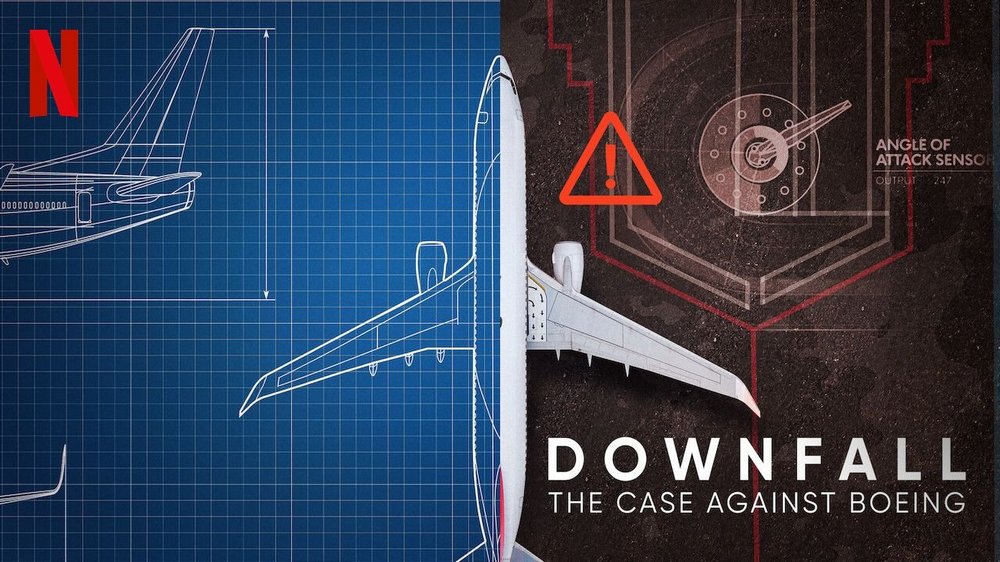
Considering its corporate colossus status, Netflix has been a platform for several documentaries which almost subversively highlight the failings of the capitalist system. For instance, in 2022, prolific film-maker Rory Kennedy (of the famous Kennedy family) released Downfall: The Case Against Boeing, which examined the circumstances around two fatal crashes of Boeing aircraft. The lasting consequences of these and other problems with the company’s practices are explored in Kennedy’s sequel Freefall: A Reckoning For Boeing. Neither documentary has a presenter or narrator, with the story being told through interviews and footage of news reports.
A date given for a shift in Boeing’s culture is 2005, when Jim McNerney was appointed as CEO. He and his successors are described as proteges of Jack Welch, who as head of General Electric maximised its profits through a strict regime of minimising production costs. This approach would guide the development of Boeing’s 787 Dreamliner model of aeroplane, which was launched in 2011. Its initial price for production was $10 billion, but the aim was for this to be halved. Cost-cutting measures included using scrapped components and outsourcing the construction of many parts to cheaper companies overseas, with the result that they didn’t fit together well enough. Boeing staff are filmed undercover saying that they wouldn’t risk flying on the planes they’re assembling. Much of the programme comprises testimony from current and previous quality inspectors, who had less influence after manufacturing was outsourced. When John Barnett found that fasteners on Dreamliners were poorly fitted, which could cause them to fail, he was told by his manager that this would cost too much to rectify. He faced further obstructions when raising concerns: docked pay, threats of being fired, reputational damage, being relocated. After retiring, he went to the media with his experiences and filed a whistleblower complaint against Boeing with the authorities. During the subsequent enquiry, he was found dead in his car, having ended his own life due to the stress. ‘Boeing may not have pulled the trigger, but Boeing was responsible for John’s death’ says his attorney, Rob Turkewitz.
Freefall also covers Boeing’s 737 MAX series, which we’re told was rushed out to compete with upcoming models by rival Airbus, a decision made by McNerney when Boeing was in financial trouble. Within a few months of each other, there were two disasters involving 737 MAX 8 aircraft: in October 2018, Lion Air Flight 610 and then Ethiopian Airlines Flight 302 in March 2019 crashed soon after taking off, with all those on board being killed. The pilots lost control due to faulty inputs to the planes’ MCAS automatic flight stabilising feature. The documentary includes footage from the ensuing court hearings, but doesn’t dwell on the legal intricacies. Boeing was accused of misleading the regulatory body, the Federal Aviation Administration, about features of the MAX before the agency certified the model to be used. A deal was arranged between the Department of Justice and Boeing which shifted the emphasis of any accountability to a financial resolution. Most crassly, Boeing’s lawyers argued that the relatives of those who died don’t deserve reparations for their loved ones’ suffering because the crashes happened too quickly for this to be prolonged. Boeing agreed to pay fines and compensation, and there was also a ‘deferred prosecution arrangement’, meaning a probation period of three years. These outcomes excluded any consideration of criminal acts, absolving the CEO and other executives of personal responsibility. This lack of accountability has galvanised a campaign group of victims’ families, represented in the documentary by Naoise Connolly Ryan, whose husband Mick was on the Ethiopian Airlines flight. She believes the Department of Justice has been protecting Boeing, with ‘complete political entanglement’ between the two.
The authorities which are shown to confront Boeing are the senators during the court hearing, watched by the relatives of those who died. Senator Josh Hawley challenges squirming CEO David Calhoun on cutting costs related to safety while he has a pay packet of almost $33 million, and Senator Richard Blumenthal adds ‘Boeing blames everyone except itself’. The programme doesn’t cover the role of others in Congress, though. Lawyer and activist Ralph Nader claims that Boeing has funded campaigns for 330 members of Congress, including most of those on an earlier enquiry committee. He also states that Congress reduced funding and powers to the Federal Aviation Administration, enabling ‘Boeing to regulate the FAA instead of the reverse’. Because of this, he doubts that any legislation will improve the situation.
The documentary gives a clear example of how the profit motive overrules safety considerations, with some of those who personify this – the CEOs – depicted as the villains. The last four Boeing CEOs have banked almost $500 million for themselves, even though the company’s commercial aeroplane division hasn’t been profitable since 2018. Their commonplace strategy of minimising production costs to maximise income for those at the top isn’t the source of the issue, which is the market system that must place more importance on finances than precautions. The legal framework which is supposed to enforce justice is also part of this system, so financial considerations shape what ‘justice’ means. This is illustrated by how the court hearings have led to monetary settlements rather than criminal proceedings. Furthermore, the financial clout of Boeing’s owners has ensured its influence within the Department of Justice, Congress and the Federal Aviation Administration. The focus of the documentary is less on these wider forces than with the people they have affected. As author David Gelles says, ‘In most companies, the stakes aren’t people’s lives, but at Boeing, they are’.
MIKE FOSTER
Next article: Book Reviews – Mills, Warfield, Rewcastle Brown, Cox ➤