Young Master Smeet

Forum Replies Created
-
AuthorPosts
-
Young Master Smeet
ModeratorPossibly, pace Mao, when the city surrounds the countryside the difference between the two will be abolished.
It comes back to Engels’ question:
“[the peasant] ought to lend a ready ear in socialist propaganda. But he is prevented from doing so for the time being by his deep-rooted sense of property. The more difficult it is for him to defend his endangered patch of land, the more desperately he clings to it, the more he regards the Social-Democrats, who speak of transferring landed property to the whole of society, as just as dangerous a foe as the usurer and lawyer. How is Social-Democracy to overcome this prejudice? What can is offer to the doomed small peasant without becoming untrue to itself?” (hereAnd further:
” Our task relative to the small peasant consists, in the first place, in effecting a transition of his private enterprise and private possession to cooperative ones, not forcibly but by dint of example and the proffer of social assistance for this purpose. And then, of course, we shall have ample means of showing to the small peasant prospective advantages that must be obvious to him even today.”(here)I don’t think Engels ever foresaw the possibility that the capitalist class would pay tribute to the land owners small and large to keep them in business and owning their land.
(As a side note, here is Engels on the compensation of expropriated capitalists: “Marx told me (and how many times!) that, in his opinion, we would get off cheapest if we could buy out the whole lot of them.”)
-
This reply was modified 5 years ago by
Young Master Smeet.
ModeratorWithout looking it up, generally, I’ve heard that there are environmental and social benefits to urbanisation, as well as opening up agriculture to mechanisation.
I’d add that state support for private ownership of land is generally reactionary, so the minimum price demand is a demand to subsidise agriculture and hold prices up.
ModeratorOne of those articles claims it’s an underlying aim of the government. In itself, cities have better health outcomes and have energy/environment and other benefits, but my point was it should be through choice not force.
ModeratorIn itself, encouraging 400 million to move out of agriculture and into cities is probably a good thing: if done with consent and inducement rather than with force, although in this case I suspect it’ll be into low wage employment and mega slums. Isn’t that basically what has happened in China?
Moderatorhttps://legalform.blog/2020/12/28/the-farmers-protests-in-india-lessons-for-marxists-jai-vipra/
An interesting Marxistante article on the Indian situation:
“In summary, this is a powerful movement that has challenged the Modi government, as few other movements have been able to do. Since it is an explicitly class-based movement, it is more difficult to demonize than many of the social movements that have preceded it. The prime minister has gone from saying “the Opposition is misleading some farmers” to “I beg with folded hands, come and discuss these acts with us”. The agitation shows us that the peasantry in India is still strong and must form the backbone of any transformative political project.”ModeratorSo, this thread I think hits the nail on the head:
https://twitter.com/faisalislam/status/1342762377599709185
Particularly:
“going back to EV/ battery example..if UK embarked on aggressive strategy of regulatory competition designed to win market/ invest share from EU (for some the point of Brexit) EU wouldve gone to same firms & said “tariff free access not guaranteed”, well before rebalancing “bites””
So, by removing the judicial process of the ECJ (and in its place an interstate arbitration process that allows retaliatory tariffs) UK has achieved its aim of independence at the expense of long term business confidence. The mere threat of potential future tariffs is enough to deter long-term investment.
Also note, ECJ and UK courts are expressly not “bound” by each others’ decisions, but it is inconceivable that they would ignore each others’ decisions, and the reasoning of the arbitration panels.
ModeratorThe UK doc (with UK spin, like the emphasis on no role for the ECJ – I bet in small print there’ll be some clarification that ECJ is the final arbiter on what EU rules are…).
ModeratorLooks like they have achieved their aims: stopped freedom of movement and paying benefits, cut the payments to the EU, and ended ECJ jurisdiction: the price is excluding (financial) services from the EU market (but that also frees UK banks from EU regulation) and of course customs regulation. Instead of a predictable judicial relationship, we have a political Joint council (though that means the UK talks to the EU Commission, not the Council of Ministers, a demotion).
ModeratorALB,
Have I pointed you at this book:
Behind the Myths – the Foundations of Judaism, Christianity and Islam
by John Pickard(Author)(I think he over eggs the pudding on none of the Abraham religions having any historical basis, and he seems to be factually wrong over the Christian tradition, but it is a fun read nonetheless and has a worthwhile bibliography that’s worth looking at).ModeratorI’ll add that the big ticket item, no automatic application of EU law, and and punitive tarrifs being based on the effect not the letter of the regulations just means Britain has committed to being the toddler that decides its own bedtime happens to be the same as the one it’s parents want…
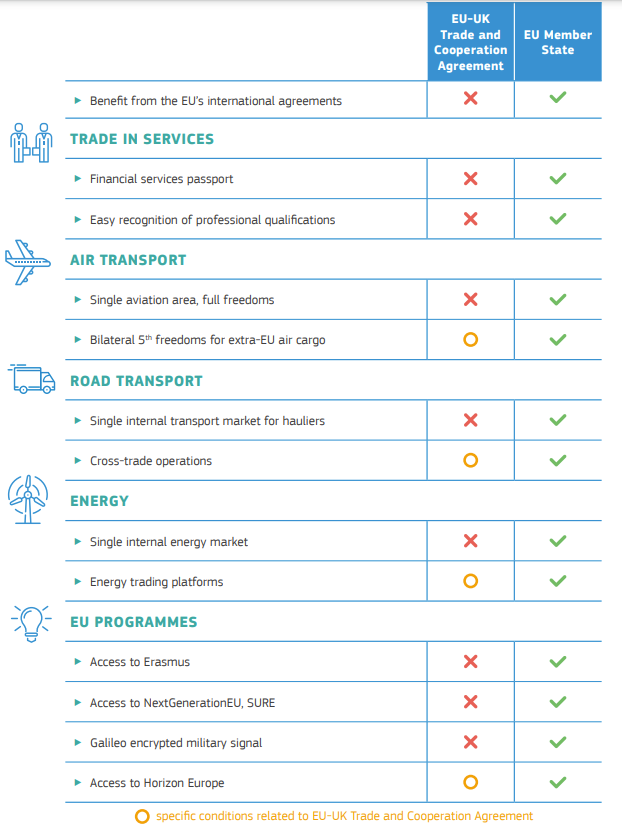
ModeratorThe EU’s first explainer on the deal:
(I think the circles sort of count as ticks, the EU wants to talk up the downsides of leaving, but still, we can see what the substantive differences are, as ALB suggested earlier, the big loss is our freedom of movement…)
ModeratorThis map is instructive:
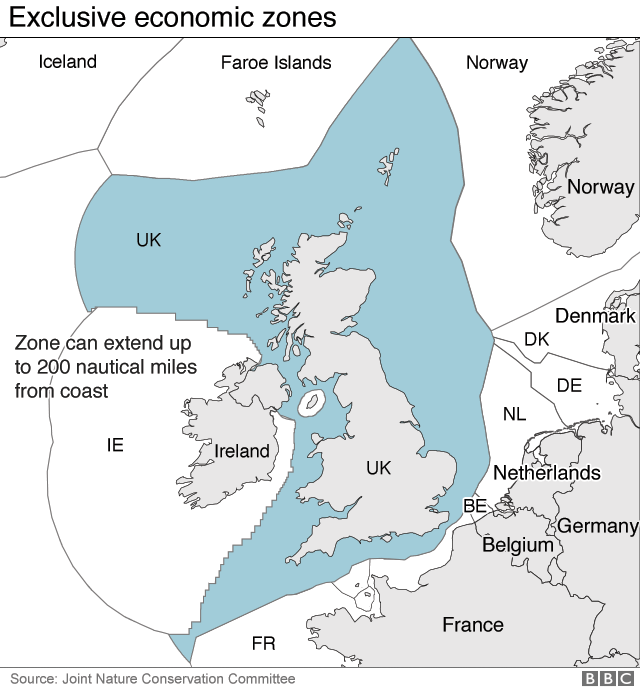
Note the misleading nature of the headlines about chasing French fishers out of the Channel, Britain only has half.
ModeratorGo on, since I’ve been quoting American trots, lets quote Indian Maoists:
https://www.cpimlnd.org/big-response-to-bharat-bandh-on-december-8/
“The people of the country have observed a near-complete General Strike and there has been a massive outpouring of peoples’ opposition to the Central Govt’s adamant attitude and rigidity towards the just and genuine demands of farmers to save their livelihood means from being captured by big corporate and MNCs.”
Lets of talk about brining cities to standstill, and support from workers: but they would say that, wouldn’t they.
ModeratorModeratorCriag Murray appears to see a pragmatic course through:
https://www.craigmurray.org.uk/archives/2020/12/sorry-johnson-will-not-disappear/
“As a former professional diplomat, I am going to be astonished if there is not a Brexit deal announced very shortly. It is plainly highly achievable given the current state of negotiations. The EU have moved very far in agreeing that an independent UK body, as opposed to the European Court of Justice, can be responsible for policing UK compliance with standards regulation to ensure against undercutting. The “ratchet clause” sticking point, where a mechanism is needed to ensure the UK does not undercut future improved EU regulatory regimes, can be resolved with some fudged wording on the mutual obligation to comply with the highest standards, but which does not quite force the EU to simply copy UK regulation in the improbable event it becomes more demanding than the EU regime. By making the obligation theoretically mutual the “sovereignty” argument about UK subservience to EU regulations and standards is met, which is the ultra Tory Brexiteers biggest fetish. Fisheries is even simpler to solve, with obvious compromises on lengths of agreement periods and quotas within easy grasp.”
-
This reply was modified 5 years ago by
-
AuthorPosts