
The White Rose and the Red
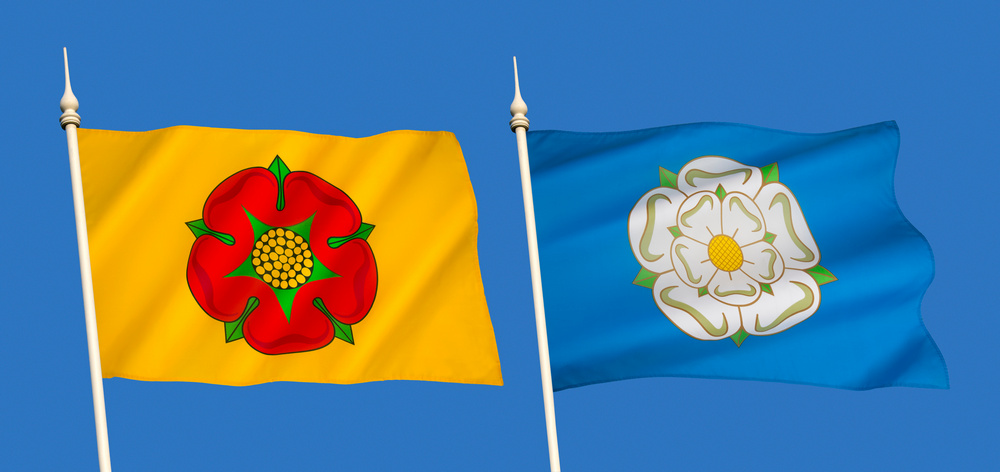
The sun is shining, again, although there is a breeze with rather a honed edge to it. I’m sitting under a tree in a West Yorkshire park next to my duo partner with his tenor banjo fully loaded. Around us are food and ice cream stalls, sideshows and charity tombola. Carried on that sharp breeze faint sounds of a fairground organ, however not so loud as to clash with us when we begin to play. People are beginning to stream in, children looking slightly bemused at two old guys sporting instruments.
It’s the first of August, Yorkshire Day. It may seem to be an event dating back to time immemorial. Actually, it’s just over 50 years old, founded in 1975, not by some ancient aristocratic family, but by the Yorkshire Ridings Society as a protest against local government reforms of 1974.
Still, a summer’s day out is welcome, especially when it’s free in these straitened times (are there ever any other such times?). At the invitation of the local civic society, who organise the event, this is our fourth year of being the in-house (in-park) musicians. This is why I’m sitting under a tree tuning my guitar with our extensive set list on the grass between us. I have a silken white rose tucked into the hatband of my panama, another pinned to my waistcoat. This may appear to be an incongruous situation for a socialist.
Even more so considering that by birth I’m a Lancastrian. Or perhaps not. This is an annual community event that happens due to the freely given time of those in the local Civic Society. A demonstration that people will work without financial inducement, even in a society driven by the profit motive.
We are able to contribute our music, without recompense, due to many hours of work in practice. We don’t need to do any of this as neither of us are, or have been, professional musicians. What makes those hours worthwhile is the appreciation we receive from those who enjoy what we play.
This is to attribute a meaning to value that transcends its economic definition related to the production and sale of commodities.
As to what we play; it’s an eclectic mix of what is usually referred to, somewhat vaguely, as traditional music. I often introduce a performance by announcing we are going to play popular dance tunes of the ‘70s and ‘80s, the 1870s and ‘80s. Actually, the time span is very much broader than that, with some tunes certainly dating back to before the 17th century to other very venerable-sounding ones written in the 2020s. They are drawn from all over the UK and Ireland, some via America and Europe. Experience has shown they are popular with virtually all ages from pensioners to those bouncing along to the rhythms in their pushchairs. Somewhat unexpectedly we get a very positive response from teenagers who might be expected to be somewhat dismissive of such ancient stuff.
This is a demonstration that there is far more that unites people than divides them. Ask, ‘do you like folk music’ and the answer is very often, no! When heard though as performed music, without a defining label, it is enjoyed. Which leads me to wonder if a political analogy might be drawn. Mention ‘socialism’ and all sorts of unfortunate associations, mostly inaccurate or downright wrong, are made. However, the prospect of a worldwide cooperative society that meets people’s needs and isn’t driven by profit becomes more widely acceptable and appealing.
This is not to argue for not using the word ‘socialism’, just as we don’t shy away from ‘traditional’ or ‘folk’ when referring to what we play. However, it is worth being aware that words can have negative associations, even if undeservedly so.
Which brings me to another question. Should a socialist be celebrating what might be seen as a mildly semi-xenophobic ‘Yorkshire Day’? As mentioned, by sheer chance and not of my choosing, I’m a Lancastrian by birth. In terms of where I’ve lived though, the Lancastrian bit was just the first eighteen years. I then migrated to the North East where I then lived for over 40 years, to which my son’s Geordie-ish accent bears witness.
For fourteen years and counting I’ve been domiciled in South Yorkshire. The Lancashire element only involves three generations. My great granddad on my father’s side moved into the county from what is now North Yorkshire. As ever, economic circumstance was the driver, the need to go where the work was. The same motivation brought my mother’s family from Devon via Wales to Lancashire. The other half of our musical duo was born and bred in what before 1974 was the West Riding and then became South Yorkshire. He has lived here almost continuously, so a true Yorkshireman then. Except both his paternal and maternal antecedents were drawn here, again by economic necessity, from elsewhere. It might not have been in small boats, but economic migration makes a mockery of claims to national, regional or local exclusivity.
So, celebrating the artificial confection that is ‘Yorkshire Day’ does not cause this socialist any difficulties. Rather it seems to me to have been a casual opportunity that I missed, its possibilities only occurring to me after the event. The persistent difficulty for socialists is meaningfully engaging with people to open a discussion about socialism and its possibilities. Public meetings have their place, but they tend to attract mainly those who are, or close to becoming, fellow travellers already.
Those discussions are very important as being the likely source of active supporters or members. However, that leaves the much broader public of whom many, perhaps most, are disengaged from politics apart from the lottery of the ballot box. Perhaps something as simple as a T-shirt with a slogan might have sparked a conversation between tunes. Then, should the oft-asked question have arisen, ‘Will people work unpaid?’ I had the living example of how that happens even under the present strictures of capitalism.
I am not suggesting this is a sure-fire way of bringing people to socialism, but as a – if somewhat fleeting – initial engagement it at least would be part of widening awareness. How many other such casual opportunities are there?
 Even someone being insistently ‘proudly Yorkshire’ on the day might respond to being challenged by the reminder that the Wars of the Roses were actually quarrels between ruling-class cousins, not counties. There is more that unites Yorkshire and Lancashire than a difference in the colour of roses:
An old slogan proclaimed, ‘The personal is political’. The reverse, ‘the political is personal’, perhaps is suggestive of looking for ways to talk to people personally, people who perhaps rarely if ever happen upon propaganda, and casually disregard it if they do. How many have recently voted Reform UK because they are disgruntled, but don’t really know why? Undoubtedly some who heard us playing at the Yorkshire Day event in the park. They can be dismissed as small-minded racists, which is the standard left-wing, even liberal, response.
As socialists it is our responsibility to engage with those who are disgruntled and try to persuade them that while their ire is understandable, even justified, their present response does not, and cannot, serve their best interests. Music may not change anyone’s mind, but it might be a starting point in the huge task of bringing people to an understanding of the causes of their predicament and what needs to be done by them, and so many others, to finally resolve it.
D. A.