
The Parkrun – an Inkling of socialism?
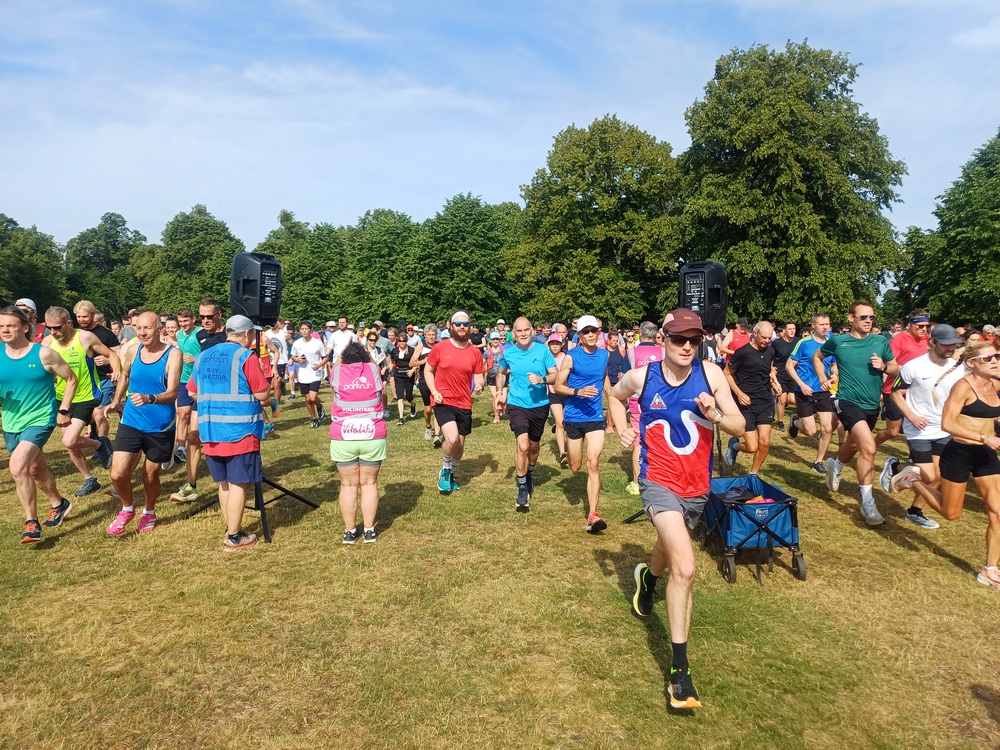
On 13 June this year, the 13 runners and 5 volunteers who set up the first parkrun ever in 2004 at Bushy Park, London, celebrated one million parkruns worldwide since then. On that day runs were taking place in 2,800 places across 23 countries. In an interview with the i newspaper, one of the original parkrun organisers, Paul Sinton-Hewitt, said that the success of the event was ‘clearly down to the simplicity … the fact it is for everybody, inclusivity, the nature of that, the fact that it’s free’. Another of the founders, Andrew Lane, said he’d originally predicted that, if the event got going, participation would peak at 200 runners per time, otherwise the course would be too crowded. But at the 1,000th Bushy Park run in 2024, there were over 6,000 participants.
Clearly people didn’t mind being crowded together with others and, since they weren’t competing with one another as in a conventional race, getting a clear unimpeded run wasn’t a priority for most. At best if people were there to compete, it was against themselves, ie, trying to improve their personal best time. Lane went on to say that he’d also predicted, wrongly again, that there would be a lack of volunteers coming forward to do the organising and this would hold growth back. But, as he put it, ‘I failed to realise … how much volunteering would become a great pleasure and destination in itself’.
Interesting words
There are some interesting words here: ‘inclusivity’, ‘free’, ‘volunteering’, ‘pleasure’, for example. Interesting because they describe a voluntary, cooperative, communal kind of activity enjoyed by large numbers of people and going directly contrary to the ethic of a society, the one we live in, based on me-first competition, beggar thy neighbour and the gaining of personal wealth and status. A society too in which we often hear of how people have become alienated, disconnected from one another (‘atomised’ is the word often used) and bereft of any clear sense of purpose. In the parkrun, however, we have an activity that is entirely cooperative and purposeful, where money doesn’t enter into any part of the equation and which is pursued by increasingly large numbers of people, whether as run participants or organisers. And clearly the ‘non-runners’ too experience a sense of community as well as a perception that they’re doing something useful, as well, no doubt, as enjoying the approbation, spoken or otherwise, of the people around them.
Social animals
Should we be surprised? Well probably not, because regardless of the way current society is organised with its massive economic inequality, its ever-present wars, the stresses and frustrations of its employment system, human beings are fundamentally social animals who, given even small opportunities, are ready and willing to work together to carry out activities and achieve ends they consider worthwhile. Apart from our common everyday experience where, in a whole host of situations and pursuits, humans display cooperation and empathy with one another, a plethora of studies, sociological and anthropological, many of which have been discussed in the pages of the Socialist Standard continue to illustrate and confirm this.
This year’s World Happiness Report by Gallup, which rates countries according to the level of ‘happiness’ of their citizens, concludes unequivocally that what makes individuals feel most happy is ‘being generous and volunteering’, since it gives ‘a feeling of belonging and sociality’. A recent discussion on the Gallup report on BBC radio reiterated this, with the broadcaster Evan Davis, one of whose specialities is business and economics, stating that ‘money matters to a certain extent for the agency and control it gives you’, but that ‘the main individual thing is to be generous to other people and to volunteer [and] you will make yourself happier’.
Another recent study carried out by a team of scientists from American and Australian universities entitled ‘Altruistic, not reputational concerns, drive human prosociality, values and aspirations across the world’, studied anonymous survey responses from almost 1 million individuals spread over more than 100 countries, taking into account different cultural contexts, age ranges, socioeconomic levels, and time periods. The researchers found that the vast majority of people reported performing acts of altruism because they were interested in the well-being of others, not because these acts benefitted them directly. They concluded that people are more likely to want to be remembered for making a difference, helping others, and improving the world, and to value things like caring over status or personal gains. The way a review of this study put it was ‘people really want to be good’ .
Cooperation or ego?
Another new piece of research, this time from the fields of archaeology and anthropology and published in the Journal of Archaeological Science, provides evidence that it has been humans’ ability to empathize and relate to one another that has allowed our species to thrive and build complex cultures over the whole planet. It points to how the archaeological record illustrates the capacity of early humans to make long-term commitments to one another’s well-being, to tolerate frustration, to plan collectively, to make sacrifices, and to trust others. In many instances, for example, archaeologists have unearthed remains of disabled and elderly humans who could not possibly have survived alone.
A review of this study on the IFL Science website concludes that yet again we have evidence that ‘one of humanity’s greatest strengths was never just ego or ruthlessness, but profound emotions and our extraordinary ability to turn those feelings into cooperation’. Of course we see ‘ego’ and ‘ruthlessness’ around us too, we see displays of non-cooperation and lack of sympathy and understanding for others. But, perhaps contrary to appearances, we see this much less frequently than the opposite. But precisely because it is less common, it attracts greater attention and becomes more ‘newsworthy’.
Purpose and enjoyment
What has all this got to do with socialism? Put quite simply, socialism – the moneyless, wageless society of common ownership and voluntary work with free access to all goods and services which we campaign to see established – can only work if human beings are able to cooperate freely and willingly to produce and distribute everything that is needed to provide a comfortable, purposeful life for all. And what we learn from the kinds of research mentioned above, from everyday experience and from voluntary on-the-ground activity such as the parkrun is that we are geared, we have the capacity, to organise ourselves and our society in that way.
We learn too that the dog-eat-dog mentality that we also see around us and can set people against one another, often in ugly and irrational ways, arises not from any ‘natural’ human inclination but from the conditions of life in the society we live in, from the very nature of the competitive, profit-driven system we call capitalism – a system effectively described by one commentator as ‘a scramble to sell our energies under conditions of duress and unfreedom’. We draw from all the evidence that such behaviour and such conditions can be overcome if we are willing to take the bull by the horns and decide, via collective and democratic political action, to establish and organise a society in which volunteering and cooperative, communal activity is the norm in every facet of life. Of course, despite the constraints of capitalism, a vast amount of such activity already takes place, not only in parkruns but across a whole range of endeavours. But socialism will provide the opportunity for us to fulfil our potential for cooperation not just in our spare time but as a way of organising the whole of society efficiently and effectively and giving us all lives that are enjoyable, meaningful and fulfilling and satisfy our deep-seated need for social interaction.
HKM