
Book Reviews – Fry, Sutterlutti, Phillips

Conflict Resolution. By Douglas P. Fry. Edward Elgar. 2026. 121pp.
‘Nomadic foragers, as we all used to live, were socialist, prosocial, egalitarian societies’ (Douglas P. Fry).
In this distillation of long years of fieldwork and scholarship, the world-leading anthropologist Douglas Fry draws upon his knowledge and experience to propose means of resolving conflicts between individuals or groups as they might arise in contemporary contexts. Its analysis and recommendations are underpinned by the author’s accumulated understanding of how human beings have related to one another throughout the 300,000 years of our species’ existence. And it is precisely this that makes it of particular interest and relevance to socialists.
To be specific, a central plank of his arguments is how entirely fallacious are the oft-repeated claims that war, aggression and greed are rooted in the human psyche. All the evidence, he insists, is that such forms of behaviour, far from being somehow embedded in our nature, are, when they occur, an outcome of social conditioning and that our evolutionary history shows that we have just as much potential for, and indeed a much more natural bent, towards attachment, caring partnership and cooperation.
Drawing on decades of his own research and with evidence from various different fields of study, he demonstrates how over the approximately 290,000 years of prehistory (the Palaeolithic era), the overwhelming principle of existence among human groups was (and still is today among indigenous populations he has investigated across the world) non-violence, cooperation and egalitarianism, characterised by sharing food, caring for the vulnerable and maintaining social bonds. This the author sums up as ‘community solidarity and harmony’, reinforced by ‘socialization and social control mechanism geared toward promoting prosocial values and behaviors’. Not that violence, greed or attempts to monopolise necessities would never have occurred in Palaeolithic societies or never occur in modern indigenous cultures, but in such circumstances ways are usually found to resolve the conflicts caused via ‘restorative’ methods or by reconciliation, eschewing violence and seeking to practice ‘fairness’ in the eyes of the individuals most directly affected and of the collectivity. But in the rare cases where this is not possible, it may be necessary to apply sanctions to ‘wrongdoers’, probably via some form of social ostracism or banishment. As for large-scale organised killing, the author echoes the now widely accepted view that this has been largely a feature of the last approximately 10,000 years. Starting then, hunter-gatherer life (referred to in this book as ‘nomadic foraging’) gave way to settled agriculture with social hierarchies and control and domination of wealth by small groups of people developing and eventually becoming the norm. Later, of course, the industrial production of capitalism took over from agricultural society, but that society continued to manifest, as it still does, those same basic features: power and wealth concentrated in the hands of the few, leaders and led, and a willingness of the many, via social conditioning, to sacrifice themselves in the interests of the privileged few.
This book is one of many in the field of anthropology, archaeology and a gamut of other disciplines which have contributed to exploding the enduring myth that violence, competition and selfishness are somehow ‘locked into’ human interaction, that there exists inevitably some kind of ‘war of all against all’. Douglas Fry’s stark opposition to that idea is summed up in his statement that ‘on the basis of cross-cultural data … humans have a universal inclination to resolve conflicts and restore normal patterns of harmonious social interaction’ and that ‘the normal state of social affairs is to exchange good deeds, to feel gratitude, to be generous and appreciate the generosity of others. Overall, people strive to maintain positive interpersonal relations with others through mutually beneficial exchanges’.
All this is serious grist to the mill for socialists, providing as it does a powerful response to those who argue that the cooperative society of voluntary endeavour and free access to all goods and services which we call socialism is impossible because it is against what is usually referred to as ‘human nature’. We cannot but agree with the author’s plea that ‘the human potential for resolving conflicts without violence should be fully acknowledged, nurtured, and further elaborated by the people sharing one small planet in the vastness of space’. At the same time, however, though this plea is expressed, as all else in this book, in truly engaging fashion, it is difficult to see how its substance can be realised within the framework of the current social system of class division and production for profit. Rather, the environment for it to come to fruition has to be a society of economic equality and production for need.
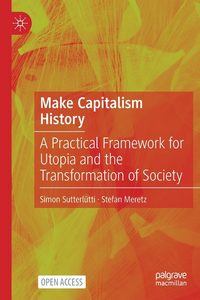
Make Capitalism History. A Practical Framework for Utopia and the Transformation of Society. By Simon Sutterlütti and Stefan Meretz. Palgrave McMillan.
The authors state that one reason for writing their book (which first appeared in German in 2023) was to get those engaged in various struggles to try to make things better under capitalism to seriously consider (rather than just in ‘late night pub talks,’ as they put it) what a feasible, rationally justified alternative society might look like.
Starting from the basic position that humans naturally want to satisfy their needs as they themselves define them, they argue that a free society can only be one where people are no longer forced to work by economic necessity and where people have secure, open access to what they require to satisfy their needs (they mention ‘places resembling modern-day supermarkets but without checkout’); work has to be freely chosen and people must be free to use productive resources to both produce and consume what they need; private ownership has to be replaced by ‘collective disposition’ (they prefer ‘disposition’ as ‘ownership’ has connotations of exclusion whereas productive resources and their products will belong to nobody but just be there to be used ). They call the new society ‘commonism’, but it is obviously socialism.
They are opposed to any form of central planning, on the grounds that it wouldn’t work and that attempting it would give power over people to the central planners. In fact, they are opposed to any central administrative body, even if unarmed and selected democratically. What they envisage is production and distribution taking place through ‘stigmergy’ (communication by signs) which apparently is how termites communicate to build their constructions. Capitalism does this without central planning with prices as the signs; ‘commonism’ would do it through (non-monetary) signals about needs.
They describe well that under capitalism the aim of production is that ‘money must be invested as capital in order to multiply itself’ (‘valorisation’) and that this is ‘not the result of the greed of managers or shareholders’ but ‘derives from a structural compulsion to valorise that is built into the system’ and enforced through competition: ‘if producers display inferior valorisation, therefore less profit than their competitors, they will be at a disadvantage vis-à-vis advertising, the development or acquisition of new machines, the design of new products and so on. That is why, in the short or long-term, they will be defeated in competition and disappear from the market.’ The state has some autonomy to resist this as it acquires money not by exchange but through taxation; this autonomy, however, ‘remains relative, as state taxes in turn depend on a functioning economy … Therefore, the economy is the dominant sphere encompassing the state’.
They don’t regard state-dominated economies, such as the former USSR, as capitalist — in fact they follow the annoying practice of Continental academics of referring to them as ‘Real Socialism’ in the sense of a ‘socialism’ that really existed— but as being subject, through participation in the world market, to the same economic compulsions; also that state ownership is still a property form, excluding the majority.
The second part of the book is devoted to discussing how to get to ‘commonism’. Here, they insist, a free society can only be established by people who want it and freely choose to establish it; people cannot be forced to be free; a free society cannot be introduced from above by the state, as envisaged by gradualist reformists as well as by violent insurrectionists. Beyond not taking this route, the authors are fairly agnostic, though they also rule out the idea that worker cooperatives could outcompete capitalist corporations on the market or that voluntary communes (‘commons’, they call them) could spread by-passing the market. They seem to envisage as most likely the ‘transvolution’ (their alternative word for revolution) being set off by some catastrophe such as an economic collapse of capitalism or an ecological collapse.
In the last chapter they relent a bit on their opposition to political action and concede that it is conceivable that the state could support the spread of ‘commonist forms’ before dissolving itself — they write of a ‘suicide state’ — giving the movement for a free society a leg-up, or as they put it ‘a stirrup holder, an accomplice to emancipation’.

How to Save the Amazon: a Journalist’s Deadly Quest for Answers. By Dom Phillips & Contributors. Ithaca £10.99.
The introduction and first four chapters were written by Phillips, but the book was unfinished when he and indigenous specialist Bruno Pereira were murdered in 2022 (one man confessed to the killings and others have been arrested, but it is not known who was behind them, though they were presumably carried out to silence witnesses). A further six chapters were completed by various journalists on the basis of Phillips’ notes. Phillips was clearly a courageous and painstaking investigator; as the people who assembled the book say in their foreword, ‘these pages have been stained by blood.’
The Amazon rainforest plays a crucial role in stabilising the global climate, storing billions of tons of carbon, among other things. But it is currently under various kinds of threat, most notably deforestation caused by cattle ranching. Fires are used to remove trees and clear land; almost nine-tenths of deforested Amazon land has become cattle pasture. The reason behind this of course is profit, and there are plenty of other attacks on the forest for the same reason, from hydroelectric plants and gold-mining to large-scale fishing and oil exploration. Indeed, the Amazon itself may already be close to a ‘tipping point’, when it no longer produces enough moisture and may change into a semi-arid savannah. All of this is exposed here, with considerable detail and personal stories.
Biodiversity is another crucial aspect of the Amazon. Having large numbers of different plants can help to build fertile soils. Also, the area is likely to contain drugs that can help combat disease, but about which the outside world knows very little. The indigenous people who live in the rainforest have a great deal of knowledge about possible uses of plants, and made use of some of their own remedies to fight Covid. But as deforestation continues, biodiversity will decline and some potentially useful plants may disappear.
The policies of the Brazilian government have had a major impact on the Amazon. The right-wing populist government of Jair Bolsonaro encouraged land-grabbers and illegal miners to invade the forest and extract natural resources. Since the election of left-winger Lula da Silva as president in 2022, things may have improved a bit, and he promised zero deforestation by the end of the decade, but it remains to be seen if anything close to this will materialise.
Defending the Amazon rainforest would contribute to limiting climate change and would also protect the indigenous communities that live there. Rather than the people being a means to the end of defending the Amazon biome, the forest should be saved to prevent indigenous genocide. They are not just hunter–gatherers but also ‘rainforest gardeners and technicians’. Massive construction projects ‘convert self-sufficient forest peoples into the urban poor’ (rather like capitalism originally forcing people off the land to become wage slaves in factories).
The book reminds us how many inhabitants of the Earth view it rather differently from those who live under capitalism. As an indigenous representative says in the afterword, ‘That land could be owned by a single person is unthinkable to us because everyone’s survival depends on it. We can’t imagine how anyone could pollute, divert or dam water for their own profit.’
PB
Next article: 50 Years Ago – The row about overseas students ➤