
Support from an unexpected source
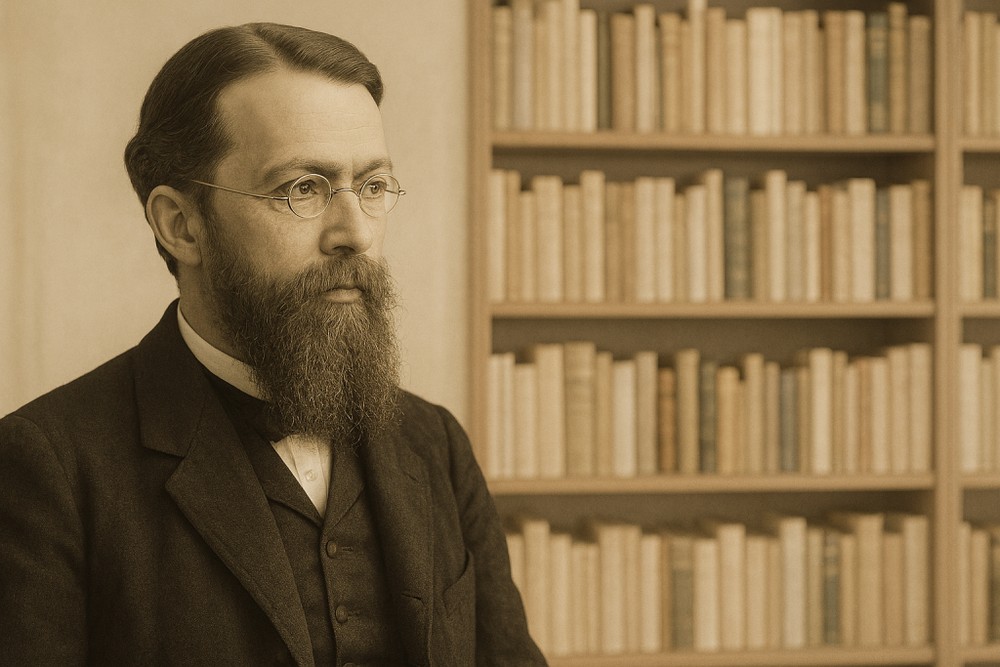
The argument for socialism receives support from many directions, whether it be our lived experience as wage-workers of just about getting by or evidence from many fields of academic research, such as anthropology, evolutionary biology and even human palaeontology, much of which has been discussed in previous issues of the Socialist Standard. Support comes too from unexpected sources and the article below discusses one of the weirdest of these sources.
You may well not have heard of Carl Menger, but he is recognised as the founder of the Austrian school of economics, which is home to the crankier supporters of free-market ideas. The one thing these people have in common is a seemingly visceral hatred of the idea that workers could take the world’s productive resources out of the hands of the minority and use them to create wealth that is freely available to all. They would certainly be taken aback, in the unlikely event that they ever read Menger, to find that he, doubtless unwittingly, gave support to socialist ideas in his 1871 book, Principles of Economics, a text that was lauded in a modern foreword by Friedrich Hayek, the monetarist darling of the Tories in the 1980s.
Hayek says that Principles is worthy of attention due to ‘the outstanding character of this work among Menger’s publications and, indeed, among all the books which have laid the foundations of modern economics’ (2007 edition, Mises Institute, p. 21). High praise, indeed, from a leading capitalist economist (even if his own ideas have been shown to be pretty useless in recent years).
As for the work itself, Menger constructs an entire system (which will later be called marginal utility) that describes how individuals act, as consumers in a market system, to ensure their own maximum well-being, in a situation in which goods are always in short supply.
This isn’t just our view – Hayek himself wrote (p.18) ‘all of Menger’s analysis is grounded on the idea of scarcity’.
For Menger, scarcity affects not only luxuries but ‘by far the greater number of goods […] even the coarsest pieces of clothing, the most ordinary living accommodations and furnishings, the most common foods, etc.’ (p.95). He refers to all such goods as ‘economic goods’
In passing, it is worth noting that this material scarcity, as it affects an entire society, creates a conflict of interests that can only be resolved ‘if the various portions of the whole amount at the disposal of society pass into the possession of some […] individuals, and if these individuals are protected by society in their possession to the exclusion of all other individuals in the economy’ (p.100). In other words, the state as protector of private property.
Menger was writing at a time when industrial production was destroying earlier forms of production by creating a world market and herding millions of workers into factories. It might seem unusual, then, that he chose to build his argument largely on isolated individuals, one of whom he imagines living on a rocky island faced with the problem of how best to use a limited amount of fresh water for his own needs and those of his animals (p.134). Another example is two American frontiersmen and their families living in a virgin forest, ‘far away’ from anyone else, who are obliged to trade with each other (p.183).
The details of Menger’s treatment of these examples are beyond the scope of this article, as is the fallacy of composition to which they lead him: ‘A social economy is made up of individual economies, and what has been said above is therefore just as valid for the trade of entire peoples as it is for single economizing individuals’ (p.187).
When goods are free
Rather, of interest here is his consideration of natural resources (water and virgin forests are much in his mind, and even light and air get a passing mention) when they are present in abundance, in other words when there is enough to meet everyone’s needs. How do people act in such a circumstance? Are they impelled to possess these resources, which he calls ‘non-economic goods’?
Definitely not, because when ‘all individuals are able to satisfy their respective needs completely […] there is no practical necessity for any individual to secure a part of the whole sufficient to meet his requirements’.
These non-economic goods are not ‘objects of the human desire for property. On the contrary, we can actually observe a picture of communism with respect to [such goods]; for men are communists whenever possible under existing natural conditions’.
And to reinforce his position, he continues: ‘In towns situated on rivers with more water than is [needed], everyone goes to the river to draw any desired quantity of water. In virgin forests, everyone fetches the quantity of timber he needs. This communism is as naturally founded upon a non-economic relationship as property is founded upon one that is economic’ (the three quotes above are on p.100).
So, according to Menger, there is no basis for one of the knee-jerk objections that many workers raise when they come into contact with the socialist case, namely that free access can never work because everyone would just take and take and take.
Menger has shown the irrationality of such behaviour. He could, of course, have had no idea in 1871 that workers, under the lash of capital, would be able to build a global production system that is capable of producing such a vast amount of wealth that everyone’s reasonable needs and wants can be more than satisfied.
But the very logic of his analysis, intended as a justification for capitalist production and capitalist property rights, turns against his and the free-market position as soon as the material conditions of production developed. Who knows, in a socialist future, Carl Menger may even be considered as one of capitalism’s gravediggers.
BUDGIE
Next article: Cooking the Books 2 – Prisoners of the market ➤