
Laundering people: the Catholic work machine
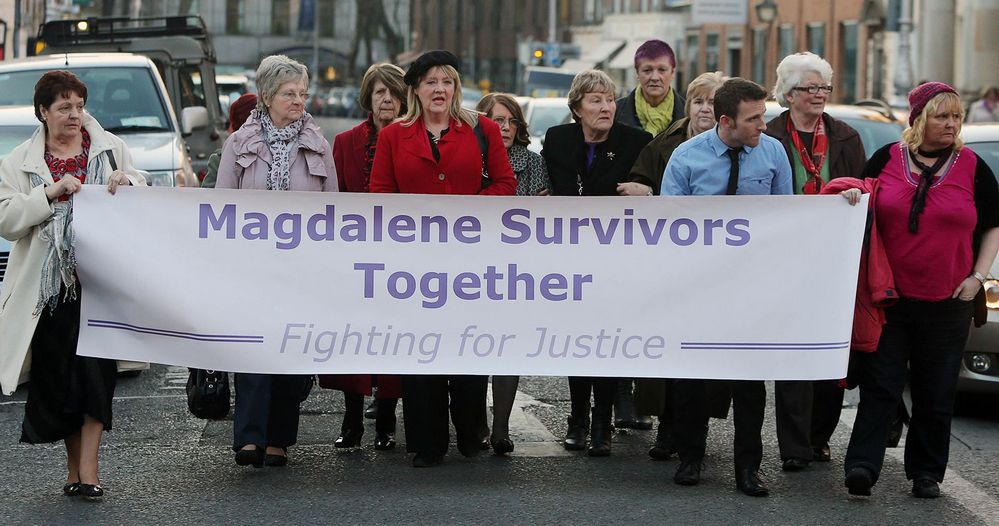
The Irish state has never stopped warehousing women it deems sexually inconvenient. It merely changed the branding.
Feminism as a tool of repression
On the surface Ruhama is a feminist charity helping women affected by sex work and trafficking. Founded in 1989 by the Good Shepherd Sisters and the Sisters of Our Lady of Charity, Ruhama operates today as a secular organisation with state backing and trades in the language of women’s liberation. These same religious orders are the institutions that operated Ireland’s Magdalene laundries. The continuities between the two systems are not cosmetic. They are structural.
A history of enthralment of women
The Magdalene laundries operated from the eighteenth century until 1996. Women and girls deemed fallen, wayward, or simply poor were confined in institutions that functioned as commercial laundries. They worked without pay, washing linen for hospitals, prisons, churches and hotels. Exhausting work in brutal conditions. The reason? To discipline women’s sexuality through productive exploitation. The state outsourced its moral regulation to the Church, and the Church turned a profit.
In 1993, building work at the former High Park Magdalene laundry in Dublin, previously owned and run by the Sisters of Our Lady of Charity (sic) revealed the vile nature of those god-botherers when 155 bodies were recovered from an unmarked grave at the site. Most lacked death certificates. Some remain unidentified as they had previously passed through institutions that included Mother and Baby Homes, industrial schools, and psychiatric wards, all devoutly segregating and controlling women and children who violated the Catholic sexual moral code or lacked social power.
The modern rebranding
Ruhama emerged from this same institutional matrix. Its founders were not peripheral figures in the laundry system. They were its operators. It’s argued that historical continuity does not matter because the organisation has since secularised, but institutions survive by adapting their methods, not by abandoning their function. The Magdalene laundries would have you believe their inmates are fallen women in need of moral rescue. Ruhama frames its service users as traumatised victims lacking agency, who have false consciousness or are at risk of exploitation. The vocabulary has been updated. The categorisation of women as problems requiring institutional intervention has not.
Ruhama’s Bridge to Work programme ‘engaged with’ 102 women in 2022, with 37 reportedly gaining job placements. Only five of those placements were paid. Women were once again working without wages, this time under the banner of rehabilitation rather than penance. The institution that emerged from a system of unpaid laundry labour is now placing women in unpaid work placements and calling it empowerment.
Money in the temple
The funding structure reveals where the money goes. In 2024 Ruhama received €2,015,271, with 91.5 percent coming from the state. Of this, 99.64 percent was spent on salaries and administration. Despite taking in €96,945 in donations, the organisation directed €71,799 towards actual service users. A resource distribution model that’s not liberating women from economic precarity. It is a model that sustains an institutional apparatus while keeping its subjects dependent and unpaid.
Ruhama’s own reporting acknowledges that poverty is a primary driver pushing women toward sex work. The logical material response would be substantial direct economic support: rent assistance, debt relief, emergency grants, childcare funding, and guaranteed paid work. Instead, the organisation expands a category called ‘at risk of exploitation’, which is sufficiently elastic to include migrants, single mothers, homeless women, women in informal economies, and young women whose sexual behaviour is considered immoral. This is not targeted intervention against identifiable trafficking. It is preventive institutional capture of a broad population of economically vulnerable women.
Historically, women did not need to have committed a crime or suffered a defined abuse to be confined. Suspicion, poverty, perceived moral danger, or simply being inconvenient to family or state was sufficient. Contemporary anti-trafficking frameworks reproduce this logic but with humanitarian language. ‘At risk of exploitation’ functions as the modern equivalent of fallen or wayward: a classification to justify intervention, surveillance, and unpaid labour regardless of the woman’s own assessment of her situation.
The Magdalene laundries were never abolished. They were incorporated into the state apparatus.
What exists today is an organisation founded under a regime of moral control through unpaid labour, now continuing to place women in unpaid work placements under the promise of moral reform and freedom from sexual exploitation. The women are not being economically liberated. They are being redirected into socially respectable forms of precarity while the institution that processes them absorbs state funding and reproduces the same carceral feminism it claims to oppose.
(Figures on Bridge to Work placements and Ruhama’s 2024 funding and expenditure are taken from research by Grace, Artist and Activist, Ethical Hoes.)
A.T.