
Book reviews – Farrier/Roberts/Sanders
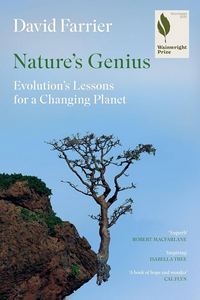
Nature’s Genius. Evolution’s Lessons for a Changing Planet. By David Farrier. Canongate. 2025. 278pp.
‘In this forest of thinking selves, capitalism arrives as a kind of dementia’ (David Farrier)
Nature’s Genius, written by a professor of literature and the environment, has had a whole range of superlatives heaped upon it. ‘Profound’, ‘fascinating’, ‘inspiring’, ‘boundary-breaking’ are just a few of the terms used to describe this book by experts from a wide range of fields. And there can be no denying that its brilliantly expressed mastery of the history, development and possible future of so many aspects of nature – humanity included – give it a special place in studies that look at the interrelationship between the many diverse phenomena making up the natural world.
The dazzling array of sources its author, David Farrier, draws on to demonstrate this interconnectedness is also used to illustrate the surprising speed with which nature is able to adapt to changing material conditions, especially those provoked by one particular element in the overall schema – ourselves. He summarises this ability, which he calls ‘plasticity’, as follows: ‘For nearly 4 billion years, life on Earth has experimented with ways of being, sensing, moving and reproducing, finding ever-new shapes by which to meet the challenges of the moment’. He provides multiple examples of this, two recent ones being the way in which North American songbirds have quickly evolved new wing shapes to cope with rapid changes to their environment brought about by humans; and how houseflies quickly developed resistance to the effects of DDT.
Given the author’s proposition that such plasticity informs the development of all plants and animals, including humans, one might begin by forming the impression – this reader did – that his contention would be that the biosphere – including humanity – will always in the end cope with everything that is thrown at it. But as we read on, it becomes clear that such an idea is as far as it can possibly be from this author’s view of the world. So, though he is happy to state that ‘evolution is irrepressible’, being ‘nature’s restless genius in action’, at the same time his views on the ongoing environmental crisis are unequivocal: ‘For as long as we continue to alter the chemistry of the atmosphere and the oceans, to carve up the environment for roads and resources, and to flood air, soil and water with industrial toxins, then death on a massive scale will follow’ and ‘the very basis of life is so threatened’.
So, though his book centres on the ability of interconnected ecosystems to adapt to changing environments, the author insists that, without urgent action, nature’s in-built plasticity is unlikely to be able to extricate us from the emergency that the existing social system has plunged us into. ‘Whole ecosystems are fragmenting under the strain we impose on them’ are his words. And in a key passage, the root of this is expressed as follows: ‘But there is one thought – one enormously powerful, overfitted idea, as persistent as the worst recurring nightmare – that is driving the world into mindlessness: profit’. He goes on: ‘The drive is all consuming, literally: capitalism’s defining imperative – grow! ( …) makes the world into a vast, auto-annihilating digestive system, consuming itself and shitting excess carbon into the atmosphere and the oceans’. He further refers to this drive as ‘the greatest barrier to our learning to live and think together with all of life’. It is not, he argues, that people are unaware of this but rather that they practise ‘cognitive dissonance’, whereby ‘they depend on a system that is hostile to life’ and ‘read daily about collapse and continue scrolling’. ‘Vested interests and denialism’, he concludes, ‘continue to work like toxins in the body politic’.
Does David Farrier have a remedy to offer to the sorry state of affairs he so eloquently gets to the core of? Does he have an alternative way forward, a route out of the single-focused profit system that is capitalism? Well, he takes up an idea that is very much in the air at the moment – degrowth. He sees degrowth as having already started at grassroots level with some local communities practising ‘agroecology’, where they produce their own food collectively and at the same time seek to begin reversing the historical enclosure of what was once common land, He wants to see this spreading further so that ‘resources can be managed for the common good’ via decisions made by ‘citizen assemblies’. In bemoaning, for instance, a lifestyle where ‘four kilograms of beef (or a month of Sunday roasts) has the same carbon cost as a return flight from London to New York’ and where ‘each year we manufacture 4 billion tons of cement’, he points to a whole range of more advanced methods of production that are already available and would be both more economical of resources and more sustainable. Among other proponents of this approach, he cites David Bollier, whose most recent book on the subject, Think Like a Commoner, was recently reviewed in the Socialist Standard . He sweeps aside the common objection that this is akin to ‘planting a few seeds when the whole forest is burning’ by stressing the urgent importance of ‘a way to reimagine our whole future together (…) where balance with the natural world takes priority over profit’.
It is difficult not to be sympathetic with such sentiments. But, as our review of the Bollier book made clear, no number of seeds planted collectively could bring about any truly fundamental change as long as society continues to operate within the framework of a market system with states, money, private property and buying and selling. Only when mass democratic action brings in a new kind of social organisation where the means of living are held in common and the production and distribution of goods and services are organised rationally with the aim of satisfying the needs of the community as a whole, will we have the ‘commoning’ that an increasing number of people aspire to and whose nature is fittingly captured in this book as ‘a seamless integration of humans and nature’.
Domination : the fall of the Roman empire and the rise of Christianity. By Alice Roberts. Simon and Schuster, 2025. ISBN 9781398510081
In the foreword of this book, the author explains that she became interested in ‘whether we can trace the spread of ideas and beliefs through changes in material culture’ and also how did ‘Christianity reach the West’ and become a dominant idea over such a wide region from its western Asian origins. Her account rebuts any idea that evangelist saints spread the religion solely through their faith or the inherent correctness of their ideas.
As she notes, she had to check herself from thinking about Christianity as an ‘it’ as if it had agency, but instead ‘who had spread this religion. Who, how and why?’ Throughout the book she repeatedly corrects herself, and although she never expressly describes her method as materialist, nevertheless, she does give a clearly materialist account of how real individuals in concrete situations found that what they perceived as their best interests was to produce, reproduce, spread and adhere to the ideas of what is now known as Christianity.
Possibly this book was intended as a treatment or idea for a television series, as it follows the format typical of modern history series, moving from one location to another, in this case from South Wales, to Brittany, to Rome and eventually to Constantinople (although her account does not stretch as far back as the foundation of Christianity itself in the Levant). The reader can picture her striding determinedly past ruins and archaeological digs, and in musty museums looking at the artefacts she discusses.
Accompanying that is a bit of showmanship as she purports to be ‘astonished’ by what she found, as if uncovering some ancient mystery Scooby Doo style. Her claim is that Christianity never was an anti-establishment religion, and that, indeed, its spread was very establishment indeed.
She begins with the evangelist saints who came to post-Roman Britain. She notes that Christianity had already been here as part of Roman culture, and many of these saints were members of elites who had what amounted to a traditional Roman education. The very prominence of these saints was connected with the relative power of churches, places of pilgrimage and the peoples associated with them.
As she notes, in the collapsing Roman Empire, wealthy and powerful families sought to protect their interests by sending sons off for education, and then ensuring their placement as bishops in the church, with the command of land, money and status that brought. This came about, in part, because of the charitable role that the church established for itself as it grew in Rome, supporting widows and orphans; and also providing some of the civil bureaucracy of running regional centres within the empire. As a part of this, the church obtained incentives through tax breaks.
The church had grown within a small and mobile professional class, as it spread through the Roman world. It was never a majority in that world, but plague and financial stresses on the empire may have helped it grow, with its institutionalised resilience alongside its doctrines of salvation and life eternal. It became, as she says, a business of charity.
It was Constantine, an emperor proclaimed in York, who further institutionalised Christianity by making it the official religion of the empire. Roberts doesn’t resolve whether Constantine was a Christian by conviction, but she does note how his rhetoric shifted as he defeated his rivals within the empire, adopting Sun cults and eventually Christian attributes in a traditional imperial display of divine favour for his rule. The suggestion seems to be that, as he consolidated his power, it became useful to tap into the institutionalised networks of Christianity.
To that end, he convened the Council of Nicea, which organised and collated the doctrines of the previously dispersed and differing (and thus bickering) Christian communities, to make a single doctrine and a state religion. As Roberts notes, the fine hair-splitting about whether Jesus existed before his birth, or was of one being with God, became a means of organising factional fights within the Church, which could spill into civil disorder, as it had in Alexandria. Obviously, the idea of one god over everyone appealed to the one emperor of such a diverse and far-flung empire.
In her final analysis, she contends that ‘in a very real way, the Empire became the Church’. The church then became the way that the empire survived its collapse. This is a very readable cross-discipline account of the way that the church grew and became the thing we know today. The metaphor of a business model that she uses throughout is very useful.
If there are any weaknesses, they may lie in sidelining the ideas. As other authors note, one tool the church used was a command of rhetoric and logic: creating effective and plausible arguments would have been an advantage: a business model needs a good sales pitch, and some of those doctrinal disputes may well have had a practical effect on the way the pitch landed.
P. S.
But not fighting capitalism
Fight Oligarchy: Where We Go from Here. By Bernie Sanders. Penguin £9.99.
Oligarchy, the opening sentence states, ‘is a system in which a small number of extremely wealthy individuals control the economic, political, and media life of a nation.’ Plenty of examples are given of inequality of wealth. For instance, Elon Musk is worth nearly $400 billion, more than the bottom half of US households. In Mexico, Carlos Slim is worth over $96 billion, while the Sultan of Brunei has wealth of $30 billion and owns 600 Rolls Royces.
Nor is it just a matter of individuals. Three Wall Street firms, Vanguard, BlackRock and State Street, are major shareholders in nearly all the largest American corporations, including Ford, ExxonMobil and Pfizer. Media ownership is extremely concentrated too: ‘Billionaires own and control virtually every major newspaper and radio network in the country.’ Moreover, there is massive oligarchic influence on politics, with gigantic donations and threats to run candidates against politicians who are the least bit awkward. Super PACs (Political Action Committees) can spend millions of dollars to defeat, for instance, members of Congress who oppose US aid to the Israeli government. The Democratic Party offers little resistance to Trump and the oligarchs, having supposedly ‘turned its back on the needs and suffering of America’s working class’ (but when did it ever support the interests of workers?).
At the same time, American workers are on average less well off than fifty years ago, adjusting for inflation. Eight hundred thousand people in the US are homeless, and over sixty thousand die each year because they cannot get to a doctor on time. Suicide rates have increased, especially among young people.
Sanders, an independent senator who has been involved with the Democrats, presents a vivid and harrowing picture of inequality and poverty in the US. He has been on a Fighting Oligarchy tour around various states, talking to audiences about what can and should be done to fight back. What he advocates is, however, the usual reformist fare: raise taxes on the rich and on large corporations, cut military spending, enact Medicare for all, make housing affordable, raise the minimum wage, improve pensions. But, even if made a reality (which is unlikely, given capitalism’s need for profits), this would leave the class division of society unchanged, with workers still subject to the unpredictability of markets and being exploited by their employers. A discussion of Sanders’ views in the April 2017 Socialist Standard noted that the so-called revolution he stood for then ‘leaves capitalism firmly in place’ . Clearly nothing in his views has changed since that time. The book is also quite expensive for such a slim volume.
PB