
Book reviews – Ahmed, Kendall, Picketty/Sandel

Alt Reich. By Nafeez Ahmed. Byline Books 2024. £12.99
This is a book about the challenge to conventional liberal bourgeois democracy posed by a network of far-right populists, ‘nativists’ and neo-nazis that appear to be in the ascendancy in many parts of the world, including the United States. They locate society’s problems not in the inability of the market economy to provide for people’s physical and psychological needs, but in the inability of the established systems of political democracy to deliver ’change’ to those who appear disgruntled with it.
Ahmed is a good researcher and he traces the way in which a relatively small number of multi-billionaires have set up or founded think tanks and pressure groups that have spread these far-right viewpoints over decades: most notably organisations like the Henry Jackson Society and the Heritage Foundation. Their reach has been deep and profound – into the heart of the media, and politically into the Trump administration, the Boris Johnson and Truss governments, and others in Western Europe and beyond.
The phenomenon is undoubtedly real and it is chronicled in detail here, but like others out to make a distinctive point, he can sometimes overstate his case. In the Conclusion, he seems to recognise this himself, saying:
‘The fascism of the Alt Reich is … a contradictory amalgamation of shifting white supremacism, extreme nativism and anti-globalist nationalist corporatism, which inherently pines for deregulated private capital to be backed by an authoritarian state reliant on unitary military power merged with techno-corporate autocracy. This is hardly a coherent worldview; rather it is an evolving mishmash of contradictory and competing worldviews’ (p.379).
Indeed, and this can be seen by the way in which some of its major players (like Trump and Musk) can fall out so easily, or why Reform UK has become a by-word for political resignation in more ways than one.
That the market fails to deliver on people’s expectations of it (and seems to have been doing so increasingly over the last 20 or so years) is at the root of why this rather incoherent set of viewpoints has gained such traction … the popular narrative is that all governments fail to deliver and they’re fundamentally all the same. As Mark Twain said, history doesn’t repeat itself but it often rhymes and so it’s almost a minor variation of the old anarchist slogan about the futility of elections, in that whoever you vote for the government always gets back in.
And allied to all this there are worrying undercurrents – the blaming of immigrants as a source of society’s problems in a way not seen since the 1970s, an unshakeable belief in capitalism as a system but not its obvious and inevitable consequences, and a leader-loving authoritarianism that underpins a not-so-sneaking admiration for dictatorial abominations like Putin, Orban and Modi.
So Ahmed’s book is worth reading for these reasons alone. It’s just worth bearing in mind that the fascism of which he writes is not really the fascism of the 1920s and 30s, and while the ‘Alt Reich’ book title is a clever one it is, in this respect, not entirely accurate. Another caveat is that it seems odd that a book of this nature (around 400 pages) does not have an index. Perhaps it’s just the sort of left-field, unconventional, liberal approach the alt-reich themselves would decry. But without having an obsession with tradition and procedure, it might just, actually, have been rather useful…
DAP
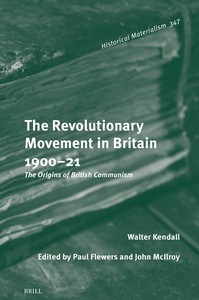
The Revolutionary Movement in Britain 1900–21. The Origins of British Communism. By Walter Kendall. Edited by Paul Flewers John McIlroy. Brill. 2025.
This is a reprint of a work first published in 1969, now with a 50-page foreword and a new index. We reviewed this at the time of its first publication so all we need to add is more detail on Kendall’s derogatory remark about us and to comment on McIlroy’s foreword.
Kendall wrote that the SPGB was ‘unwilling to enter the political fray even to the extent of adopting a programme of “palliatives”’. This is a peculiar understanding of the term ‘political fray’ but it let slip what Kendall, a left-wing Labourite, thought that politics was all about — what measures to adopt within capitalism to try to mitigate the problems it inflicts on the working class. The SPGB did most certainly enter the ‘political fray’ in its normal sense of political battle, even to the extent of standing candidates in local elections during this period.
Kendall was also being disingenuous as the SPGB was not the only party he discussed that took this position. The DeLeonist Socialist Labour Party (SLP), which was the other product of the ‘impossibilist revolt’ in the Social Democratic Federation, was also unwilling to adopt a programme of palliatives. Yet Kendall devoted a whole chapter to them and argued against this position (‘barred as it was from any advocacy of reform, the SLP was unable to make contact with the mass of the working class’) rather than dismissing it peremptorily as not part of the political fray.
McIlroy, in his foreword, discusses the validity of Kendall’s conclusion that the founding of the British Communist Party, thanks to the machinations of the Comintern and ‘Russian gold’, was a mistake and had a harmful effect on the working class movement in Britain. As a Leninist himself (subspecies, Trotskyist), he argues against this and speculates that things would have been worse had the CPGB not been formed. But one thing did happen. The SPGB did survive and from the 1920s onwards provided a Marxist criticism of the Leninist distortions and undemocratic practices (as well as the Voice of Moscow) that the CPGB introduced into the working class movement and which represented a step backwards. On this point Kendall was right.
ALB
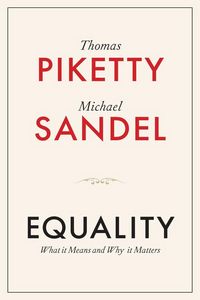
Equality. What It Means and Why It Matters By Thomas Piketty and Michael Sandel, Polity, 2025. 119pp.
‘‘Why should a hedge fund manager make 5,000 times more than a teacher or nurse, or for that matter a physician?’ (Michael Sandel)
This short book is the record of a public discussion between two well-known ‘left’ academics. Social and economic historian Piketty is author of the much discussed Capital in the Twenty-First Century (see review in this journal), while Sandel is a prominent ‘public intellectual’, who has written books on what may broadly be called political philosophy. The book is divided into a number of chapters with titles such as ‘Why Worry About Inequality?’, ‘Should Money Matter Less?’, ‘The Moral Limits of Markets’, ‘Globalization and Populism’, ‘Meritocracy’, ‘Borders, Migration and Social Change’ and ‘The Future of the Left: Economics and Identity’.
Though presented as a kind of debate, both participants tend to agree on most things. In particular, they both seem convinced that the current social and economic system, capitalism, can be reformed in such a way as to make things significantly more ‘equal’ than they are at present. Piketty points to how, over the history of capitalism, vast swathes of people have seen their conditions of life greatly improve. And we can agree: even in the nineteenth century, in the system’s relatively early stages, this is something which Marx, for all his insistence on capitalism’s inevitable inequalities, observed as an ongoing reality. In this connection Piketty mentions, for example, the abolition of slavery, universal suffrage, decolonisation, increasing gender and racial equality, the welfare state, and higher living standards for many.
The way forward from this, according to both discussants, is even greater equality. They do not view this as lying in the ‘neoliberal’ turn capitalism has taken since the 1980s which has seen an increased proportion of total wealth owned and controlled by the richest, but in governments levying swingeing taxation rises on the wealthiest (‘80-90% on income and profits’) and being more active in implementing ‘a fuller development of the welfare state’. This, rather than ‘uncritically embracing the market faith’ as they see recent Western governments as having done, will assure a more equal (or at least less unequal) distribution of wealth and give more people access to the goods and services which will allow them to have comfortable living standards. The aim, Piketty argues, should be an economy that is ‘99% decommodified’, by which he means extensive government ownership and control of the means of living, and one which, Sandel asserts, will also lead to ’greater equality of recognition, honor, dignity and respect’.
It would be churlish not to acknowledge the well-meaning nature of the two commentators’ wish lists, their support, for example, for ‘more investment in health and education, higher progressive taxation, curbing the political power of the rich and the overreach of markets’ (Sandel). Unfortunately, however, these do not stand up to close scrutiny. While capitalism, with its ‘growth at all costs’ compulsion, may continue to improve living standards for many on the planet overall, governments simply cannot create anything resembling equality among those who live under that system, since their prime purpose is to manage it in the overall interest of the minority who monopolise the wealth. Different governments may of course have different approaches to this, in the degree of central control they exercise, for example, but, so long as the overall framework of money, wages and salaries, and buying and selling exists, they will always – and inevitably – find themselves trying to keep afloat a system founded on producing goods and services for a profit.
At one point, one of the discussants (Piketty), who claims to stand for ‘democratic, federalist, and internationalist socialism’, seems to come close to suggesting the society of free access that socialists advocate. He talks about a situation in which ‘99% of goods and services, like education and health, are freely accessible’ and ‘you only have 1% left commodified’, advocating ‘a system outside monetary logic and the profit logic’. Yet he comes out the other end still failing to see beyond a monetary economy, and in the end it becomes clear that what he is hoping for is a form of capitalism with a less unequal distribution of wealth and income and a more extensive welfare state (or ‘social state’, as he calls it) than exists at present. It also becomes clear, in the end, that the discussion between the two figures is one about old-fashioned reformism, about the extent to which it is possible for capitalism to ‘narrow’ the pay gap between one worker and another and the wealth gap between workers and capitalists. It is not about achieving the absolute economic equality that will characterise a society of voluntary cooperation and free access to all goods and services – the society of the future that we call socialism.
HKM