
Spain: The ‘Maricarmen’ Effect
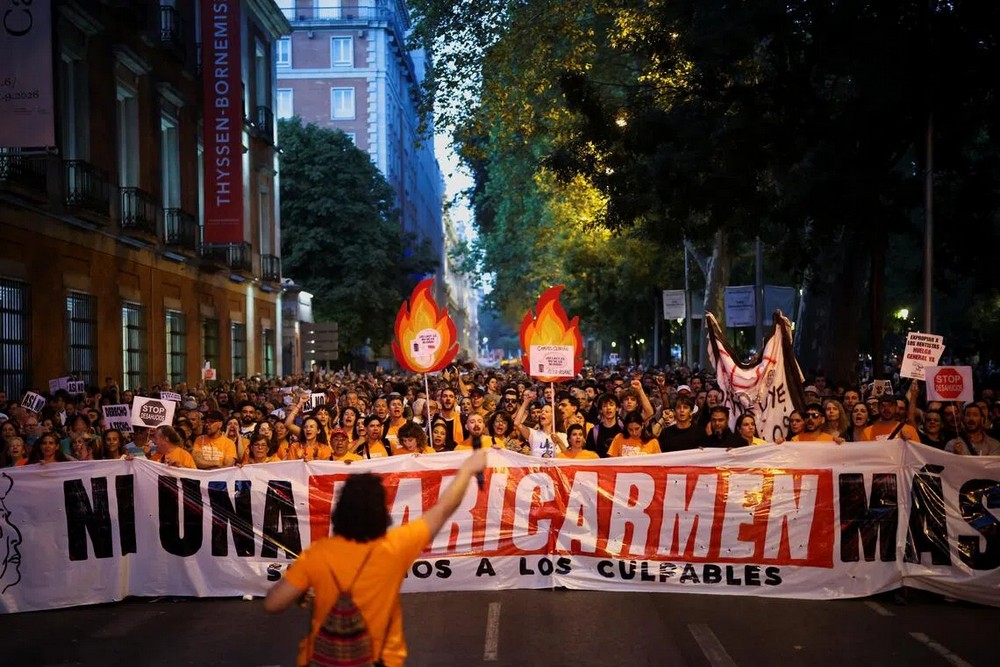 On 7 October this year, an elderly woman, María del Carmen Abascal Martín (‘Maricarmen’), died in Madrid’s Gregorio Marañón Hospital. She was 87 when she died and, for a short while, unintentionally became the centre of a political firestorm that has engulfed Spain. Not just Spain but far beyond.
Indeed, her case has attracted global attention. She became a symbol of growing anger over Spain’s housing crisis. The problem isn’t just the rising cost of buying a home (last year, house prices rose at three times the rate of wages) but also the rising cost of renting.
These two aspects are interconnected. Currently, 73 per cent of Spaniards own their homes (down from 80.6 percent in 2007). Yet, paradoxically, while Spain has among the highest levels of homeownership in Europe, it is also among the worst affected by the housing crisis.
When a growing number of people can’t buy, demand for rental properties rises, and so do the rents tenants pay. Unsurprisingly, more than half of 18 – 34-year-olds in Spain now live with their parents or depend on them for living costs.
Maricarmen’s case was somewhat atypical. She had lived in the same flat in Madrid’s Retiro district for 70 years, a relatively affluent part of the city. The original tenancy agreement (a ‘renta antigua’ or rent-controlled lease) was signed by her father in 1956. After a succession of inheritances, the building in which her flat was located was eventually purchased in 2018 by a real estate investment firm called Urbagestión.
The firm then sought to raise her monthly rent from around €500 to a mind-boggling €2,650 for what is a modestly sized apartment. The figure was later adjusted to €1,650, but even that exceeded Maricarmen’s pension income of about €1,350. After she contacted the Tenants Union, the landlord made four eviction attempts beginning in the autumn of 2025. The first attempt was suspended after a large neighbourhood mobilisation. Two more attempts occurred in the summer of 2026 but also failed due to mounting public pressure, with even the United Nations calling on the evictions to be halted (El País, 8 October).
The fourth and final attempt to evict her on September 23 proved successful, despite hundreds of people spending the night outside her apartment to offer resistance in the face of a significant police presence. Maricarmen was carried out on a stretcher and taken to the hospital, where she later died.
The protests that subsequently erupted throughout Spain have been enormous. Waves of demonstrations have swept many cities, and tent encampments have sprung up in places like Madrid’s iconic Puerta del Sol square.
The despicable callousness shown towards this single frail old woman seems to epitomise so much of what is wrong about present-day society and its twisted priorities.
As one might expect, politicians on both the Left and the Right have cynically jumped into the fray to make political capital out of it. The Sánchez government, no doubt trying to leverage these developments to stem the decline in its popularity, particularly since the Ceuta crisis, hurriedly sought to introduce two bills to tackle the housing crisis. The opposition PP and the far-right Vox party voted against these measures and, with the help of the business-friendly Catalan nationalist Junts party, succeeded in having them quashed.
A clue as to the opposition’s motives for doing so is provided on the France 24 website (2 October):
‘Friday’s defeat increases pressure on Sanchez’s minority government and could intensify opposition calls for an early election. The leader of the far-right Vox party, Santiago Abascal, said earlier Friday that “the sooner elections are held, the better”’.
If the intention was to force an election, the Right succeeded, and Sanchez subsequently decided to hold a snap election on 29 November. At this point, and despite the Right being ahead in the polls, it is difficult to say whether its political manoeuvres might not backfire, given the level of public outrage the housing crisis has generated.
Structural problem
But, in a sense, what politicians do or say matters little. The roots of the problem run much deeper than any legislative measures can reach or effectively address. The housing crisis is a structural, or systemic, problem.
According to Al Jazeera (7 Oct):
‘Spain has a deficit of about 750,000 homes, which is set to grow to more than a million by 2028, according tothe Bank of Spain. The average rental price of 1,176 euros ($1,315) is equivalent to about 98.7 percent of a young person’s average monthly salary in Spain, Youth Council of Spain figures show’.
The percentage of people spending more than 40 percent of their disposable income on housing costs is significantly higher in Spain (28.1 percent) than the European Union average of 19.2 percent. As Ashifa Kassam notes:
‘It was, as newspaper El País said in an editorial, a glimpse of a housing market that had become completely unmoored from the average income in Spain, as rents rose 80% in a decade, while the cost of homes had climbed by 63%. “The law was upheld, and the market worked. But it is the law of the jungle in a broken market, and it is a failure”’ (Guardian, 27 September).
However, when we talk about a ‘deficit of 750,000 homes’, we should remember we are looking at this issue from a market-based, commercial perspective. In reality, there is no deficit; in fact, the opposite is true. In a recent press release dated 30 June 2023, the National Statistics Institute (INE) revealed that ‘according to the consumption of electricity in a full year, 3,837,328 dwellings were classified as empty and 2,514,511 as occasional use’.
This data comes from the 2021 Population and Housing Census. Needless to say, there are many other vacant non-residential properties, such as offices, shops, and even warehouses, that could be converted into habitable dwellings but are not included in the statistics. So we’re talking about a market-driven shortage, not an actual shortage. There are a number of factors that might account for this.
One is geography. Drive through Spain, and you will be struck by the enormous contrast between the bustling cities along the coast (Madrid being a notable inland exception) and the near-empty interior. Population densities in some places are extremely low — as low as parts of the Sahara, in fact.
Since Franco, increasing urbanisation and industrialisation have exacerbated this contrast. Over 3,000 villages in inland Spain stand abandoned. Small farmers struggled to make a living, and changing weather patterns worsened their plight. It’s no surprise that more and more people left the countryside because of poverty and better job prospects in cities.
Another factor is tourism. Spain is the second-largest tourist destination in the world, behind France, and the growing tourism industry has significantly affected the local housing supply. Many properties have been converted into short-term rentals and Airbnbs. As elsewhere in Europe, this has given rise to protests against ‘overtourism’, particularly since 2017.
Yet, another factor is the continuing fallout from the 2008 crisis. Before that, Spain experienced a frenzied construction boom fuelled by easy credit. When the bubble burst, many developers went bust, leaving a trail of empty or half-completed projects, particularly along the Mediterranean coastline. Residential building is far more modest these days, partly because planning permission tightened up after the 2008 crash but also because the developers are more cautious. Shortages exist, particularly in areas experiencing an influx of newcomers. Despite Spain’s declining birth rate, the population continues to grow because of migration, with most immigrants heading to the big cities.
Some suggest that, to overcome this housing shortfall, more so-called public housing should be built. In Spain, only 1.2 percent of the housing stock is ‘publicly owned’, according to the OECD, far below levels in countries such as Britain, France and the Netherlands. Since the Franco era, Spanish housing policy has emphasised home ownership over public housing. The reluctance to provide more of the latter has been compounded by Spain’s highly decentralised political system, with responsibility divided among the central government, autonomous communities, and municipalities.
 Corporate landlords
Regarding privately rented properties, Spain’s Ministry of Consumer Affairs published a report in April 2026 showing that landlords with multiple properties, legal entities, and public entities together held about 61 percent of the habitual rental market, while landlords with just one rental property accounted for around 39 percent.
In Maricarmen’s case, the former type of landlord was involved. The share of rental properties owned by corporate landlords such as private equity funds is increasing, but still quite low. Most private landlords are individuals who own one or more properties.
Much has been said about the role of ‘vulture funds’ in the housing crisis, but in reality their role has been mainly limited to hotspots like Madrid and Barcelona. Critics argue that such funds have bought properties cheaply and pursued evictions more aggressively than smaller landlords. Supporters counter that without corporate investment, tackling the alleged housing shortage would be harder. They say investors will be deterred from building projects if they have to contend with too much bureaucratic red tape and overly restrictive regulations.
Indeed, this was one pretext for why various right-wing parties decided to vote down the two housing bills the Sanchez government put forward. The bills aimed to ensure rental contracts automatically renew when they expire as well as restrict the eviction of vulnerable tenants.
The Junts party, for instance, argued that it was unreasonable to lump small landlords who depend on rental income together with large real-estate companies. They suggested this could have ‘negative and irreversible’ effects. Some properties could be withdrawn from the rental market or converted to holiday rentals, to the detriment of tenants.
The bills also targeted corporate investors seeking higher returns. As Kassam notes:
‘The head of one of the country’s biggest labour unions called for investment funds to be “kicked out” of the housing market. “Homes are for living in, not for large corporations to do business,” said Unai Sordo of the Workers’ Commissions (CCOO) as he called for a tax system that would make “the business of hoarding homes unprofitable”’.
Who could possibly object to the idea that ‘Homes are for living in, not for large corporations to do business’? The problem, however, is that we live in a capitalist society, with all the moral hazards and dilemmas it creates.
Ultimately, it’s nearly impossible to isolate one part of the system from another. Everything is connected. Directly or indirectly, the repercussions of a capitalist cost-benefit calculus will filter through to affect our lives and the homes we live in.
It’s a bit like water finding its own level. Like the mould that returns every winter, we cannot insulate ourselves from the consequences of living in a society where most things, including our homes, are commodified. We may think of our home as our castle, but even castles can be repossessed by the bank if push comes to shove.
As Friedrich Engels put it in 1873:
‘The housing shortage from which the workers and part of the petty bourgeoisie suffer in our modern big cities is one of the numerous smaller, secondary evils which result from the present-day capitalist mode of production’ (The Housing Question).
Such an observation remains as relevant today as it was back then, 150-plus years ago.
ROBIN COX