
Capitalism is not freedom
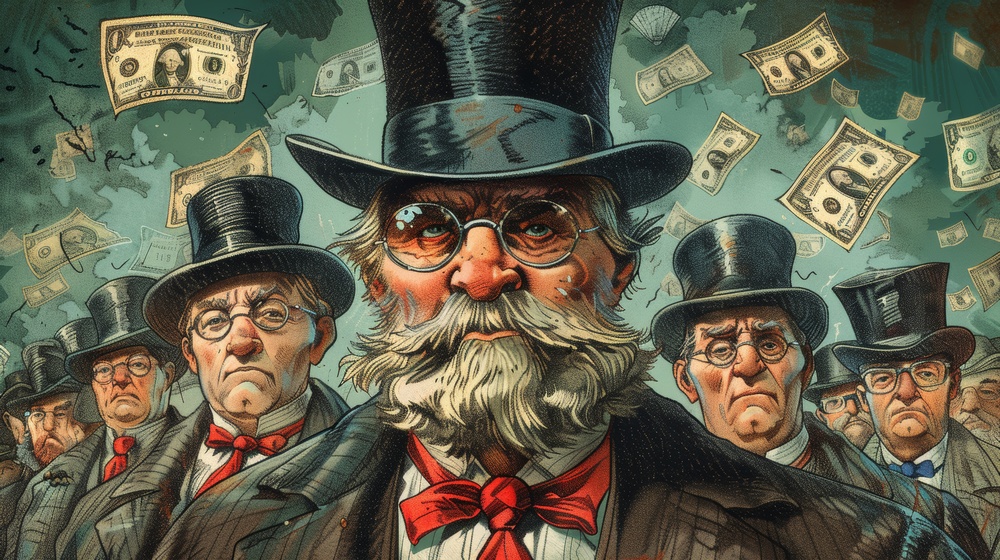
The ideology of capitalism as freedom only ever made sense when it was contrasted with the brutal and oppressive laws found in feudalism or slavery. However, there was no reason why private ownership had to persist as an institution once forms of democracy were accepted and established throughout much of our social organization. But private ownership was confused with invention, entrepreneurship, and innovation. At no point were inventors with capital able to magically realise their dreams by their genius alone, but instead they required an army of workers ready to execute them. This confusion was the beginning of unnecessary complexity in our society, and the perpetuation of a society, as with earlier class societies, that did not prioritise human needs, in contrast with the avowed intentions of scientists.
Although capitalist apologists insist that the market system is best at meeting needs, they are merely persisting in this confusion out of a redundant identification with ideology. For every great idea there is almost never accompanying capital to realise it. Once an idea is married to capital investment, it suddenly takes on a commodified form, owing to its embodiment of not just use-value but also exchange-value, further and further distancing itself from meeting needs. Suddenly, this imagined, drafted, and then built object must be concerned with such features as how to entice consumers, how to package it, how to save money, potentially making it shoddier. Such concerns are not the priority of the innovator or inventor. We live today in a mad society with this increasing distance between needs and commodities which has propped up irrational, wasteful and disquieting complexity. Instead of the aforementioned concerns, production criteria should be asking more rational questions. Will it be safe? Will it be healthy? Will it last as long as possible? Can the parts be recycled? Can the parts be standardised with other producers elsewhere? Might it be both useful and beautiful?
The marriage of industrialism to the market economy led to the continued division of humanity into economic classes. It also condemned industrialism to serving the aims of whatever political regime might develop, such as the destructive goals of its military, which presumably led to scientists abandoning their fields’ hallowed ethical and pro-social standards.
Not all of capitalism exists with a liberal democracy. Much of it has persisted and still persists under autocratic rule, under welfare states with oppressive governments, under religious rulers who continue to keep children believing in the invisible and impossible while at the same time churning out advanced machines such as cell phones and automobiles. Because this society is inherently unstable owing to its market nature, tending to sudden changes in commodity prices, availability, quality, and affordability, it leads political activists of all shades to exploit such instability to further their identified interests. Thus, society at the cusp of developing mass production began also to mass-produce ideologies that have divided humanity to the point at which, today, adherents of one are ready to murder the other either by hand or by vote.
Being wedded to an ideology entails an emotional identity with an idea, doubtlessly constructed out of varied biases and woven pretty tightly into a personality. A liberal, fascist, leftist, theocrat, military ruler, or a conservative is a human being overly identified with values and beliefs that become justified through a delusion of varied intensity. Ideologies are similar on the psychological level to commodities, possessions, inasmuch as they beckon for your consumption, and weave us into complex and appetitive webs from which our own minds and lives will be consumed. They also yearn for exchange. They make it difficult to understand the whole, to follow evidence, or to find the way out.
A human failure to reinforce values of reason, equality, and progress through the community standing together to put industrial civilisation at the behest of all humanity has led today to levels of confusion among workers that are pitiful and depressing to encounter. Just as capitalism led to a vast complex infrastructure that was completely unnecessary for the progress of humanity — its banks, insurance companies, advertisers, state departments, and armies — all of which consume vast planetary resources, so the thoughts and emotions of humankind must also in this era be dominated by highly complex and completely unnecessary political ruminations about ‘preventing the communists,’ ‘protecting the family,’ ‘standing behind God,’ ‘keeping out the immigrants,’ or ‘protecting/dominating pregnant women.’ Ideology has become as significant in our psychology as commodity production. We all take our stances, we all stand for something, we are always angry, we never make things better.
In the United States the worthy goal of fighting racism or sexism on campus must violate free speech and prevent even moderate thinkers from speaking and teaching, with billions of dollars in grants distorting real science to support a social justice ideology. Capitalist ideology is by nature sneaky and divisive, locking our minds into a quasi-reality from which it is difficult to escape, and which always distorts. It has the power to split your family, your sense of belonging to your community, your very mind. Truth itself is under scrutiny by post-modernists. Society finds itself more and more impossible to understand. We live in virtual universes at the very time when we need to more and more defend the earth and all the creatures we share it with. In short, it’s time to get real.
All of this is because of a failure to abolish capitalism in an earlier phase, which was clearly a realisation that entered a vast number of heads in the 19th century, partly in response to the writings of Marx and other anti-capitalists, but also in response to a growing body of workers organising for a new world. Though philosophising about it, they were far too naive about ideology. The socialists of the 19th century did not sufficiently promote the essential features of a socialist society, nor did they rail adequately against the reformist ideas that were to lead to the Australian Socialist Party of 1899, the UK Labour Party of 1906, the French Guesdists of 1902, the Russian Bolsheviks, and so many more pseudo-socialists. Except among a very few small organisations such as the SPGB and some anarchist-communist groups, revolutionary thinking turned reformist, yet still referred to itself as ‘socialist’, ‘communist’ and ‘Marxist’. The rest, we may say, is history. Perhaps there was insufficient history back then to support the hypothesis that all reform would only perpetuate our servitude to power, bosses, money, and the state.
With our planet arguably dying, it is hoped that a new generation will finally put an end to reformist thinking, although there are few solid signs of that at this time. What is required is the formation of groups in every town and city of the world standing for one thing: the ownership of the means of production in the hands of a democratic community, a refusal to reform capitalism, knowing from history that it cannot be reformed, an end to money and exchange, and a replacement of the commodity with objects and services with only use-value. This must be done in a manner that promotes freedom and community, overcoming the hierarchy and rule of despotic governments. We call also to all parties using such words as ‘Worker’, ‘Socialist’, ‘Communist’, and ‘Marxist’ to transform their parties only into organs for the actual abolition of money and the state, for the conversion of their platforms to those advocating the abolition of the wages system. Only its abolition is truly socialist or communist, and only its abolition will deliver humanity from a world in which the community is prioritised, to a world where needs come first. Any other goal makes a mockery of their name.
DR WHO
Next article: Cooking the Books 2 – No reformism in one country ⮞