
Book reviews – Budd, Cox, Sayle
 Class Divisions
Underdogs: the Truth About Britain’s White Working Class. By Joel Budd. Picador £10.99.
By working class here is meant those who fall into the census groups of lower supervisory and technical occupations, semi-routine and routine occupations and long-term unemployed (this covers 40 percent of adults, and includes jobs such as baristas, gardeners, bricklayers, chefs and shop assistants). People count as white if that is how they see themselves or how most people would see them. But ethnicity, it is said, is not a stable characteristic, and people born in Ireland or with recent Irish ancestors, can be described as Britons.
Budd investigates white workers by means of statistical studies and his own visits and interviews, which were overwhelmingly done in England and Wales. Three main kinds of area are distinguished. Heartlands, such as Rhymney in south Wales, have very high proportions of white workers who are mostly quite old. Wythenshawe is an enclave, a large council estate on the edge of Manchester and ‘an example of deep poverty in a pleasant setting’. Thetford in Norfolk is a colony, settled by white working class people from elsewhere (mainly London). The three types are not mutually exclusive, and Edlington near Doncaster is a mixture of a heartland and a colony, mainly white but with people who have come from all over England and Ireland.
The book contains a number of interesting points. For instance, poorer white British children generally do very badly at school, while better-off kids do fine. Poorer children can have high aspirations in terms of education and career, but lack high expectations. Few people expect to move for a new job, and young people from poor places usually stick around, so Britain is now ‘a nation of stayers-at-home’. Moving to a new city or town can be expensive and the rewards are not obvious.
Attitudes to immigration are determined not so much by class as by age, as ‘young white working-class Britons … are largely unbothered by immigration and ethnic diversity’, seeing diversity as ‘a fact of life’. Class (in the sense used here) does not indicate how a person will vote but whether they will vote at all, with poor people less likely to vote. White Britons have largely ceased voting Labour, but this change applies less to black and Asian Britons.
One informative section deals with the Lithuanian community in Boston in Lincolnshire. Agricultural work in Fenland is badly paid, and much of it is now done by immigrants from Eastern Europe. A community organisation teaches English to migrants and Lithuanian to their British-born children. The children have an accent that is ‘part Lincolnshire, part Multicultural London English’. More generally, language skills can vary by gender, with Polish women speaking decent English if they work in industries such as care and hospitality, while men often work on building sites with other Polish speakers and so their English is much less good.
An informative look at part of the British population, but without placing it within the general social structure of the UK.
PB
 What Comes Next? Why Our Society Needs a System Upgrade. Volume 1: The Illusion of Money. By Robert Everett Cox. 2026. 326 pp.
This book, the first in a 3-volume series, presents a detailed explanation and critique of the capitalist system. It delves into various different views on the origins and rise of capitalism and the impact that system has had, and continues to have, on people’s lives. Its four chapters, each divided into various parts, are entitled ‘Why Work?’, ‘The Wages System’, ‘Abundance Thwarted?’ and ‘For Richer or Poorer’.
It is difficult to do justice in a single review to the breadth and intricacy of the investigation the author conducts, characterised as it also is by multiple references to the contributions of other writers and researchers. It may be useful, however, to pick on certain aspects that this reviewer found especially striking for the way they illuminate certain widely discussed topics whose implications are often incompletely understood and rarely taken to their logical conclusion.
The first one of these, which spans the volume and is interrogated with admirable clarity, is the ‘two-class’ case advanced by socialists, ie that society is divided between the tiny minority who own most of the resources and wealth in society (capitalists) and the vast majority who don’t (workers). Among the objections often raised to this view is that, since not everyone falls neatly into either of these categories, it does not reflect the reality of things. The author’s response to this is a frank and simple admission that such a picture of society is indeed ‘a simplification, a generalisation’, but that ‘making generalisations is unavoidable if we want to see the wood for the trees as far as understanding society is concerned’. More precisely: ‘A capitalist may be loosely defined as someone who possesses sufficient capital to comfortably live off the proceeds of investing that capital. This should not be confused with a self-employed worker; however hard-working, entrepreneurial and frugal such a worker may be. The latter does not possess sufficient capital to qualify as a capitalist and therefore still depends on working to obtain a living, like other members of the working class’.
Secondly, the much debated subject of ‘financialisation’ of the capitalist economy (‘making money out of money’), the ‘fictitious capital’ associated with it and how that relates to capital invested in the traditional production and distribution of goods and services is examined in a way that sheds far more light on the phenomenon than this reviewer has previously found and is also linked in innovative fashion to Marx’s ideas on money, credit and surplus value. Ultimately, the author tells us, we should not be surprised by the manifold forms that capitalism’s drive for profit may take, since ‘like some hydra-headed monster of Greek mythology, it grows a new head as new circumstances dictate’.
Next, there is ample discussion of what the author refers to as ‘capitalism’s structural waste’. Most people are aware that a good many of capitalism’s technological advances, rather than being used productively to better the human lot and create the abundance modern technology is capable of, are directed instead into activities that make life more complex, more insecure or more perilous the world over. Here we are talking about, for example, increased bureaucracy, the sales and advertising industry, and preparation and waging of war, which absorb the time, effort and mental and physical energies of so many of the working population. This ‘progress perverted’ phenomenon is, of course, widely understood, but rather than just lament the waste associated with it, the writer is not afraid to refer to the whole world of ‘commerce, finance and retailing’ as ‘socially useless industries’, and then to take it further by analysing and putting an actual figure on the ‘wasted labour’ all this represents (50 percent). His incontrovertible explanation for this is that ‘Under capitalism, generally speaking, technological innovations tend not to be taken up and developed if there is no prospect of making a profit by doing so’.
A final example, among many, of the issues this volume addresses in a novel and thought-provoking way is the futility of proposals or attempts to reform capitalism in the interest of workers. It dwells, in particular, on the advocacy by many of Universal Basic Income (UBI). In a section entitled ‘The UBI Panacea’, it explains in entirely credible fashion how automation and AI are unlikely to drastically reduce the number of jobs any more than previous major technological developments have and so are unlikely to cause what John Maynard Keynes wrongly foresaw as ‘a new disease … namely technological unemployment’. It follows from this, the author goes on to argue, that UBI policies by governments will not be needed, since dire want among the mass of workers owing to unemployment will not come to pass. As for UBI as a solution that governments could adopt anyway to deal with the structural unemployment caused by capitalism or simply to try and equalise spending power among workers, he points to the impracticality and potentially disruptive nature of this on a plethora of different levels whatever the model proposed. A hypothetical example given is of a government conceiving and trying to bring in UBI as a measure that ‘provides everyone with the same lump sum, which they receive on top of their income, earned or unearned’.
Such samples of the issues addressed in this volume may give an idea of the breadth with which it covers a wide range of other areas, eg, the ‘human nature’ argument, the ‘fake’ socialism of Lenin and the Bolsheviks, the nature and causes of inflation, ‘the penetration of money into every aspect of our lives, the continued validity of Marx’s analysis of capitalism, the concept of ‘relative poverty’, the vast disparity of wealth ownership between workers and capitalists. It also offers a small taste, if only a taste, of the ‘What Comes Next?’ of its title, ie the alternative system of society the author sees as necessary to replace the one investigated here. This alternative is summed up as ‘a post-capitalist society when employment (and hence “unemployment”) would cease to exist and when money would no longer be required to access the goods and services we need’. How this characterisation is followed up and fleshed out in the further 2 volumes of What Comes Next (‘Beyond the Price Tag’ and ‘A Sharing Society’) will be discussed in reviews of those in future editions of the Socialist Standard.
HKM
 Marching backwards
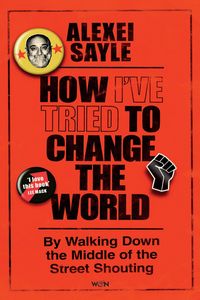
How I’ve Tried To Change The World. By Alexei Sayle. Weidenfeld & Nicolson, 2026. £16.99
This is the third of Sayle’s entertaining autobiographical meanders and is subtitled ‘… By Walking Down The Middle of the Street Shouting’. Instead of a straight autobiographical approach to the more recent decades of his career, stand-up comedy’s greatest ever shouter has instead chosen to focus on his political activity and this is the thread everything else revolves around. To an extent it works, though it is also a catalogue of failure and frustration, as he largely admits.
His parents were stalwarts of the old Communist Party of Great Britain but the young Alexei moved on to the Communist Party of Britain (Marxist-Leninist), a Maoist outfit he tired of over time and whose internal atmosphere and membership behaviours he has bemoaned, arguing they could learn a lot from some of the practices of Alcoholics Anonymous. Since then, he has been a supporter of most leftist causes from the late 60s, often prominently so. In recent times he has been especially animated by the atrocity in Gaza and appears to have fallen out with a number of friends over it, including others – like him – of Jewish heritage.
As he recognises, ultimately much of this political activity has been futile, though he clearly had his hopes of something bigger and more successful rekindled by the rise of Jeremy Corbyn when he was Labour leader. This soon went the same way of course, though he seems to downplay the inherent contradictions in the Corbynite position (which was always focused on delivering rhetoric on behalf of the oppressed – while never really challenging the capitalist system of markets, profits and competing nation states that creates the oppressed in the first place). As a great supporter of the Palestinian cause, Sayle also underplays the tendency of Corbyn and his allies to focus on single-issues and rely on the belief that an enemy of an enemy must somehow be a friend, often in a way that has demonstrated a huge degree of political naiveté.
Sayle, however, does show some real lucidity at times which is memorable (as he always does in his stand-up and radio shows). Here he is writing about the Arab Spring when mass movements threatened to topple – and often did topple – a series of Middle East dictatorships:
‘There is no greater argument than the failure of the Arab Spring for leaders of protests needing to understand that they absolutely have to possess a political ideology. For them to have adopted socialism or Marxism or anarchism, this providing a way to bring structure to the act of rebelling. For them, in fact, to have a code. Otherwise, you risk your protest ending up like the Black Lives Matter rallies which went from a visceral outcry against state brutality to players occasionally kneeling before a football match for fuck knows what reason’ (p.147).
Elsewhere Sayle also says that he regards Marxism as the best way available of understanding the world around us … even if it won’t necessarily make you happy! Cheers, Alexei.
DAP