
The Fabian Society again
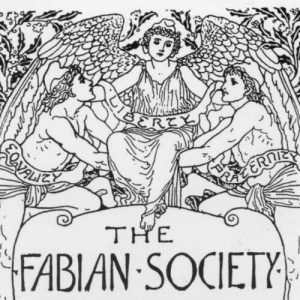 Around the end of 2025 social media was full of howling comments about ‘Fabians’ and how an insidious conspiracy was spreading through society, in the form of ‘Fabians’ who were undermining ‘our institutions’.
The reason was a judge in the Epping hotel case who, in August that year, ruled against the government and had been a member of the society. Suddenly, the internet was full of how this 140-year-old organisation was hell-bent on a secretive mission to undermine the nation state and implement socialism.
The claims are that not only are most of the cabinet Fabians, but also people like the judge and prominent staffers at the Bank of England. The implication was that they are ‘controlled’ as if the Fabians were a secret society.
The Fabian Society is actually quite open. Its website advertises it as one of the world’s oldest think tanks, but it is also a membership organisation:
‘The Fabian Society consists of socialists. It therefore aims for a classless society, where a just distribution of wealth and power assures true equality of opportunity. It holds that society, through its democratic institutions, should determine the overall direction and distribution of economic activity and seeks to promote where appropriate the social and co-operative ownership of economic resources’.
But, as the rulebook also notes: ‘The society as a whole shall have no collective policy beyond what is implied in rule 2; its research shall be free and objective in its methods’.
Formed in 1884, it took its name from the tactics of the Roman General Quintus Fabius Maximus Verrucosus (nickname Cunctator, the ‘delayer’). He beat Hannibal’s superior forces by avoiding frontal assault: grinding his opponent down. This became the metaphor for the gradualist approach the society hoped to implement.
An earlier form of its rules stated: ‘The society seeks recruits from all ranks, believing that not only those who suffer from the present system, but also many of those who are enriched by it, recognise its evils and would welcome a remedy’. That is, advancing by appealing to the powerful.
Its early coat of arms was a wolf in sheep’s clothing: since abandoned for its obvious negative connotations, but dug up gleefully by the commentators as a sign of the conspiratorial nature of the society.
Its Wikipedia page notes that 174 entries in the Dictionary of National Biography are listed as Fabians, a sign of the number of prominent people who have belonged to the society. Currently, its executive committee has five MPs, so it is definitely well connected. It has 6,000 members, and seven affiliated trade unions.
The right-wingers have latched onto the eugenicist associations of the early society: many of the original members did believe in eugenics, this was in keeping with a science-oriented approach that saw society being fixable through rational if authoritarian organisation, rather than through human freedom. It might seem strange that right-wingers, normally attracted to such ideas, should condemn this, but in part this is down to the stigmatisation of eugenicist ideas, and partly the right’s adoption of fears of dystopian ‘fifteen minute cities’ and World Economic Forum domination.
They are correct that Blairites in the 1990s used to talk of a hegemony strategy: staying in power long enough to become the establishment by filling posts with like-minded individuals. We’ve written in these pages before how apparently natural networks of the old ruling class (public school, university, clubs, professions) provided a basis for trust and collaboration, and outsider networks, like the Labour Party, the Fabians, Labour Together, the British American Project and the like are built up to replace those networks.
This replaces the ‘natural’ establishment with consciously political appointments (in itself a good thing) but this opens up a partisan tit-for-tat, as the last Tory government began to swiftly and openly remove Labour appointees in favour of people of their own ilk.
The central flaw in the Fabian strategy is that albeit, as H.G. Wells put it, an open conspiracy, it addresses itself to the powerful, and achieves its advances despite the consciousness of the public.
As Engels put it in 1892:
‘The means employed by the F[abian] S[ociety] are just the same as those of the corrupt parliamentary politicians: money, intrigues, careerism. That is, English careerism, according to which it is self-understood that every political party (only among the workers it is supposed to be different!) pays its agents in some way or other or rewards them with posts. These people are immersed up to their necks in the intrigues of the Liberal Party, hold Liberal Party jobs, as for instance Sidney Webb. who in general is a genuine British politician. These gentry do everything that the workers have to be warned against’.
As the years have gone by, the end goal of socialism has been eased out, in favour of diffuse reforms to capitalism as an end in themselves. Far from being a sinister conspiracy to end capitalism, it is just a career path and training ground for the soft-left. To that end, they are a normal, if mistaken, part of the legitimate democratic social ecology.
What is interesting is that by casting them as a sinister conspiracy, right-wing commentators are delegitimising them, casting ‘the left’ as some sort of alien goal to destroy society, that will need to be swept out. This would be the response of the powerful to a hegemony strategy: openly exercising power to shore up their position.
We have always stood against the Fabian gradualist strategy, as reforms only attract people interested in the reforms themselves, they do not build the case or support for socialism. And enacting supposedly socialistic reforms irrespective of workers’ views is a recipe for confusion and resentment.
We continue to insist that only the active self-organisation of the working class, the vast majority of the population, can bring socialism into being: if we had a coat of arms, it would be a human in human clothing, because that is the only thing that will build socialism.
PIK SMEET