
Proper Gander – Manipulated by the Monoform
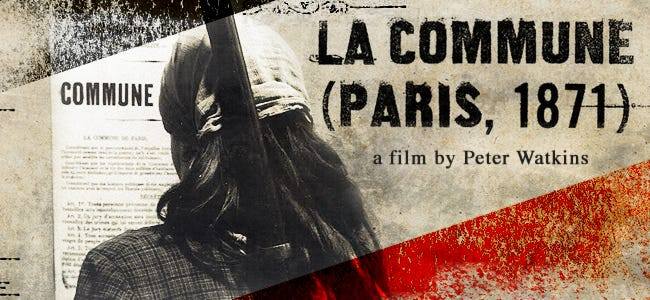
The mass media is a ‘systematically organised, one-way path from the producer to the spectator. Constantly. Constantly. And that is not communication. We should try and find some other word for it. And it’s certainly manipulation’, according to film-maker and theorist Peter Watkins, who has died at the age of 90. His words come from a 2001 video interview following the release of his film La Commune, through which he aimed to use the medium of film-making to communicate, rather than just present one interpretation. The film re-enacts the Paris Commune of 1871 and was made in a less hierarchical, more democratic way than found in the mass media’s usual output, by having non-professional actors improvising scenes and shown discussing the views of both their characters and themselves.
La Commune was the last film Watkins made, after which he honed his theories about how the media industry functions for his 2004 book The Media Crisis. His films, in one way or another, focus on conflict between states and between classes. Their subject matter includes nuclear war (The War Game, The Journey), oppression of political activists (Punishment Park, Evening Land) and historical flashpoints (Culloden, La Commune). His two productions of the late 1960s, Privilege and The Gladiators, share the theme of the elite using the media to divert and channel working class dissent. These films employ a setting of the near-future to examine this, while his theories about film-making investigate how this happens in real life.
Watkins argued that the mass audio-visual media (MAVM) industry moulds the reactions of its audience through the style and arrangement of its products. He called the prevailing template for films and programmes the ‘Monoform’. This is defined as ‘a formatted and repetitive TV language form of rapidly edited and fragmented images accompanied by a dense bombardment of sound, all held together by the classical narrative structure’ (Notes on the Media Crisis, Peter Watkins, 2010). This is a familiar description of dramas and documentaries with predictably linear plots, scenes too short to explore details and mood-accentuating soundtracks. This style is particularly noticeable in the common practice of documentaries starting with a quick summary of the programme to come, reducing what could be a complex subject into a couple of minutes (before then reducing the subject into only forty-or-so minutes for the rest of the duration). Watkins continues ‘Because of its extreme rapidity (especially the version developed over the past 20 years [ie, from circa 1990]), the Monoform gives no time for interaction, reflection or questioning […]. It is organised to create pre-determined responses, which means that before the audience sees any Monoform film or television programme, its producers already know how they (the audience) will react – or at least such is the intention’ (ibid). In emphasising how the format or approach adopted by film-makers can be used to push an agenda, Watkins is echoing Canadian theorist Marshall McLuhan, who said ‘the medium is the message’ in his 1964 book Understanding Media: The Extensions of Man. As the MAVM is owned by corporations, their films and programmes are intended to reinforce acceptance of the social framework of which the MAVM is a part, as well as make a profit for their shareholders. The Monoform followed by the MAVM’s products reinforces this acceptance by discouraging critical thinking about that social framework. Here, Watkins’ views have similarities with those of Frankfurt School luminary Herbert Marcuse, who described how capitalism utilises the mass media as a means of social control, including by stifling anti-capitalist thought.
A film or programme’s style, music and editing support the priorities of the media industry even if its content appears to criticise society. Watkins says ‘The fact that many filmmakers and media intellectuals believe that a radical subject or a powerful theme in themselves create an ‘alternative’ cinema is another paradox. In most cases it is only the content that could be considered alternative: a radical theme per se does not challenge the over-riding problem of hierarchical form, process and structure. In fact, it only confuses the issue, and is a prime reason why critical thinking on the role of the MAVM has not developed beyond a limited point’ (ibid). This may explain why films and TV programmes haven’t prompted truly radical political action, even when they often depict capitalism’s failings.
Another way that programme-making is shaped by its capitalist context is what Watkins called ‘the universal clock’. This refers to how television shows are made in uniform lengths to allow time for adverts within and between them on a fixed schedule. The prerogatives of the marketing industry are important enough to limit the running times of programmes, chiefly those on traditional broadcast channels. YouTube has its own norms for how advertising affects content, with commercials intruding upon videos mid-sentence, and vloggers interrupting their spiel to promote their sponsors, both in a crass way which makes the scheduling of TV commercial breaks almost seem polite in comparison.
Watkins gave a cogent, class-conscious account of how the media industry’s role in capitalist society impacts on the nature of its products. Films and TV programmes project the hierarchical structure of capitalism through the way they are edited and paced, regardless of their content. The template followed by MAVM output is intended to present a one-sided view, reinforcing acceptance of the status quo and discouraging critical discussion among the audience. In his own films, such as La Commune, Watkins tried to counter these tendencies through his collaborative, improvisational methods, with the consequence that his work became unattractive to major studios, distributors and broadcasters. His marginalisation, to some extent, proves his theories right. He has left us with not only a set of challenging, passionate films but also a valuable contribution to explaining how capitalism’s media industry has to operate, by manipulating us, its consumers.
MIKE FOSTER