
Book reviews – Sarkar, Baston, Power
 Minority Rule. Adventures in the Culture War. By Ash Sarkar, Bloomsbury, 2025. 310pp.
This is a book that takes down with panache and enthusiasm the myths of race, nation and gender that are used to divide the class of wage and salary earners, the vast majority in society. Blending personal anecdote and lived experience with hard and well-documented fact, Ash Sarkar, journalist, broadcaster and social and political commentator, exposes the multiple ways in which the so-called ‘culture wars’ have been stoked and fostered by those with retrograde views who have been successful in spreading false notions about how groups such as anti-racists, immigrants, trans-activists and ‘Marxists’ are taking over the public platform, preventing free speech and thereby oppressing and silencing the majority.
She is clear that the system we live under (capitalism) is ’a product of economic interests, not abstract ideas’ and that this divides society into two main classes — workers (the vast majority) and capitalists (the tiny minority) – whose interests are diametrically opposed. She explores how this tiny minority (‘the real ruling minority of hedge fund managers, press barons, landlords and corporations’), who have control over ‘a planet-spanning and tightly interconnected system’, are, via the media and others with influence, happy to engage in a ‘misdirection of blame’, inflating minor issues and distracting workers from the real causes of the poverty, inequality, insecurity and lack of community that keep the majority divided among themselves. She is scathing about how ‘identity’ causes (race, gender, climate change, etc.) are blown up and labelled ‘culture wars’, putting barriers in the way of ‘a united working class’. This, she goes on, works ‘to inhibit, splinter and weaken class consciousness based on economic status and steer resentment instead towards an extreme fixation on culture and identity’. It makes scapegoats of minorities and directs ‘horizontally and downwards’ the anger of those ‘who have to live off wages and not asset wealth’. It thus encourages a view of the world as competing interests among groups of workers rather than in terms of a collective class interest. As she puts it, ‘division among identity lines is more useful to the ruling class – it keeps people from recognising their majority class status and shared material interests’. All this, she insists, serves the purpose of ‘keeping us divided and competing against one another’ and of ‘preserving an economic system that is destroying your well-being, your community and the very planet you live on’.
She is scathing too in her characterisation of some of the aspects of that system. She paints pictures such as ‘rough sleepers (…) curled up against storefronts, unsheltered and freezing on some of the most valuable real estate in the world’ and condemns the dehumanisation of asylum seekers whipped up by ‘press and political collusion’, causing ‘a frenzy of racist and indiscriminate loathing’. She reserves particular condemnation for social media and its effects, which she sees as part of the way in which ‘capitalism, in commodifying every aspect of our waking lives, has managed to come up with a form of leisure that’s even more alienating than labour’. And, as a media ‘insider’, she puts particular emphasis on what she sees as the media’s noxious role and, in particular, on its most recent iteration, social media. In a chapter entitled ‘Talk is Cheap’, she condemns, with a plethora of examples, the absurdly inflated focus on the ‘microevent’ (eg, a well-known actor slapping a well-known comedian at the 2022 Academy Awards), the misleading nature of many news headlines calculated to spread xenophobia, and social media’s ‘infinity pool of people posting nuts things’ where real news often gives way to ‘trivial, identity-driven controversies’. ‘The media machine that drives Minority Rule’, she concludes, ‘works by turning citizen against citizen; we’re more inclined to mistrust someone who shares our material conditions, than those who are in charge of shaping them’.
Overall this book, written with wit and brio, offers a sound, wide-ranging and well-informed analysis of the wrongs of capitalism, of the ongoing inability of the majority class in that society to see how they are being manipulated and of their failure to come together to do something about it. But it also has a disappointing aspect. The author calls herself a Marxist and her class analysis based on relationship to the means of production is consonant with Marxism. But her proposed solution for removing the minority class’s stranglehold over society strays far from this. She presents herself rather as a left Labourite critical of Keir Starmer’s current Labour government and its way of running capitalism but favourable to Jeremy Corbyn’s kind of Labourism, which, after the result of the 2017 General Election, she tells us she thought might herald a new era of Labour coming to power and bringing in massive pro-worker reforms. But if she is a Marxist, she should know that reforms any government can bring in are limited by the needs of capitalism and anyway are not capable of seriously redistributing wealth and bringing about economic equality – this is what the followers of Corbyn would have found if he had come to power. After all, in Marx’s own formulation, the state is the executive committee of the ruling class. Only the moneyless, stateless, classless society of free access based on from each according to ability to each according to need can achieve the economic equality which to be fair to Ash Sarkar is no doubt what she would like to see. But it is an illusion to think it can be achieved outside of such a society.
HKM
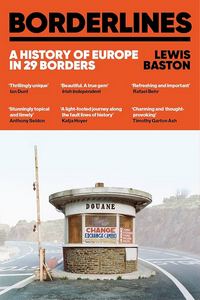 Lines on maps
Borderlines: a History of Europe in 29 Borders. By Lewis Baston. Hodder Press £10.99.
This is a combination of history, contemporary politics and a travelogue. The author records his travels around parts of Europe, from Ireland to Finland and Romania, especially the border areas, reflecting on linguistic and cultural issues over the centuries. His account is supplemented by a number of photos and some helpful maps.
Prior to 1500 or so, there would have been no checkpoints at boundaries, and people could cross them as they pleased. Many borders nowadays are completely arbitrary, often going through the middle of fields and roads. There are over two hundred border crossings between Northern Ireland and the Republic, for instance. The Large Hadron Collider at Geneva in Switzerland is partly in France, and when it is operating a proton will cross the border 20,000 times a second. But perhaps the most extreme example is the town of Baarle, which is split between the Netherlands and Belgium: the border sometimes runs through the front doors of houses, and the Belgian part of the town consists of twenty-one enclaves surrounded by parts of the Netherlands. But at least the local fire brigade is cross-border, as ‘fires do not recognise international borders’.
The Sudetenland (the pretext for the Munich crisis of 1938) ‘did not exist before about 1930’. Kaliningrad (formerly called Königsberg) is in an exclave, a part of Russia enclosed by Poland and Lithuania; it was wanted by the Soviet Union as a year-round port on the Baltic. It was tightly controlled under Bolshevik rule, but now it is apparently ‘reclaiming its Prussian heritage’. The town of Chernivitsi is currently in Ukraine, but previously it was at various times in the USSR, Romania and Austria-Hungary.
People often talk about ‘historic boundaries’, as if they automatically have some legitimacy or justification. But borders change so often and so much over the years that they just reflect a particular moment or the balance of power at some period. In the case of Poland, for instance, borders have been altered many times, with partitions, annexations and people being forcibly relocated. After 1945, the German population of around eight million on the Polish side of the Oder–Neisse line was expelled, mostly to West Germany. This was ‘radical ethnic cleansing’, largely because Stalin saw this as a suitable border.
Borders are often a convenient place for smuggling, and also for taking advantage of differences in prices. Several million Russians cross into Finland each year to buy white goods of supposedly superior quality. But more often borders are heavily-policed places of suspicion, where mixed communities suffer and are oppressed. This book gives a vivid account of what borders, boundaries and frontiers can do to humans.
PB
 An Economy of Want. Economics Reworked. By Donald Power. ISBN 978-1399985888. Also available free from Amazon as an e-book.
This self-published book starts off well enough. That, like all other animals, humans survive by applying their natural energy to obtain from the rest of nature what they need. Thanks to humans’ particular anatomy, their needs — or ‘wants’ as Power calls them — have become immensely greater than those of any other animal, as have the ways of obtaining from nature the means of satisfying them. How they obtain them has been the basis of the economic system of every human society.
Present-day society, he points out, is one where a minority owns most natural resources and instruments of production, fashioned and refashioned from materials that originally came from nature, while the rest have nothing but their natural ability to work. The latter have to work for the former and provide them with the means to satisfy their wants. This means, Power claims, that the economy is driven by what the owners ‘want’ in order to satisfy their needs. They pay workers to produce these and so provide workers with the money to satisfy some of their own ‘wants’ even if not much more than enough to maintain their particular ability to work.
That is alright as far as it goes, but the assumption is that what drives the economy today is the consumption wants of the owners. Power explicitly states this and it is the basis of his argument against the dominant school of economics that teaches that the free market system tends to lead to full employment and also of his explanation of booms and slumps. According to him, the level of employment depends on what the owners want (desire) to consume, so it is entirely possible that they might not want enough to bring about the full employment of the whole workforce. Booms are explained by the owners coming to want more and slumps by their coming to want less after the bubble bursts. He would seem to be saying that the economy is driven by the arbitrary desires of business owners.
He is, however, on the right track in that how today’s economy moves does depend on what the owners do with the surplus that the workers provide them with. But it is not what they want to consume that drives the economy but what they re-invest — or don’t. Power is well aware that they seek profits but gives the impression that this is something they decide to do when they desire to consume more. In reality, it is something that is forced upon them by the workings of the competitive struggle for profits, which is part of what capitalism is; they have to give priority to re-investment in more modern machinery and methods just to survive as a business concern. The capitalist economy is not driven by consumption, not even the consumption of the capitalists. It is driven by business owners’ market-imposed quest for profits, not their own consumption. What we have today is not so much an Economy of Want as an Economy of Profit.
Power’s main concern is to save the planet. Because he thinks that the economy is driven by wants rather than profits, he thinks that it can be reformed — ‘redesigned’ is a word he uses — to work differently by measures to change what people want to buy or use. He proposes to limit the consumption of the owners and, through taxes and subsidies, to re-direct the population towards wanting goods and services whose production and use don’t harm the rest of nature. This is a desirable goal but is incompatible with the present economic system which is driven by profits not wants and so requires its abolition.
Having said this, the book is written in simple, easy-to-read English. It is also refreshing to read a book from a critic of the way capitalism works who doesn’t repeat nonsense about banks having the power to create money from thin air. He accepts that work is the basis of wealth-production. In fact, he uses a labour theory of value, even though he doesn’t realise that Marx was as aware as he is that this doesn’t explain the price of land, paintings or the high income of talented footballers and other artists (demand in relation to unique supply does; the labour theory only applies to what can be reproduced).
ALB
Next article: 50 Years Ago – The Crisis: Capitalism’s stranglehold on the Labour government ⮞