
ALB

Forum Replies Created
-
AuthorPosts
-
ALB
KeymasterBruton has a point about Northern Ireland. At the general election 10 DUP, 7 Sinn Fein and 1 Independent Unionist were elected. In the referendum 56% voted Remain. But because SF refuse to take up their seats, only the views of the pro-Brexit DUP count and are seen as representing the views on Brexit of the majority in Northern Ireland. It also gives them bargaining power with the government that depends on their support. The voice of the lone NI MP who supports Remain, the Independent Unionist Lady Hermon is hardly heard at all even though it is her who represents the majority view on the issue.
If, because of the DUP taking advantage of its anomalous position, there is a no-deal Brexit, then a hard border will be erected between Northern Ireland and the Republic. It would have to be, by the EU to prevent goods that did not meet the specifications for its single market entering it by the back door as well as to collect tariffs. It would turn the clock back over 50 years to before the Anglo-Irish Free Trade Agreement of 1965,
The trouble with turning the clock back is that it goes against economic reality, which always has consequences, usually a downturn in economic activity. In Northern Ireland it could have obvious political consequences, not just a revival of the troubles but even a referendum vote to join the rest of Ireland.
KeymasterIt wasn’t just the anarchists who were there So were the many varieties of Bolshevik-Leninists, but they were split three ways: for Brexit, against Brexit, and against both.
FOR BREXIT was the Communist Party of Great Britain (Marxist Leninist):
“If we truly want to fight against austerity, privatisation, the loss of our jobs, homes, hospitals and everything else that we value, we must not allow the referendum result to be overturned.”
AGAINST BREXIT was “Socialist Fight, Liaison Committee for the Fourth International”:
“But socialists should demand Brexit be cancelled to defend free movement against reactionary attack from little England chauvinists, including those who claim to be on the left and support so-called ‘Lexit’.”
AGAINST BOTH was the Revolutionary Communist Group:
“neither Brexit nor Remain offer any solution for the working class … The British ruling class is deeply split over Brexit – whether to side with the EU imperialist bloc of fortress Europe, or to go it alone with an illusory dream of an independent British imperialism, ultimately siding with the US … The debate over Brexit is an expression of the crisis of British capitalism. For working class people the only option is to reject both choices …
What about the SWP and SPEW which both campaigned for Brexit? The SWP had their conference last weekend and debated the issue. As reported in the latest (9 January) issue of their paper:
“Sabby from north London argued that a ‘low level of class struggle’ meant that the debate had been pulled to he right. He said socialists should not support leaving the EU. Others strongly disagreed. ‘If you really think the EU gives a space for progressive politics, think again,’ argued Alex Callincos from the central committee …. People debated how socialists should respond to calls for a ‘People’s Vote’ — effectively a second referendum. This would split the working class and the SWP is opposed to it … If it was a clear choice between Remain and May’s Brexit, a possible option would be ‘active abstention’ — a campaign to reject both options … Several people said it is possible to win people to opposing the EU.”
So, still basically Brexiteers. SPEW seems to have shifted its position from the days of No2EU and its leftwing nationalism. They too are opposed to a second referendum, and support calls for a general election (and voting Labour in it). In their leaflet, however, there is support for staying in a customs union:
“And, as he [Corbyn] has said, he will need to seek a customs union which would enable the continued flow of necessary goods – for people’s needs and jobs.”
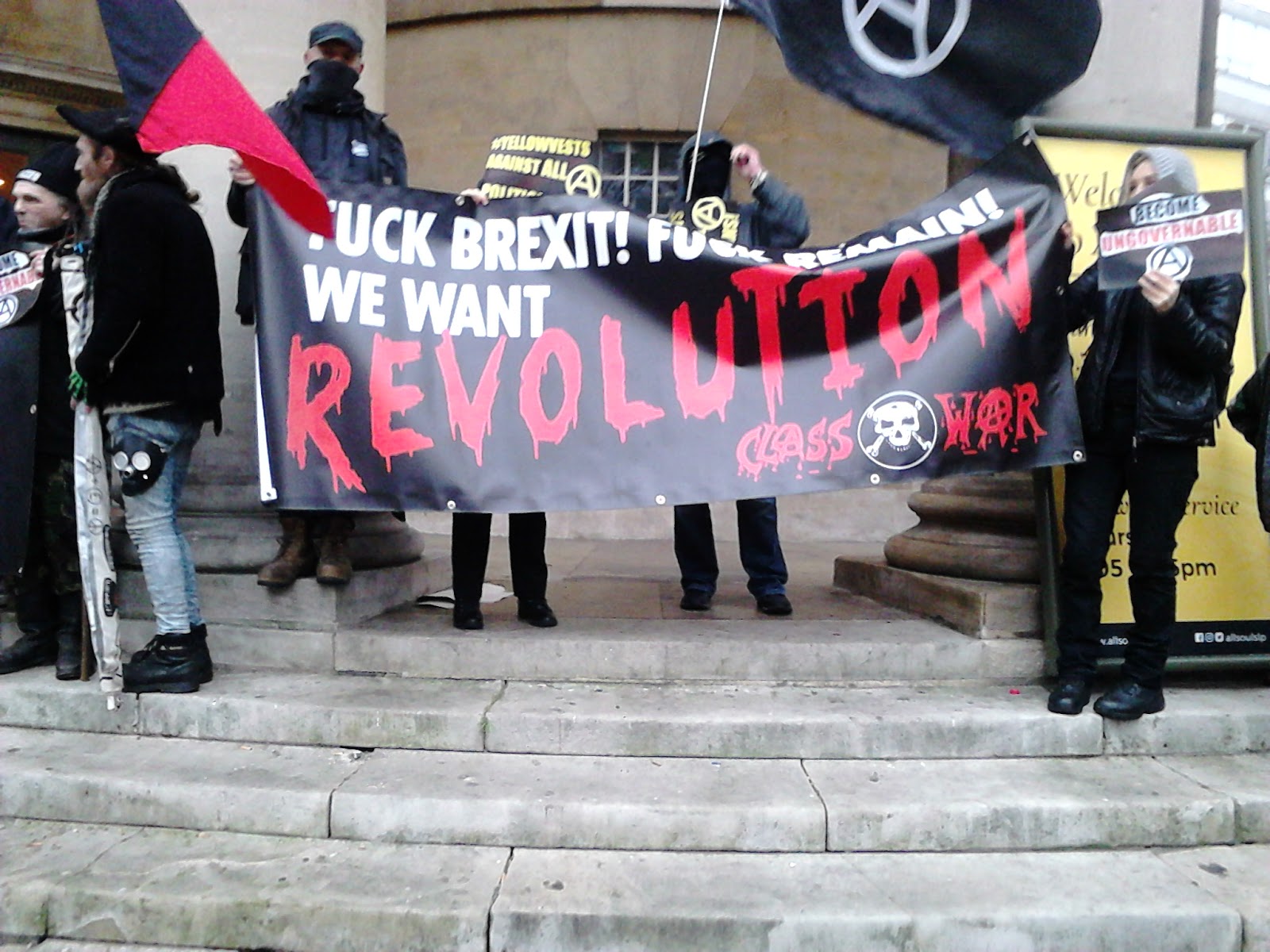
KeymasterClass War banner at the assembly point for today’s pro-Labour march in central London calling for a general election:
 Keymaster
Actually, the words of that tweet are not bad. If they had come from us it would be an appeal for the class struggle. But it didn’t come from us but from the leader of the band of professional politicians known as the Labour Party. In this context it means something different.
It’s a text that takes into account that Labour voters were and are divided between Leavers and Remainers and is an appeal to both of them to forget their differences and vote Labour.
It also reflects Labour’s fence-sitting on the issue for fear of antagonising one side or the other.
From their point of view of getting their bums on the seats on the other side of the dispatch box, Labour’s strategy makes some sense. It’s their only chance of getting a general election before 2022. May’s withdrawal bill is essentially only a technical document which Labour could easily support as they wouldn’t be able to negotiate anything much different. The real negotiations about the UK capitalist class’s future trading arrangements will take place during the 21-month “transition period” when they will stay exactly as they are now (in customs union and in single market). But if Labour votes through May’s bill then the Conservatives will be in power during this period and will probably negotiate something that might be a bit different from what a Labour government might. In any event, the Labour politicians wouldn’t get a chance at coming into office until 2022. No wonder they are engaged in parliamentary manoeuvring to force an early general election.
Still, the fact that Corbyn is using such language gives our position some credibility and us some standing in the debate.
KeymasterAccording to today’s papers May’s phone call to McCluskey was “constructive”. This is not surprising as Unite is the main union in the car industry which is the industry likely to be hit the most by a no-deal Brexit (as tariffs on cars to the EU countries go up and supply chains are disrupted). He has in fact long insisted, all along, including in his articles in the Morning Star, with the car industry employers, that Britain should not leave the single market. I doubt if he really thinks that there’s a realistic chance of a general election or even of a referendum and wouldn’t be surprised if, when it comes down to it, he doesn’t eventually back on pragmatic grounds the government’s deal which, after all, is only an orderly withdrawal that leaves a future trading agreement with the EU open and 21 months to negotiate it.
Keymaster“We’ll never be able to develop macro models capable of predicting demand-side recessions. And we shouldn’t even try,” wrote Scott Sumner, an economist and professor at Bentley University in Waltham, Massachusetts.
Good advice for us socialists too, as well as drawing a distinction between a stock market “correction” and a downturn in production.
KeymasterI thought they already did in Thailand.
KeymasterAlthough I am reluctant to feed this thread as it harms the Party’s image, there’s a revealing article here on why vegans are so unpopular (and so why it’s bad for the Party’s image to be seen to be sympathetic towards them):
https://inews.co.uk/inews-lifestyle/food-and-drink/why-people-hate-vegans-greggs-sausage-roll/
“Deep down it’s a matter of ‘Why are you making me feel that your norm…should be imposed on me?’ It’s really about feeling threatened. “People have a tendency to feel questioned even when they are not being questioned,” he adds. Food author and presenter Stefan Gates agrees that many meat eaters fear that their lifestyle is under threat and likens tensions in the UK surrounding veganism to the issue of gun control in the US. “It’s a case of, ‘You’ll take this ham sandwich out of my cold, dead hand’”, says Gates.
I must confess that that’s my kneejerk reaction and that of many other workers. And in fact of most Party members as shown b the overwhelming opposition to the suggestion at our last delegate meeting that only vegetarian food should be served at our summer school.
We are really not doing ourselves any favours by going on and on (and on) about this. It upsets most workers and members and our replies upset vegetarians and vegans. So we lose out on both counts.
Incidentally, some climate change activists put off ordinary people by also giving the impression that their lifestyle is being challenged (as Dave B has already pointed out).
KeymasterWest London branch members will be going to this. And there’s a vineyard just round the corner.
KeymasterInteresting piece in today’s Times:
Of all the odd friendships thrown up by the Middle East’s civil wars, America’s military alliance with Syria’s Kurdish YPG militia is the oddest (Richard Spencer writes). On the one side is the world’s foremost capitalist power, the leader of NATO and the western alliance. On the other is a guerrilla group whose ideology veers between old-school Marxism and the cult of an obscure anarchist philosopher called Murray Bookchin.
(He means old-school Leninism of course).
The PKK/YPG may allow and encourage popular participation, including of women, at local level but at its semi-state level it is not all that democratic, banning other political parties and imposing conscription. Still, it’s not the worst actor on the scene. If they can solve the language question they shouldn’t get on too badly with the Syrian government.
They, or at least their supporters, are also into ecology (Bookchin’s influence no doubt):
https://anfenglish.com/news/call-for-actions-to-stop-erdogan-s-war-in-northern-syria-32000
And they are certainly right that women would be a lot worse off if fanatical jihadists overrun more of their territory. But their appeal for help from the US and other capitalist powers is not going to be heard.
KeymasterFound De Leon’s pamphlet The Vatican in Politics. Ultramontanism: The Catholic Political Machine in Action:
The trouble is that you have to read it sideways.
A bit surprising that the SLP of America were still issuing as a pamphlet as late as 1962.
KeymasterActually in the end it ended up the other way round, with Connolly dying “in the faith” with the last rites from a catholic priest (or whatever religious catholics have to before they die).
I suspect he was always a secret catholic. After all, he sent his kids to a catholic school when he didn’t have to since he had married a protestant. And then there was his falling out with Daniel De Leon over De Leon’s opposition to the catholic church or rather to its “ultramontanism” (your “globalism” ? even claim to world domination, logical if you claim to be god’s representative on Earth).
KeymasterI don’t know how reliable Vanity Fair is (not much I suspect) but the headline of this story is amusing:
Trump Official Threatens Peasant Revolt in China If Xi Doesn’t Cut a Deal
https://www.vanityfair.com/news/2019/01/wilbur-ross-trade-war-little-villages
KeymasterWhile the League of Empire Loyalists and the Mad Marketeers wax lyrical about the benefits for British capitalists of trading on World Trade Organisation terms (not that they are many capitalists that are convinced of this), there may not be a WTO with a year or so. Trump is threatening to withdraw the US from it and in the meantime is sabotaging the functioning of its appeal court:
If his happens then world trade will become a free-for-all where might is right.
Even some Mad Marketeers are beginning to have second thoughts. Today’s Times quotes a “scholar” at the rightwing Cato Institute and former WTO appeal judge as saying:
If the United States gets its way, then these smaller countries will no longer have the benefits of the rule of law. They will be subjected to the rule of power and might makes right.
KeymasterInteresting headline of an article in today’s Times
GREED NOT FEAR WILL SAVE OUR POLLUTED PLANET. Only economic incentives can encourage people to adjust energy use and drive down emissions.
Opening paragraphs of the article can be read here.
In view of the impasse at the inter-governmental conferences the profit motive may well be the only way of something more being done. Wouldn’t have thought that that’s any guarantee though, but that’s the best capitalism can offer.
-
AuthorPosts