
Nine days that didn’t shake the world
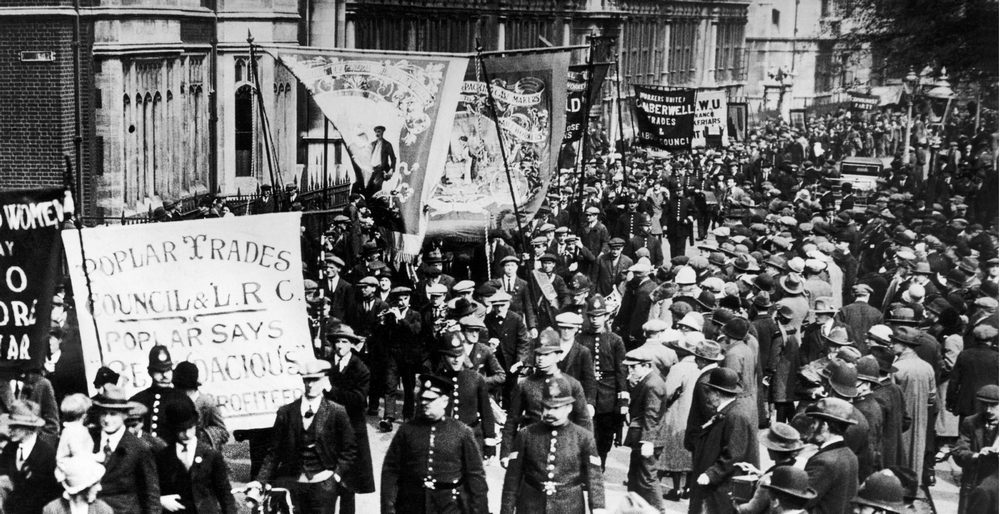 At 11.59 pm on 3 May 1926 the General Strike began, called by the General Council of the Trades Union Congress (TUC) in solidarity with much put-upon miners in the coal industry. The intention was to force the British government to act on behalf of over one million locked-out colliers.
The coal industry was in decline. It had reached its peak annual production, of 292 million tonnes, in 1913. Seven years later output had fallen to 233 million tonnes. The First World War (1914-18) had made such demands on the industry that many of the better coal seams had been depleted.
The same period had seen the expansion of coal production in other countries such as Poland, Germany and the USA. After 1918, as coal working became more difficult in British mines, and therefore more expensive to produce, cheaper imported coal became an increasing challenge.
The Dawes Plan of 1924 enabled Germany to once again export coal, ‘free coal’ as it became known, as part of war reparations. The effect was to reduce the price of coal on the international market. A year later the Chancellor of the Exchequer, Winston Churchill, placed Britain back on the gold standard.
This strengthening of the pound sterling made exports more expensive which, along with raised interest rates, led to economic instability in some sectors and a quest for cost cutting in Britain. Coal mine owners subsequently found themselves faced with falling profits.
The reaction was, as usual, to make the workforce bear the cost. There began a sustained process of increasing working hours and reducing rates of pay. Miners, unsurprisingly, reacted against this assault on their living and working conditions.
The response of the Miners’ Federation of Great Britain was, in the words of AJ Cook, the Federation’s leader, ‘Not a penny off the pay, not a second on the day’. As to action, Cook had made his position clear in 1924, ‘I believe in strikes. They are the only weapon.’
Unrest in the mines echoed through many a steel mill and loco shed, through industries also having straitened times. This resulted in widespread sympathy for the hard-pressed colliers, organised workers expressing solidarity.
Stanley Baldwin, Prime Minister of the Conservative government, introduced a nine-month subsidy of miners’ wages along with a Royal Commission under Sir Herbert Samuel to investigate the industry.
Its main recommendations, in March 1926, were nationalised royalties, national (rather than local or regional) pay and employment agreements, along with the withdrawal of the government subsidy and a reduction in miners’ wages of 13.5 percent.
Emboldened by the Commission’s report, mine owners proposed new employment terms of a longer working day with reductions in pay packets. The Miners’ Federation rejected these proposals, exposing the supposed neutrality of governments in such matters.
Following failed negotiations on 1 May, the General Council of the TUC announced that a general strike would commence at a minute to midnight two days later.
Despite there being up to 3 million workers on strike, mainly but not exclusively in heavy industries, there was no clear strategy as to how to conduct or progress the campaign. The government, however, was organised and responsive.
The Labour Party, not wishing to be associated with disruptive and possibly revolutionary action, adopted a sympathetic but distanced attitude. A legal ruling under the Trade Disputes Act, 1906, declared that union funds during a general strike were not protected. This enabled employers to sequestrate union assets.
On 12 May, the TUC called the general strike off. The miners were left to fight on largely alone until the extremes of poverty forced their return to work under even more stringent conditions. Capitalism’s prioritising of profits over the needs of workers had been blatantly demonstrated.
Although the strike garnered mass support, the majority of workers were not directly involved. There were some though prepared to physically confront any who were actively working to mitigate or undermine the strike.
For example, in Leeds, on 5 May, a crowd of over a thousand gathered by the Corn Exchange. They were determined to prevent the continued, somewhat reduced, running of the tram and bus services.
To make their point obvious, coal was taken from a delivery lorry and used to pelt a tram on Duncan Street, smashing its windows, thereby forcing it to stop. Next day more trams and buses were forced out of service the same way.
Such small victories may seem significant in the moment, but they serve only to provoke a predictable response from the forces of the state. The police responded with horses, truncheons and arrests. What occurred at Orgreave six decades later was not unprecedented.
The week after this event the General Strike ignominiously collapsed when the TUC’s General Council went to Downing Street and surrendered. This was always the most likely outcome as was the defeat of the miners’ strike later that year.
Limitations of trade union action
Trade unions have served a positive and useful purpose as a collective response by workers to the depredations inflicted on them by capitalism. Indeed, they have played an important part in tempering some of the worst features of capitalism, fighting to improve wages and working conditions for their members.
They eventually gave workers a voice in parliament by founding their own political organisation, the Labour Party. However, ameliorating the excesses of capitalism was, and is, the extent of their power.
The slogan ‘A fair day’s pay for a fair day’s work’ gives voice to union and Labour Party aspirations. It leaves capitalism free to determine to its own advantage the definition of the word ‘fair’. Also, the word pay indicates no sense of looking beyond capitalist relations; employers who take profits while employees depend on wages/salaries. A relationship defined in terms of money.
Unions and their political party can only, at best, reform elements of the capitalist system. Miners, in the twentieth century, exemplify this. In the 1920s their parlous state motivated a collective, if limited, response by their fellow workers. Ultimately defeated.
1 January 1947 was Vesting Day, when the Coal Industry Nationalisation Act of the previous year came into force. There were many who welcomed this as a ‘socialist’ measure, along with the NHS a year later, by the reforming Labour government.
Just 25 years later, in 1972, the National Union of Mineworkers (NUM) was taking strike action against the employers, the National Coal Board (NCB). Had coal mining been truly socialist those miners would, effectively, have been striking against themselves.
Mining could not, of course, be a socialist enclave within a capitalist economy, just as there cannot be a single socialist country in a capitalist world. The NCB ran the mines on behalf of the state that itself runs society of behalf of capitalism. Coal mines were reformed, but not socialist.
It has been estimated that 253 coal mines closed during periods of Labour governments between 1964-70 and 1974-76 with the loss of over 200,000 jobs. Prior to 1964 coal was in long-term decline. The economic problems of mining coal in Britain that so adversely affected mining in the 1920s, difficulties in extraction and cheaper imports, along with newer competition from other fuels, oil and natural gas, resulted in falling profitability.
Even the success of flying pickets and a second strike in 1974 could do little to divert capitalist economic logic. By 1984-5, any illusion as to the socialist nature of coal mining was surely dispelled by the Thatcher Conservative government.
No matter how great the solidarity of workers in dispute, or subsequent reforms enacted in response, ultimately capitalism, through its state, will organise matters to its own requirements. Reforms granted are readily withdrawn when increased profitability demands.
Strikes are essential to our lives as wage-slaves, yet their very existence is a mark of the failure, to date, to confront the reality of capitalism and the necessity of replacing it with socialism.
D. A.