
Throwing custard over the Crown Jewels and shoplifting at Waitrose
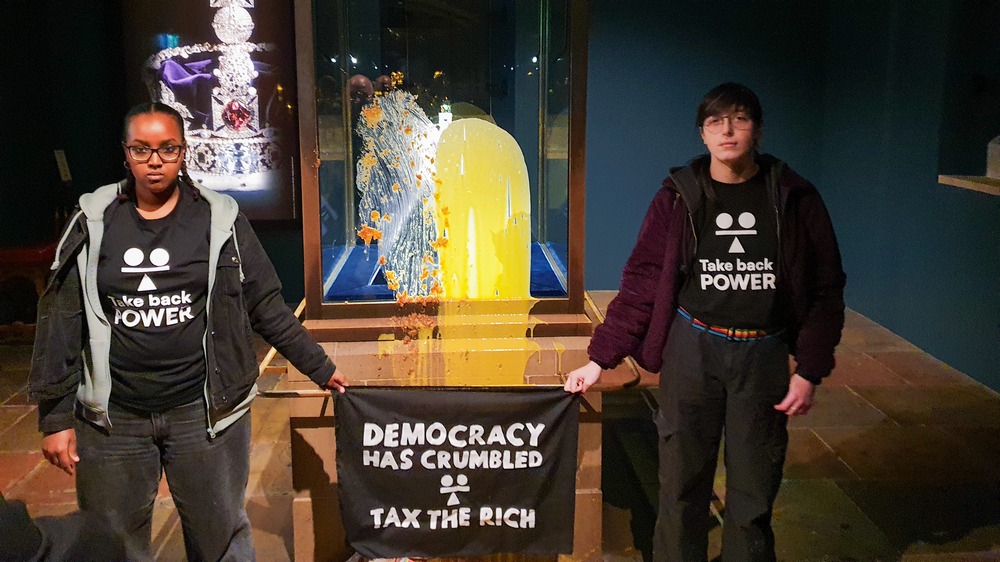 Last December a group called Take Back Power made news by throwing apple crumble and custard over a glass case containing the Crown Jewels in the Tower of London. Describing itself as a ‘nonviolent civil-resistance group’, Take Back Power, though talked of as a successor to Just Stop Oil which has now dissolved itself, has a new and different agenda focusing on what can broadly be called ‘economic inequality’. Its declared concerns are matters such as the cost of living and, in particular, what it describes as ‘unfair taxation’. To bring attention to such issues, its members are promising mass shopliftings of ‘high-end’ stores such as Waitrose and redistribution of the food removed to those who need it. Such activities are seen as a way of exerting pressure on the government to set up what they call ‘a permanent citizen’s assembly – a House of the People, which has the power to tax extreme wealth and fix Britain’. This echoes the words on the sign carried by those arrested at the scene of the apple crumble and custard event: ‘Democracy has crumbled – tax the rich’.
Daily Mail v Take Back Power
The group was the subject of a predictably derogatory report in the Daily Mail on the occasion of its formal launch in January of this year. One of its founders, Arthur Clifton, was reported as telling the audience at the founding event: ‘We have seen that food is locked behind skyrocketing prices. Less and less people can afford less and less food’. And then the article went on to mention that two of those involved in the ‘custard’ protest were ‘an NHS worker and a former doctor’ and pointed out that Clifton was ‘privately educated’ at ‘one of the country’s top public schools’ and came from a wealthy family. In so doing it lit the blue touch paper for its discerning readers in the comments facility on the website. Typical examples of comments were:
‘Terrorists, by another way and means. They need locking up.’
‘Start prosecuting and imprison these vandals & thieves with long sentences.’
‘Morons and jealous half-wits.’
‘Why do this lot always look like they need a good bath!!’
‘If they hate capitalism why not moving to China or Cuba? or … North Korea?’
‘Anti-capitalist group: the upper-middle class way of saying “’thieves”’.
‘Middle class privileged kids playing at politics.’
‘A few baseball bats and pickaxe handles would soon sort these goons out.’ (from Big Richard of Birmingham)
‘Live rounds, now!’ (from Shampoo Bamboo of Sheffield)
Such comments are of course to be looked upon with the contempt they deserve, but of real relevance to the venture they are commenting on are a number of points made in earlier editions of the Socialist Standard about Take Back Power’s predecessor group, Just Stop Oil.
Single-issue groups
Firstly, single-issue groups, no matter how well supported they may appear to be at a given time, tend to have limited impact, if any, in the longer term. Recent history illustrates this when we think of, for example the Campaign for Nuclear Disarmament, the Anti-Vivisection Society, Occupy, Extinction Rebellion, which either become extinct when members tire of working hard for little visible gain or soldier on even when they get overtaken by events and changing conditions make the issue they are campaigning for seem less relevant. In general, it must be said that such organisations are nothing if not commendable for their concern for human welfare and the sincerity of their intentions. And on occasion they can be judged to have had some kind of positive impact on society or on social attitudes. But this is usually because their agenda becomes aligned with the needs of the social and economic system we live in (capitalism), making what they are campaigning for useful or necessary for the continued smooth running of that system. Examples of this are the campaign for a National Health Service in Britain at the end of the second world war (basically a necessary back-to-work scheme for efficient employment), and the Civil Rights movement in the US which was at least partially successful in improving conditions for the black minority. One of its effects was to put them in a less inferior position to the white majority in the labour market and so giving employers a wider pool of workers to choose from. In the end, such ‘successes’ as there have been among single-issue campaigns form part of the list of never-ending reforms that capitalism itself always needs to facilitate its operation.
What does ‘anti-capitalist’ mean?
Secondly, though the Daily Mail article referred to Take Back Power as an ‘anti-capitalist group’ and a number of its readers’ comments picked up on that, when looked at closely the group’s aims and activities are not ‘anti-capitalist’ in any meaningful way. It envisages its ambitions as being achieved within the framework of the current system of money, wages and buying and selling. They involve either influencing existing governments or leaders or somehow having a part in government themselves. There is nothing ‘anti-capitalist’ in this. Anti-capitalism (or ‘socialism’ as we would call it) means a social system without governments or leaders based on common ownership of all goods and services and free access to all the necessities of life for all. Reforms to the current system (even a conglomeration of them) cannot provide that. Nor does anti-capitalism or socialism have anything whatever to do with China, Cuba or North Korea, as suggested by some of the Daily Mail’s keyboard warriors.
Class
Thirdly, some explanation is needed regarding ‘class’, especially given that the protestors in question are referred to in the newspaper as ‘middle-class’ (and therefore not ‘working class’). The important reality to grasp is that there are very few of us indeed who are not ‘working class’. This is in the sense that the overwhelming majority of us need to find an employer to work for in order to have a wage or salary as a means of survival. And that will certainly be the case for virtually all those who gathered on 17 January at Limehouse Town Hall in London to formally found Take Back Power. We can say with a good degree of certainty that very few of them indeed, if any, belong to that small group of people who do not have to sell their energies to an employer day by day because they own enough wealth to be able to live comfortably without doing that, ie, those who belong to the tiny minority of people who own most of the earth’s resources – those we call the capitalist class.
Who pays taxes?
Finally, while the idea that imposing higher taxation on the rich and reducing it for the poor may seem superficially attractive, it is, when examined closely, fundamentally wrong-headed. It’s true that most people have an image of the state and its government as a kind of ‘neutral’ agency standing above society, to which all must contribute. In this view state revenue is the ‘public purse’, which we all have to support through taxation. But the main burden of taxation in fact rests on the tiny minority of people who own the vast majority of the wealth (the capitalist class) and who the government extracts it from in order to maintain the whole machinery on which the system depends for its orderly functioning . And they pay it out of the profit accruing to them from their ownership of the means of production and distribution over the whole of society. If they were prevailed upon to pay even more than they already do, it would have the effect of eating into the profit which is the life blood of capitalism, cause disinvestment, economic decline and possibly worse, and make workers even poorer as wages declined and unemployment rose.
Mirages, dead ends and the real deal
So in all these terms Take Back Power’s aim of a society run by a ‘Citizens’ Assembly’ which would tax ‘extreme wealth’ is nothing more than a mirage. It is a mistaken notion that, within the framework of a society founded on buying and selling, things could be run in a notably more equitable way than at present. If, by some unimaginable quirk, such an experiment did come to be tried, it would quickly become clear that whoever or whichever body was running things, they would quickly have to bow to the dictates of profit and to a similar order of things as exist already for the vast majority (ie the workers) and effectively carry on running capitalism. While we can thoroughly agree with the statement made by Take Back Power that governments ‘serve the super rich’ and ‘do not care about working people’, their plans for somehow reducing the wealth of those they call ‘the obscenely wealthy’ could not possibly be realised within the existing framework of social organisation with its governments and monetary exchange.
The ‘guru’ of Just Stop Oil, Roger Hallam, who has recently served a prison sentence under the British state’s arsenal of repressive laws for involvement in tactics like blocking roads or gluing yourself to paintings, is on record as saying ‘If you don’t upset people, then nothing happens’. It remains to be seen whether Take Back Power will now go in for similar actions to try and attract attention to their cause. But even if they are successful in this, what they will be spreading is attention to what can only be a dead end. What is needed is a wider view of how society works than that adopted by any single-issue campaign. The working class does indeed need to ‘take back power’, but it needs to do that in a way that focuses not on social or economic reform within the framework of capitalism, but on a change from a society of production for profit to one of production for need based on common ownership of the world’s resources and free access to all goods and services.
HKM