
Book reviews: Heron-Milburn-Russell, Grant, McEwan
 Beyond the state
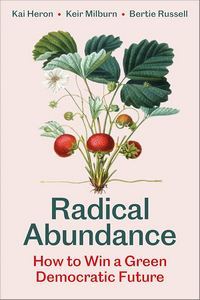
Radical abundance: how to win a green democratic future. By Kai Heron, Keir Milburn and Bertie Russell. Pluto Press, 2025. ISBN 9780745351353
This is an interesting attempt to consider the transition to a society of common ownership in a concrete and practical fashion. The authors identify what they call the two invariant aspects of transition: ‘popular protagonism’ and ‘contested reproduction’, and these are necessary to overcoming the ‘metabolic control of capital’. That is, changes to formal ownership and state control are insufficient means for dealing with what they call the dialectic of ‘bullshit abundance’ (ie the abundance of pollution, authoritarianism, inequality, etc.) and artificial scarcity (the failure to meet real human needs) of commodity society.
As suggested by the title, this book is partly a rebuttal to the ‘Abundance’ deregulation theme that has emerged in the United States (as exemplified by the book of that name by Klein and Thompson, which we reviewed in our November 2025 issue). What they propose though, is something they call ‘Public Common Partnerships’. This is a riff on public private partnerships, or what they identify as the process of the state de-risking capital investment as a means of promoting economic growth. In their version, assets and enterprises that are otherwise unprofitable for capitalists can be taken over by tripartite bodies, made up of representatives of the workforce, representatives of the public authorities and a community trust. The last of these has a responsibility for distributing any surplus generated by the enterprise: either as a return to workers, further investment, or support for other such partnerships. As such, these bodies bring in those more broadly concerned with the reproduction of society, eg those engaged in child rearing or caring, rather than those directly employed. The surplus is in the hands of the community.
They argue that these bodies would enable ‘contested reproduction’ and ‘popular protagonism’ fulfilling community needs while also being an educational tool for increased popular participation in the economy. The authors are clear they do not consider this a magic bullet, but rather a practical tool for spreading de-commodified practice and an educational experience. They pose it, rather, as a political wager, that might move things in the right direction. As they note, they are not calling for the abandonment of other forms of struggle, but adding this into the mix.
They do, in one chapter, though, speculatively examine how a network of these PCPs could plan food production across an entire country. They look to leveraging ‘Council Farms’ which, despite decline, cover thousands of hectares in the UK. They look to movements in Brazil, Venezuela and Kerala as examples to follow.
The authors themselves work on such structures as practitioners, and they point to a number of examples of where such models have been implemented: including a take-over of an in-door market in Tottenham and a pharmaceuticals plant in France.
This does come close, though, to the islands of socialism suggestion that is frequently put to us: the idea that socialism can be created in bits, rather than as a hard change-over from capitalism, which can simply ‘outcompete’ capitalist methods.
The issue is that their examples come from taking on peripheral parts of the capitalist system, bits that it no longer finds productive, which means that these PCPs mostly survive precisely because they are not a threat to the metabolic control of capital. Should they ever become so, the state would be called in to intervene. As the authors note, by the 1970s, in the UK, around a third of housing was council housing: Margaret Thatcher disposed of that with the stroke of a pen, and there is no reason to suppose that a ‘self-expanding commons’ of PCPs could not meet the same fate.
While the authors might well in fact relish such a contest as an opportunity to expand the contestation of reproduction, it seems likely that the result would be the same as the outcome of the Thatcher era: state power would prevail.
Particularly, as the authors claim it doesn’t require political organisation to set up PCPs, but rather public agitation (although how political/governmental bodies come to be involved other than through sympathetic politicians getting involved seems to be a question). If political organisation becomes required, then why go the roundabout way of challenging capital through these bodies, rather than striking at the legal and political structures that sustain it?
This then brings us back to the problem of using PCPs as some sort of educational tool. The working class already manage capitalism from top to bottom, we just do not do so in our own interest. There is no reason to suppose that those, like the Tottenham traders, who engage in a PCP to save their local market or bottle plant, or whatever, will have a desire or interest in challenging the ‘metabolic control of capitalism’. As with any reform-minded movement, the majority of those attracted will be for the immediate goal itself, and they would balk at going further, or even be actively opposed.
This leads us to suggest that there may be a third invariant aspect of transition: consciousness. Unless there is a conscious desire to do away with capitalism, and at least some idea of what is supposed to replace it, there cannot be meaningful popular protagonism, much less contested reproduction.
This book raises important issues around the way in which transition to a non-commodity society can be achieved. The proposed PCPs are at worst harmless, and at best could form a part of the way that the working class can defend its own interests within capitalism (or, maybe, even organise society post-capitalism).
The authors are correct that a wider network of activity is required beyond the state, but for us that is the conscious mass movement for socialism that must include taking political control of the state as a minimum to stop it being used to prevent the spread of a self-managed and co-operative way of organising society from emerging.
PIK SMEET
 Better, not more
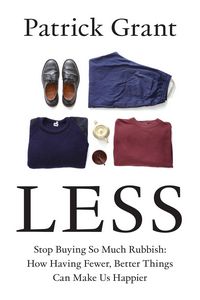
Less: Stop Buying So Much Rubbish: How Having Fewer, Better Things Can Make Us Happier. By Patrick Grant. William Collins £10.99.
In the August 2022 Socialist Standard, we reviewed Phillip Coggan’s More, which deals with the expansion in production over the centuries. Grant’s book is a kind of counterpart to that, advocating the making of fewer things. The author is a fashion designer, business owner and judge on a TV programme to do with sewing. Here we will focus on his general remarks, rather than his account of his own history in business (he is founder of the Blackburn-based Community Clothing, communityclothing.co.uk).
The development of capitalism meant that the interests of business took precedence over everyone else, including those who did the work and produced the goods. Only the rich benefited from this, and the emphasis switched to increasing output and consumption, rather than happiness. The fashion industry in particular grew via social manipulation, with seasonal fashions having a fixed shelf life. Many companies spend more on marketing and selling their products than on making them, and over thirty percent of all the clothing made is never sold, with fast fashion brands such as Shein and Temu leading the way here. Shein’s marketing strategy is simple: ‘make an unfathomable quantity of incredibly low-quality stuff, sell it cheaply, aggressively acquire customers, swamp the competition.’ A new product is launched every three seconds. A mention of Oscar Wilde’s remark that ‘fashion is merely a form of ugliness so absolutely unbearable that we have to alter it every six months’, would have been apposite here, except that it seems now to be a matter of days rather than months.
The quality of much of what is produced has declined over the last several decades (though cars may well be an exception). Cheaper products usually mean higher profits, of course. Fewer raw materials means clothes are often skinnier, shorter or thinner, and overcoats contain far less wool than they did fifty years ago. From the 60s and 70s, synthetic fibres such as nylon, polyester and acrylic became widely available and many manufacturers of natural-fibre fabrics went out of business, especially as offshoring became more common. The owners of companies that produce poor-quality goods are extremely rich (H&M, for instance). When you buy a garment online, you cannot judge its quality.
Moreover, few people nowadays love their jobs, even though work can contribute to personal happiness. These days far fewer people actually make things for a living, and there is a lack of workers in manual trades, which are not just ‘manual’ as they require a lot of knowledge and cognitive processing. One aim should be the creation of skilled fulfilling local jobs. Clothes, the author argues, can be produced in a way that will ensure that they age so as to provide pleasure to the wearer. Older second-hand goods can still be of high quality, and the better an object is, the more likely it is to be repaired.
There seems to be no mention here of degrowth, but a lot of what Grant advocates would imply a reduction in the amount produced and even an end to the continuous economic growth of capitalism. Much of what he says here could certainly be considered for adoption in a socialist world, but it is hard to see how it could be implemented under capitalism.
 Futuristic
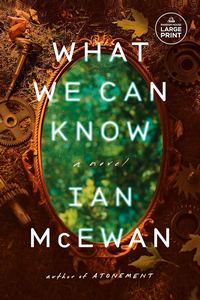
What We Can Know. By Ian McEwan. Jonathan Cape. 2025. 301pp.
What a fine novelist Ian McEwan is. Apart from being a superb craftsman of language and plot and a massively perceptive observer of human behaviour, his widely read fiction often contains strong social or socio-political elements offering serious food for reflection. Even more trenchant on this front than others of his novels is his latest, What We Can Know, which also stands out for its strong futuristic content. Yet, set as it is in the year 2119, it also reflects back on the present day at a moment before climate change and nuclear conflict have caused global populations to halve, seas to rise massively and biodiversity to decline. And it offers a constant interplay between the imagined future, which humanity’s response (or lack of response) has shaped, and the world of today.
As it moves between these two time periods, it reveals the details of what is imagined to have happened through human mismanagement of the planet and its resources and technology. So, for example, scores of cities, including Glasgow and New York, have vanished and there is no longer any kind of globalised economy. Yet despite the wars, genocides, floods, famines, viruses, droughts, tsunamis, starvation and disease that have decimated the population, human society has carried on (‘we scraped through’ is the expression survivors use). As for Britain, what is left of it is an archipelago (ie a group of small islands) that is all the remaining population has left following the inundations caused by rising seas, and whose ‘finest achievement was not to be at war’. Though run by corrupt elite ‘Citizens Committees’, there is relative order in society and formal education still takes place. We are told that: ‘Significant parts of the knowledge base were preserved. Many institutions crawled through the gaps between catastrophes. People lived at poverty level but they lived.’
The main character is an academic at the University of the South Downs teaching history (for which he receives half the pay of his science and technology colleagues) and at the same time working on the biography of a poet who lived 100 years earlier. Hence his interest in that (our) era. Could those pre-inundation populations not have done ‘something other than grow their economies and wage war?’, asks one of his students, which makes the teacher himself wonder whether ‘many of humanity’s problems could have been solved’ before planetary havoc set in. But could it have been different? The question is left in the air.
Obviously the precise circumstances laid out as having led up to this future are no more than speculation. Yet it is speculation plausibly depicted, building on the political and environmental instability of the world we live in today, in which, as the author puts it, ‘capitalism… invents furiously and persuades us of new needs’. Not that his well-founded and pungent comments on various aspects of current or recent reality (for example, ‘These were the early Thatcher years, and there was crazy greed in the air’) are accompanied by any proposed solution or clear course of action regarding the problems he perceives. Little more in fact than the kind of wishy-washy statement he made in a recent interview to the magazine Positive News that: ‘We just have to stop doing bad things and do good things’. No recognition, therefore, that those ‘bad things’ come out of a bad system, which, in order to stop those things getting worse, needs to be replaced by a better system.
But it would be wrong-headed not to recognise that What We Can Know is a work of fiction and that, in the final analysis, there is no obligation for fiction to be prescriptive or to propose remedies. The main virtue of McEwan’s writing lies in its power to create believable human character and interaction through effective use of language, so allowing the reader to see truthfulness in what is depicted. It is especially in the clever and nuanced ‘looking-back’ element of his story that the author does this most consistently. He captures some highly recognisable realities of the social and political mores of the current age, while also managing to weave much ‘human interest’ into his narrative, for example a highly sensitive portrayal of early onset Alzheimer’s, a love story or two, and a crime of passion. No short review can in fact do justice to the book’s overall literary merit, but the following passage can be seen as a typical example of its acuteness of perception and mastery of language: ‘Memory is a sponge. It soaks up material from other times, other places and leaks it all over the moment in question. Its unreliability was one of the discoveries of twentieth-century psychology’.
HKM