
Why we can’t support Your Party
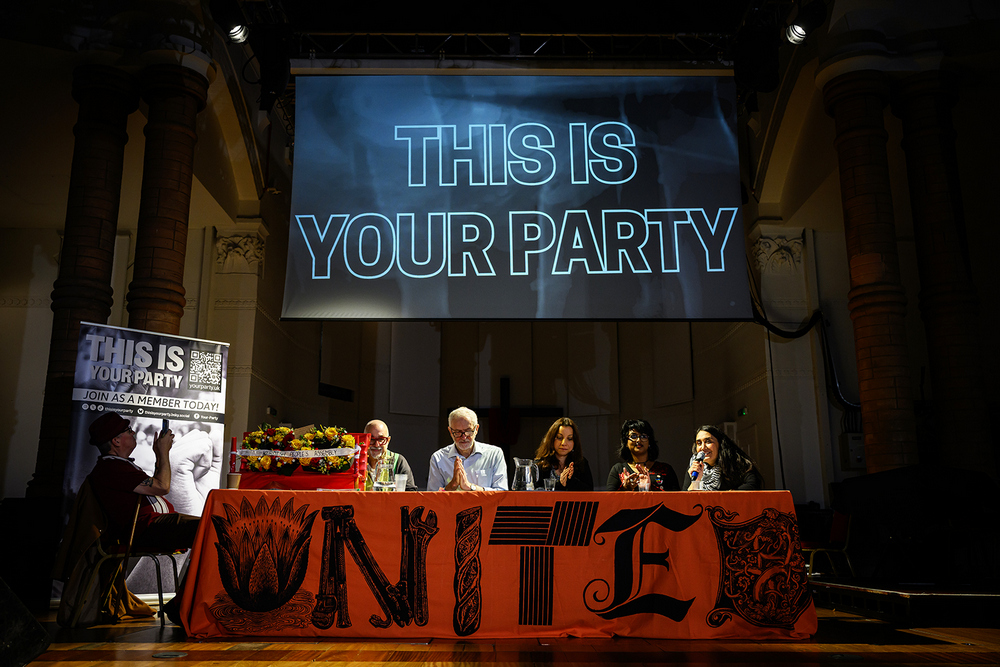
Over the weekend of 29-30 November some 2000 attendees at a conference in Liverpool founded a new political party called simply ‘Your Party’.
After Labour lost the 2019 General Election long-time left-winger Jeremy Corbyn resigned as leader and was succeeded by the man who is now the Prime Minister. During the four years during which he was leader Corbyn had tried to steer the Labour Party towards the left. Starmer decided not just to reverse this but to turn the Labour Party into a mainstream capitalist party, even to the extent of describing itself as a better ‘party of business’ than the Tories.
Corbyn himself was suspended as a member of the Parliamentary Labour Party (though not of the Labour Party itself). Starmer could have let him stay a member (as Corbyn would have wanted) but he and those around him were adamant. They wanted to completely change the Labour Party by in effect lopping off its leftwing. Corbyn’s supporters were expelled. Corbyn himself was not allowed to stand as a Labour candidate in the 2024 general election. They put up a candidate against him; which meant that as he stood against a Labour candidate he was automatically expelled from the Labour Party. He won, easily, as an Independent.
From that point on, there were calls for Corbyn to support the formation of a new left-of-Labour party which would in effect be the Labour Party’s former leftwing as a separate political party. Whatever the reason Corbyn dithered and another suspended Labour MP, Zarah Sultana, precipitated things by announcing in July that she was resigning from the Labour Party to co-lead a new leftwing party with Corbyn. This was an announcement that a lot of people had been waiting for and up to 800,000 were said to have expressed an interest in the new party, though by the time of the conference only some 53,000 had actually joined.
Sortition
A new party cannot be created just like that. It has to have a statement of what it stands for and a constitution. Corbyn and his advisers drew up a plan which, in theory, seemed reasonable enough (as long as the provisional committee played fair).
A provisional committee is set up to draft a statement of aims and a constitution both to be put to a founding conference. These would be subject to amendments suggested by meetings of members. Those attending the conference are to be chosen by lot (now called sortition) from the membership. Conference will debate the finalised documents and selected amendments. These will be voted for or against online, not just by those chosen to attend the conference but also by the rest of the membership on the basis of one member one vote.
This — including sortition — seems a democratic way of going about founding any new party whatever its aims. Choosing those attending a founding conference by lot should ensure that they will be a representative cross-section of the membership and reflect the views of the average member and not just of an activist minority. More generally, it is an alternative to election but still a democratic way of choosing people to carry out particular tasks (as it already is today for choosing trial juries) and could have a wider use in a classless socialist society.
This, however, did not go down well amongst the activist minority made up of the various Trotskyist groups that had decided to ‘enter’ the new party (as in the past they had ‘entered’ the Labour Party). They argued that this would exclude experienced activists like, er, themselves.
In the event, it didn’t exclude them. It just ensured that they were represented in accordance with their proportion of the new party’s members. The Trotskyist groups were pleasantly surprised that quite a few of their militants were chosen to attend, even some from the more obscure grouplets
Do as I don’t
The Trotskyists also objected to a provision in the proposed constitution barring dual membership with another political party. This was in fact already in the application form to become a member and take part in the founding process. This, however, wasn’t enforced and members of the SWP, the old Militant Tendency (now calling themselves SPEW) and most lesser Trotskyist groups joined and participated freely in the pre-conference Your Party meetings.
One objection to Trotskyists being in the new party was set out by the General Secretary of the Communist Party of Britain, Robert Griffiths, in an article in the August issue of their paper Unity, where he criticised ‘the readiness of the ultra-leftist sects to infiltrate broad-based mass movements in order to divide them, pose as a “left opposition” to the leadership and recruit from those they influence and mislead’.
Which is indeed what Trotskyists plan, though it’s a bit of a cheek coming from the CPB as it’s what its antecedents used to be good at. (Incidentally, the CPB position is not to join the new party but to vote and campaign for its candidates under certain circumstances).
The Trotskyists lost no time in forming a ‘left opposition’ and campaigning to make the constitution of the new party as democratic as possible. This was not because they believe in democratic organisation but because it would give them a wider opportunity to work and recruit within the new party. They joined a ‘Socialist Unity Group’. One of its constituents calls itself the ‘Bolshevik Tendency’; which would have been a better name for their faction.
They are hypocrites because their own organisations are not organised democratically. Take the SWP, for example. It is run by a Central Committee which is chosen in this way:
‘The outgoing Central Committee selects and circulates a provisional slate for the new CC at the beginning of the period for pre-Conference discussion. This is then discussed at the district aggregates where comrades can propose alternative slates. At the Conference the outgoing CC proposes a final slate (which may have changed as a result of the pre-Conference discussion). This slate, along with any other that is supported by a minimum of five delegates, is discussed and voted on by Conference’.
What this means is that the SWP is run by a self-perpetuating group that in effect renews itself by co-option. The slate ‘selected’ by the outgoing committee is virtually assured of winning. It was how the Politburo of the CPSU was chosen in the old USSR. Their constitution also states that ‘permanent or secret factions are not allowed’.
When the SWP led a move to ‘seize control’ of the conference agenda by means of an emergency resolution, the conference organisers took this literally as a call to storm the platform and invoked the paper ban on dual membership to expel the leaders of the SWP (and hire a security firm to guard the platform).
In the end, the conference voted not to endorse a complete ban on dual membership but to make acceptance of being in another party more difficult. So the Trotskyists are still there.
What does the new party stand for?
Before adopting a constitution the conference also adopted a Political Statement setting out its general aims. This began:
‘Your Party is a democratic, member-led socialist party that stands for social justice, peace and international solidarity. Our goal is the transfer of wealth and power, now concentrated in the hands of the few, to the overwhelming majority in a democratic, socialist society’.
This is rather vague and says nothing about how quickly — or how slowly — this ‘transfer of wealth and power’ is to take place nor what the end result will be like. It is what the Labour Party promised in its election manifesto for the February 1974 general election. In fact, it is even rather less radical in terms of rhetoric as that manifesto talked about ‘a fundamental and irreversible shift in the balance of wealth and power in favour of working people and their families’.
The Statement doesn’t go into what they envisage this ‘transfer of wealth and power’ as involving but it will be much the same as Attlee set out in 1932 (Will and the Way to Socialism, p. 42):
‘A Labour [read: Your Party] government, therefore, not only by the transference of industry from profit-making for the few to the service of the many, but also by taxation, will work to reduce the purchasing power of the wealthier classes, while by wage increases and by the provision of social services it will expand the purchasing power of the masses’.
So, different private profit-making sectors of the economy are to be gradually brought into some form of ‘public ownership’; taxes on the rich increased; services provided by central and local government expanded and improved, and money wages increased. All this to take place initially within the framework of the existing mixed private/state capitalist economy. The end result — several decades down the line — would be a society where people’s incomes and what they owned would be more equally distributed than now and in which they would be working for some ‘public enterprise’ paying them a good wage and be provided with well-funded public services and amenities.
This is the old Fabian dream of the gradual transformation of capitalism into a more equal society by means of nationalisations and social reforms. It’s not as if it has not been tried, and failed. It always was impossible because it involves trying to make capitalism work in a way that it cannot.
What drives the economy under capitalism is the pursuit of profits to be accumulated as more capital invested for more profit. If a government interferes with this, the result will be a slowdown in the economy depriving the government of the tax revenues to proceed further towards a more equal society. Based as it is on profit-making, the capitalist economy cannot tolerate a growing increase in the purchasing power of workers and their families at the expense of what is the source of the purchasing power of the rich, profits.
The last time it was tried
All reformist governments with such a programme have failed everywhere, the most recent, spectacular one being the Syriza government in Greece in 2015. This failure is particularly significant as Your Party has a lot in common with Syriza, whose name is an acronym in Greek for ‘Radical Coalition of the Left-Progressive Alliance’ and which included Trotskyist groups as constituent parts.
Leftists explain the failure of Syriza either by a lack of determination or by a sell-out. In fact, it failed because the leftwing government came up against how capitalism works and realised that if it continued to try to apply its policy it would make things worse (they reasoned that if things were going to get worse it would be better that this should be managed by them, who had some sympathy for the working class, rather than by their political opponents who didn’t). A Your Party government would face a similar dilemma.
It is all very well Zarah Sultana saying, as she did in her closing speech to the Conference:
‘We are not here for tweaks of a broken system. We are not here just to lower some bills and sprinkle a wealth tax. We are here for a fundamental transformation of society’.
It got her a standing ovation and it will on May Day and at the end of the next Conference and similar ceremonial occasions but, in practice, in between, Your Party will be campaigning just for ‘tweaks’ and ‘sprinkles’ and seeking votes and popular support on this basis. It will be yet another reformist party. Support built on that basis will be of no use in furthering the cause of socialism. Which is why we cannot support the reformists who have formed what we can only call ‘Their Party’.
ADAM BUICK
One Reply to “Why we can’t support Your Party”
Leave a Reply
You must be logged in to post a comment.
Excellent article, Adam.
To be honest, I can’t see the difference between Your Party & Socialist Alternative (AKA: SPEW). Being anti-Israel & anti-Western imperialism (while being more sympathetic to Eastern imperialism) isn’t just reformism (like the Green Party), it’s some kind of Leninism.