
What is progress?
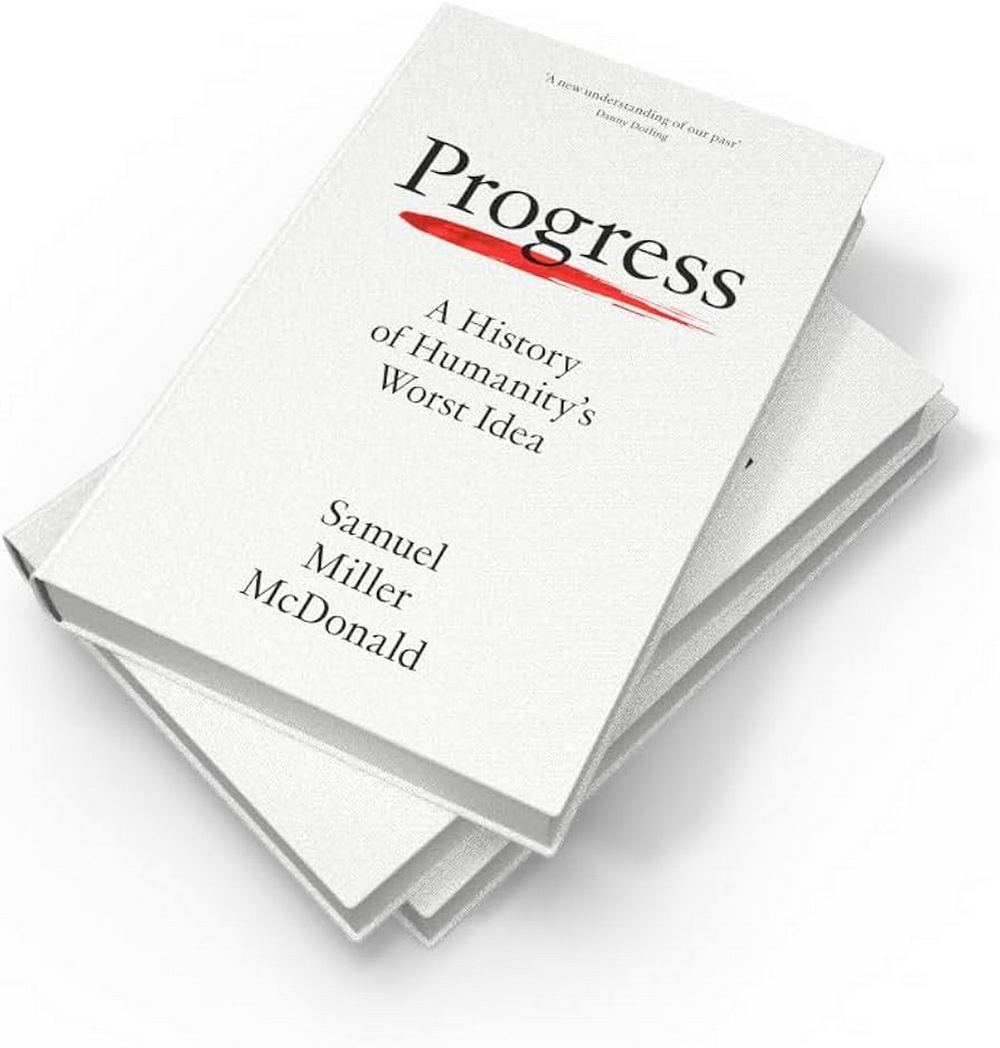
Every so often a book comes along that causes us to question something many have considered a self-evident truth. The ‘truth’ questioned by Samuel Miller McDonald in his recently published Progress. A History of Humanity’s Worst Idea by (William Collins, 2025, 424pp.) is that the story of humanity has been one of gradual and, more recently, rapid amelioration in the conditions of life. There has been a growing understanding that the hunter-gatherer period of human existence (i.e. the first 290,000 of the 300,000 years of our species’ existence) was characterised by a egalitarian, non-hierarchical and relatively peaceful lifestyle. At the same time it was a comparatively hand to mouth (‘immediate return’) existence and it might be thought that the increase in wealth brought about by the shift to settled agriculture starting around 10,000 years ago would have improved this – and increasingly as time went by. The author of this book argues that not only was this not the case, but that over the last ten millennia (and especially during the last five) the lives of human beings have actually got worse, even during what is usually seen as the vast leap in living conditions of the last 100 years or so, during which period life is usually seen as having improved beyond all measure for most on the planet. While not failing to recognise such developments as state health services, eradication of many fatal diseases, ability of workers to take industrial action, health and safety laws, advances in gender and race equality, and overall higher living standards, his challenge to this narrative is that some benefits to some humans on the planet have caused untold suffering – and even extermination – to very many others as well as to countless non-human creatures and to the planet as a whole.
Hierarchy and empires
In a work that is widely sourced and painstakingly referenced and, as a comment on its dust cover states, ‘spans cultures, continents and millennia’, MacDonald sets out to illustrate his thesis in two main ways. He does it firstly by pointing to how the coming of agriculture upset the equilibrium of previous human societies bringing with it with hierarchy, domination of the few and unequal access to the means of living and resulted in countless oppressive empires, in untold suffering for millions through the practice of slavery, in destructive wars that killed many other millions and still persist, and in the theft in recent times of the lands of Indigenous populations who were also subjected to indescribable cruelty and, in many cases, extermination. Examples he gives, with significant and vivid detail, are the ruthless Roman rule over its Empire, the Viking invasions of the British Isles with its accompanying plunder and slaughter, the ultra-violent expansion of the Islamic and Mongolian Empires of the Middle and Near East, the horrors of the transatlantic slave trade, and the European takeover of the Americas and the barbaric treatment and near annihilation of its native peoples.
He gives particular prominence to this last phenomenon, which he calls ‘the genocide of the Americas’, which, he says, ‘represented potentially the greatest loss of human life and cultural diversity in any single event up to that point, eradicating tens of millions of lives and dozens or hundreds of cultures [and] killing billions of animals in the process’. He also suggests that the attempt to conquer Europe by Hitler’s Nazis and their industrialised murder of those millions regarded as ‘other’ (Jews and gypsies in particular) is likely to have taken its inspiration from the American treatment of the continent’s indigenous peoples, ‘justified’ as it was by the USA’s founding concept of ‘manifest destiny’. In this context he quotes with approval the words of Howard Zinn: ‘Indian removal was necessary for the opening of the vast American lands to agriculture, to commerce, to markets, to the development of the modern capitalist economy.’ It should be added that, at the same time, the author does not fail to draw attention to and condemn what he terms ‘the cults of Stalinism and Maoism’ in the Soviet Union and China which claimed the lives of millions more.
Parasitism vs commensalism
His other principal point of reference concerns the effect of ongoing economic growth by humans on the biosphere. In bringing about apparent improvements in living standards for some, this has, he argues, progressively damaged the ecology of the planet, wiping out species which are part of the natural environment and causing what may be irreparable damage to its necessary biodiversity. He points to the rapid acceleration of this over the past two centuries and to the fact that, despite widespread consciousness of it, there are no signs that it is abating. All this he attributes to what he calls ‘parasitic systems’ (a concept used with great frequency in this book), that is systems whose purpose has been (and continues to be) to extract as much as possible from the biosphere without serious thought for the consequences and which have done this by ‘hijacking human beings’ natural cooperativeness’. The focus of these parasitic systems is, he tells us, ‘growth’, economic growth, the only type of development that human society, and particularly those who currently dominate it, see as ‘progress’. He sees this as a disastrous practice, ‘a mass, collective delusion’, and so, as per the title of his book, ‘humanity’s worst idea’.
The author’s argument that ‘progress’ has inflicted devastating collateral damage on humans, non-human creatures and the environment alike is nothing if not cogent and powerful. But where does he (and we) go from here? What, if anything, does he have to suggest to replace the ‘progress’ mantra, which in the modern world is nothing other than the economic growth every government declares to be imperative? Having hinted in various parts of his book at alternative ways in which human societies might move forward, in a final 40-page section entitled ‘After Progress’, he proceeds to go into this in more detail. Broadly he argues for a society with a ‘mutualistic’ form of relationship between individual humans as well as between human society and the natural environment, one that needs to be ‘non-extractive’ and ‘non-exploitative’ Or, if that is not always entirely feasible, he favours at least relationships he calls ‘commensalistic’, where humans benefit by exchanging their particular skills with one another while being careful that nature should come to no harm.
Better not more
What does this mean in social and political terms? While at one point declaring himself in favour of ‘democratic socialism’ and having made it clear that this has nothing to do with the kind of ‘socialism’ associated with the old Soviet Union, or with China (seen as being ‘state capitalist’ and entirely undemocratic) or with Cuba (described as having ‘welcomed economic liberalisation without any of the apparent benefits of political liberalisation’), he is at pains not to propose any single or existing ‘model’ of society as something to imitate or to build on. And he dismisses any notion that human society should (or could) go back to its earliest stages where the conditions of life and the pro-social nature of humanity combined to provide a self-sufficient, egalitarian existence. However, he does see a future where ‘growth’ and the colossal cost it exacts from both humans and the natural world are replaced by a society that uses the advanced technology now available to create a settled and satisfying existence for all – a society of better rather than more, one perhaps reflecting his description of the earliest human societies as ‘rich in leisure time, generous and egalitarian in its distribution of resources, abundant in communion with people and wildlife’.
Profit – the core of capitalism
How can this be brought about? On this the writer, perhaps understandably, offers guidelines rather than prescriptions or recipes. Broadly he seems to favour not widespread political action but, for example, ‘agro-ecology’, ‘land-based resistance movements’ and pressure for universal basic income, which activities he sees as already taking place on a significant scale and presaging well for the future. He sees no point in pressing governments, growth-obsessed as they inevitably are, to take action to do things such as mitigate climate change, since any such declared ambitions will always be destined to fail or just have the function of political theatre. But while he – understandably – seems, on the one hand, to have no faith in the governments who manage the capitalist system to enact meaningful change, on the other he seems also to see a distinction between different ways in which they might run it. That is to say that he consistently declares abhorrence for what he calls ‘neo-liberalism’, the kind of free-market capitalism he describes as ‘lubricated by relationships based on self-interested transactions’ where the function of the state is the simple one of oversight of the market’s predatory operations. Rather he indicates more of a preference for the kind of capitalism in which there is greater state control both in ownership of industry and surveillance of the privately owned sector.
The trouble here – and this is something that does not seem to be clearly perceived – is that the core of all versions of capitalism is the profit motive, which is inherently extractive, prejudicial to the majority, and unsustainable. Any form of capitalism, with its money system and buying and selling, can only, whatever the preferences or intentions of those in charge of it, to be run along lines of growth and profit. And in all cases the role of a government is to be the executive committee of the owning class. It cannot bring about – or even start to bring about – the production for use society that MacDonald would clearly like to see. It seems futile to argue therefore, as he does, that ‘a guided decline in some forms of production would be helpful’, since such a thing could not happen under any government without the needs of profit and ‘progress’ demanding it.
A total break
So while this book is a powerful indictment of modern capitalism – and of the other hierarchical systems that preceded it – what is far less persuasive about it is how it points forward to a transcendence of it, i.e. how the author proposes to get to a different kind of social arrangements for humanity where we can, in his own words, ‘pursue a non-parasitic mode of human ecology and political economy’ [and] ‘democratic, participatory and community connection’. He states quite correctly that ‘a total break is needed’, that ‘mass, collective delusion must go’, and that ‘we need to have a new conception of our place in our ongoing history’. But for that to happen what is needed is democratic action, ideally via the ballot box, by a socially conscious majority to establish the kind of cooperative society that he is clearly looking for, one of free access to all goods and services where human needs and the health of the planet are the driving force – in other words ‘progress’ in its most positive sense.
HKM