
Book reviews – Service, Wynn-Williams, Coggan – plus exhibition
 Blood on the Snow: The Russian Revolution 1914-1924. By Robert Service ISBN 9781529065855
Continuing his popular histories of the 1917 Russian Revolution, Robert Service seeks to look more broadly at events, rather than through personalities and political decisions alone. Rather, he seeks to ‘explore […] how ‘ordinary’ people coped – or failed to cope – with the shattering dislocation of Russian and global affairs’ during the revolutionary period.
He utilises the diaries of the likes of Alexei Shtukaturov, a worker who was conscripted into the Imperial Army, and Alexander Zamaraev, a peasant, too old to be conscripted. Embedded within the stories of events, their own words reveal frustrations and aspirations. In part, this helps unveil the political sophistication of those often dismissed as ignorant peasants (as Service notes, ‘peasant’ was a legal, rather than an economic category). Nonetheless, the frustrations of the peasants form a significant backdrop to the events of the revolution.
Zamaraev lived in Totma district, Vologda, where 92 percent of agricultural land belonged to the state, church, and Imperial family. His diaries reveal concern over conscription, support for the Tsar and for the war, and over access to food as the war continued.
Service effectively brings home the conditions under Tsarism during the war, and helps show how common people were far from passive objects during these great events. At this time, one-third of European Russia was placed under martial law, and 13 million men went through the army (Service notes its harsh discipline.) Many others also laboured in the civilian economy. This fact, and the way that previously toothless local government bodies took on increasing responsibility for welfare provision, such as food and medicine, in a co-ordinated fashion (later to be joined by industrial committees) prefigured the kind of state that was to come out of the war.
Service is critical of Tsar Nicholas, especially his war aim of trying to gain Istanbul (or Tsargrad, as they referred to it) for the Russian empire. Service also notes the racist suppression of Jews and Poles within the Empire, the Tsar’s failure to grapple with its massive structural problems, and the way he vigorously resisted the changes needed to fight a modern mechanised war.
He notes that the Bolsheviks did not expect or want the specific revolution that they found themselves involved in, but that the line of party discipline and a one-party state were part of their core ideas from the very beginning: ‘They opted for force over persuasion; for central authority over democratic accountability’. They had no more legitimacy than the provisional government of Kerensky, but they were more prepared to use force to get their way.
The book draws out the role of the peasants, economically, politically and legally, and the way their frustrations formed a significant part of the backdrop to the drama against which the political leaders played their parts. In his assessments, though, Service does not look at whether there was any alternative path available which could have led to a different outcome.
P.S.
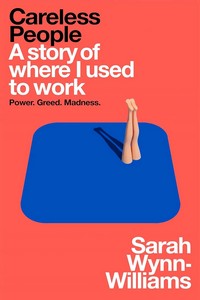 Careless People: Power, Greed, Madness. A story of where I used to work. By Sarah Wynn-Williams (2025, 4th Estate)
Remember the Metaverse? Funny that you don’t hear much about it these days. This was going to be the Next Big Thing, the fully immersive virtual reality (VR) heaven where we all spent every waking moment, in our aspirational avatar forms, shopping, meeting people, swanning around in flying cars, and never going outside to see the real sky, or indeed talk to a real person. Unappealing as all this might sound to jaded old cynics and doubters, Mark Zuckerberg was so excited by his own visionary virtual universe that he changed his company name from Facebook to Meta, hired thousands of engineers and invested $36bn in development. As might be expected, tech firms chucked in plenty of money too, just in case it ever took off, and even manufacturers and high-street businesses like HSBC, Skechers, Bosch, Next and Heineken. Seoul City Council even went so far as to build a VR community space where people could ‘take advantage of public services 24/7 all year round and even visit the virtual mayor’s office and library’, as well as availing themselves of ‘various administrative services such as economy, education, and tax affairs’.
It’s hard to imagine a duller advertisement for the Metaverse than, ‘Hey, you can use it to pay your taxes!’ For once, the doubters were on the money. It turned out people didn’t want to spend their lives indoors wearing silly Oculus headsets. Sales flopped, followed by investments, until Zuckerberg quietly dropped the whole project.
One indication of how preposterous the whole thing was, and also why apparently nobody told Zuck this at the time, is the fact that in her tell-all exposé of her five years as a top Facebook executive, Sarah Wynn-Williams doesn’t bother to mention the Metaverse once. But she does have plenty to say about Facebook’s dirty off-book activities. One of these, which Facebook publicly denied to the consternation of their own marketing teams who were using it as a selling point, was to target vulnerable teenagers who had just deleted a selfie by thrusting beauty ads at them, on the assumption that they must hate the way they look. Though often funny, the darkest part of the book is where Zuck finally realises how the Trump campaign has used Facebook’s comprehensive data tools in an ingenious and targeted misinformation offensive in order to win the 2016 election. What’s dark about this is that Zuck and the other FB execs are not horrified, they are impressed. Zuck allegedly even begins to form his own plans to use the same techniques to run for president himself. After all, he’s so rich he wouldn’t even need to fund-raise.
The take-home gist is that, whereas FB starts off as a maladroit mix of idealists and nerdy technicians with no concept of the political reverberations they are about to unleash on the world, the more wealth and power they acquire, the less they give a damn about anyone or anything, a point rammed home by their casual indifference to the FB-driven massacres in Myanmar. Nobody comes out of this book looking good, including in some ways the author. The corruption, hypocrisy, sexual harassment and megalomania are laid bare for all to see. Some of these people would probably have been jailed, except that capitalism doesn’t jail people this stupendously rich. Zuckerberg, increasingly isolated in a protective shell of fawning sycophants, comes across as having had any trace of humanity surgically removed. He is never told that any of his ideas (like the Metaverse?) are just dumb and won’t work, because FB ‘ices out’ and then fires anyone who dares. He’s actually tried to have this book banned in the USA, a truly stupid move because of the ‘Streisand effect’, where attempts to suppress tend to backfire in spectacular fashion. To no one’s surprise, the free-speech champion’s attempt at censorship has sent the book to the top of the bestseller list.
But in truth, apart from showing how dysfunctional the business is, there are no real revelations that weren’t already out there. Yes, Zuck lied to Congress. Yes, FB are manipulative bastards out to make money out of your data. No, they have no scruples whatsoever. We knew or could guess all that. It’s a fun read, but socialists won’t be surprised by any of it. It’s just the reality of capitalist business with the veneer removed.
PJS
 Planlessness
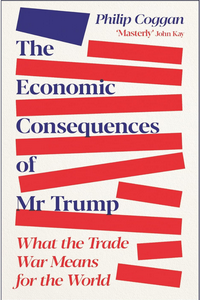
The Economic Consequences of Mr Trump: What the Trade War Means for the World. By Philip Coggan. Profile £7.99.
A first reaction to this book is that it was likely to be out of date by the time it was published. Given Trump’s tendency to change his mind, anything said would probably no longer apply after a month or two. The author does indeed record Trump’s decisions about tariffs and his repeated revisions of them, describing him as ‘a man without a plan’ who based the calculation of tariff rates on an absurd formula. But he also notes some ideas that underlie Trump’s policies.
The main reason seems to be the intention to return manufacturing industries (and jobs) to the US, but this is unlikely to be successful. In 2013, as an illustration, Motorola opened a smartphone factory in Texas, but it closed after a year because of high costs. Even when it does pay off, building new factories takes time and the US has a shortage of factory workers; they might come from abroad, but of course Trump is clamping down on immigration. The US will simply not re-enter ‘a golden age of manufacturing employment’.
On the whole Coggan adopts an orthodox economic perspective, arguing, for example, that tariffs interfere with market signals about the causes of rising and falling prices. Tariffs have varied over the centuries and protectionism was more widespread between the two world wars. But since the 1960s tariffs have generally been falling, from a global average of 14 percent then to 10.9 per cent in 2000 and 2.5 per cent in 2021. Free trade, he says, is good for an economy, though there has rarely been completely free trade.
One good point he makes is about the interconnectedness of global production, with long and complex supply chains. An iPhone is based on 187 suppliers across twenty-eight countries, while cars imported to the US from Mexico consist largely of components made in the US. Around eighty per cent of the toys sold in US shops are made in China, so the massive tariffs Trump wanted to impose on imports from China were a non-starter, and they have now been scaled back in a major way. American workers are already complaining about higher food prices as a result of the various tariffs, such as bread doubling in price (Guardian 19 October).
The whole world, Coggan suggests at the end of this short volume, ‘will suffer the adverse economic consequences of Mr Trump’. But really these are the consequences of the capitalist system, not the result of the idiosyncrasies of one man.
PB
Exhibition Review – Manchester and the world
The John Rylands Library in Manchester was founded on the basis of profits made from the cotton industry. It is currently staging an exhibition, ‘Cottonopolis: the Origins of Global Manchester’, on until May. A number of books, letters and samples of cloth are displayed (one of the books being Engels’ The Condition of the Working Class in England).
The population of Manchester grew massively in the 19th century, to over ninety thousand, this increase being mainly in workers in the cotton industry. There were massive increases in production of calico and fustian, especially in the twenty years from 1790, and cotton cloth became Britain’s most valuable export. Inventions by Arkwright, Compton and others increased productivity enormously, and there was sizeable growth in companies that made machines, as well as in companies that output the cotton cloth. Steam power resulted in mechanical mills, and new ways of printing cloth were also developed. Mass production meant that the British weaving industry was able to out-compete manufacturers in India.
But, of course, weaving was only part of the story, as the raw cotton came from plantations worked on by slave labour, in the Caribbean and the American South. Some of the cloths manufactured were poor quality ‘Africa goods’, produced for sale to slave traders to clothe the slaves. One suggestion made in the displays is that the creation of a captive workforce in the colonies changed ideas about how workers in Britain could be exploited under the same industrial machine.
Nor was it just Manchester that profited from the enormous expansion of the cotton trade. Liverpool became an important port for imports and exports, and new canals were built, partly to transport food, coal and so on to the growing industrial hub in the city and its surroundings.
Not a large exhibition, but an informative and interesting set of displays.
PB