
Rights – a movable feast / Doughnut revisited
 Rights – a movable feast
The Tory leader, Kemi Badenoch, recently announced that her Party will take the UK out of the European Convention on Human Rights if they win the next election. A big ‘if’ obviously, but, in stating at the same time that such a move was ‘necessary to protect our borders, our veterans, and our citizens’, it’s clear that what she was trying to do was to steal the clothes of her dangerous competitor on the right wing of British capitalist politics, Reform UK. She was giving a nod towards the extreme nationalism that currently seems rampant and gets expressed most virulently in the call to ‘stop the boats’.
Whether any such move would actually curb immigration is of course open to question, but, if what would seem to be the most overarching of rights – human rights – can be removed at a stroke by a government with a parliamentary majority, is there anything permanent or consistent in the notion of rights at all?
How many rights?
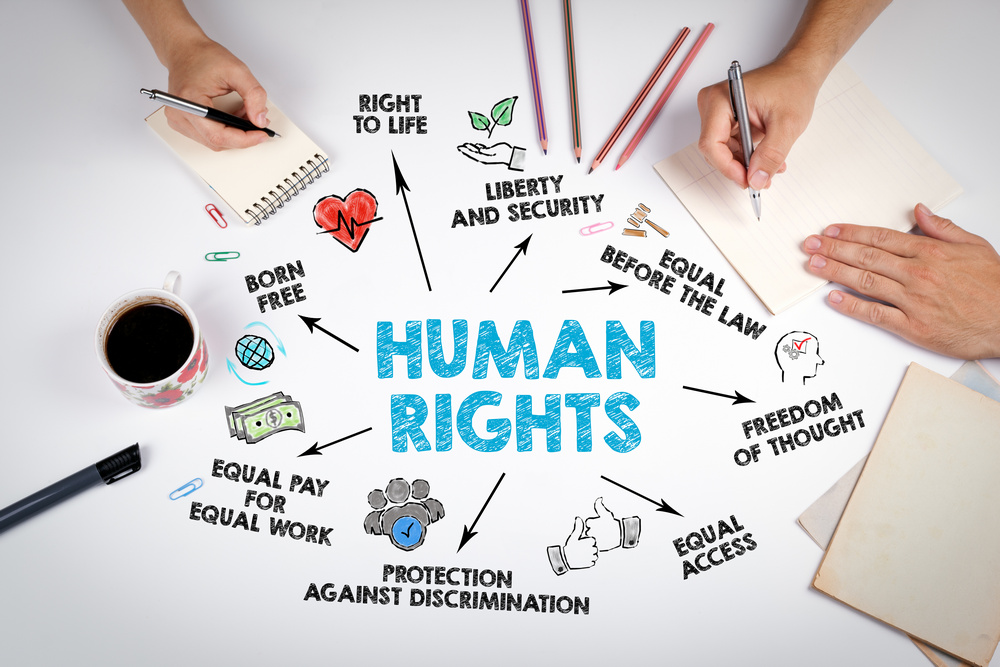
We certainly hear much noise about rights, both from those who want to do away with or weaken them and from others who oppose their removal or weakening. What kind of rights are we talking about? Well, to give a few examples, there are workers’ rights, pension rights, women’s rights, property rights, gay rights, the right to free speech, the right to family life, the right to privacy, the right to strike, the right to peaceful protest, the right to education, the right to a fair trial, and so on. A short time ago I found myself attending a lecture given by the Older Persons’ Commissioner for Wales on the subject of ‘How we move from principles to practice to make rights real for older people’. There are also some ‘rights’ which, while often talked about in the past, little is heard of these days – for instance, ‘the right to work’ or ‘ the right to rest and holiday’. There are also some bizarre ‘twists’ on the rights agenda, such as ‘the right to bear arms’ (usually with reference to the US), and ‘the rights of the unborn child’ (insisted on by opponents of abortion).
Looking at the broad historical context, rights are a feature of the fact that the system we live under has found ways of becoming more benign and less repressive. The overriding reason for this has been the perception by governments and wealth owners that those in society who have to work for a wage or salary to survive are more likely to do that readily and acceptingly and at the same time be more productive and efficient in their work if their lives are made not altogether uncomfortable. And indeed one of the effects of having the various ‘rights’ conferred has been to make us feel more comfortable in our position as wage slaves. But it took a long time. Most of today’s ‘rights’ would have been considered unthinkable not just in pre-modern times, where the ‘divine right of kings’ prevailed, but even in the early years of industrialisation and capitalist development. In the nineteenth century, for example, talk of, say, ‘women’s rights’ or the ‘right to education’ or ‘pension rights’ would have been unlikely to say the least. And, until well into the 20th century, even the notion of ‘workers’ rights’ was much contested, and only in recent times has ‘gay rights’ become part of the vocabulary of English. This kind of thing is of course still very much the case in many ‘less developed’ parts of the world where dictatorial or repressive regimes hold sway. Examples such as North Korea, Myanmar, China, Belarus and some countries in Africa and the Middle East come to mind.
Different ‘rights’ in different places
But, despite the existence of many kinds of ‘rights’ in most of Europe and North America, it would be mistaken to regard these as necessarily permanent or consistent features. They can easily be watered down or removed by the governments that oversee the system of production for profit and buying and selling that we live in (ie, capitalism), if it seems to them to be in the interest of the continued smooth running of that system to do that. A British government deciding to withdraw from the European Convention on Human Rights, as the Tory leader has promised to do if her Party comes to power, would be an example of that. A recent example of this actually happening has been the watering down of the right to peaceful protest by the ban on demonstrations by supporters of the Palestine Action group. As for ‘the right to strike’, it still exists of course, but it has been chipped away at by various different governments, with the overall effect of making striking today markedly more difficult for workers than at times in the past. I have testified to another instance of the watering down of ‘rights’ in my own place of work, where the contracts signed by employees have moved from specifying a ‘maximum’ of 35 hours as the standard working week in recognition of ‘The European Working Time Directive’, to now specifying a working week of ‘at least’ 35 hours.
And there can also be striking differences between the most economically advanced countries in the rights they accord. The most ‘generous’ in this domain tend to be the Scandinavian countries, while in the United States, despite its being the hub of world capitalism, ‘workers’ rights’, for instance, are all but non-existent. To give an example, in Sweden parents are eligible for up to 480 days of paid parental leave from their employment, a policy driven by the idea that children well looked after by their parents are likely to be more productive and better socially integrated later in life when they enter ‘the world of work’. In the US, where a different ethic (more of a dog-eat-dog one) prevails, there is no statutory ‘right’ to paid leave, such being entirely at the employer’s discretion. This can create situations, as one commentator has put it, where ‘American parents scramble back to work days after giving birth’. To add to this, employment practice in the US regards work as a voluntary contract which can be dissolved at any time by either party without the mandatory right to redundancy pay for the employee.
A slippery concept
The reality is that ‘rights’ (like reforms) are very much a movable feast easily or not so easily granted but then rowed back on as convenient and also sometimes differing drastically even from one economically advanced country to another. The 1948 Universal Declaration of Human Rights asserted everyone’s right to an adequate standard of living, including the right to food, public services and social security. But everyone knows that, in a world where people may be poorly paid, unemployed or homeless, this is no more than an unattainable wish list. What price such people’s right to an ‘adequate standard of living’ or their ‘property rights’? Again, while very few would disagree that people should have the right to free speech and the right to be free from arbitrary arrest or imprisonment, how does that square with the reality of a system where the accumulation of wealth for the already wealthy few dominates and allows authoritarian regimes (Venezuela, Cuba, Russia, etc) to fly in the face of that?
In the kind of world socialists campaign to see established – marketless, moneyless, wageless, leaderless, and based on voluntary work, democratic organisation and free access to all goods and services – the slippery concept that is ‘rights’ will not enter into the equation. Instead, in a classless society of human freedom, needs, both practical and social, will be satisfied as a matter of course. Above all, the productive machinery of society and the goods and services it produces will belong not to one class, but to everyone as an automatic and inalienable ‘right’.
HKM
 The Doughnut revisited
In last month’s Socialist Standard we discussed Kate Raworth’s book Doughnut Economics. As it happens, on 1 October Raworth and co-author Andrew Fanning published an online paper ‘Doughnut of social and planetary boundaries monitors a world out of balance’ in the journal Nature . This updates and widens the scope of previous work in this framework.
Things have not improved since the original work was done: ‘Billions of people are falling short of meeting their most essential needs, whereas humanity’s ecological imprint on the living planet is now overshooting at least six of the nine planetary boundaries’. Previously four of the boundaries had been crossed, ecological limits which it was essential to keep within.
The boundaries are measured in terms of indicators, with more than one indicator for some boundaries. Ozone-layer depletion has been stable since the early 2000s, but the other indicators for which information over time is available show a worsening of conditions. For instance, four indicators have more than doubled the extent to which they exceed acceptable limits: CO2 concentration and radiative forcing (both of which relate to the climate change boundary), and hazardous chemicals and phosphorus (relating to chemical and nutrient pollution).
The inner ring of the Doughnut deals with meeting people’s needs. Here two indicators have deteriorated significantly, food insecurity and the existence of autocratic regimes. Others have improved, but only slightly, with 10 percent of the world’s population being undernourished in 2021–2, compared to 13 percent in 2000-1. A rapid improvement would be needed to eliminate this problem by 2030. The proportion lacking access to safely managed drinking water only went down from 39 percent to 37 percent over the same period.
Has there been progress overall? Global GDP doubled between 2000 and 2022, but ‘only modest improvements were achieved in reducing social shortfalls worldwide, whereas ecological overshoot increased rapidly, disrupting the critical planetary processes on which all life depends’.
So the Doughnut’s method of examining whether society is coping with meeting everyone’s needs while keeping the planet in a sustainable condition shows very clearly that the present system, capitalism, is unable to meet either goal. A system based on profit cannot solve these problems, and only a change to a world based on production for use will be able to do so.
PB