
Book reviews – Gee, Yang, Lali
Under-population?
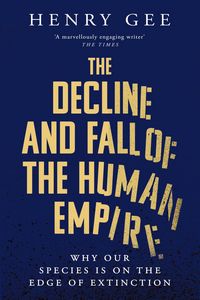 The Decline and Fall of the Human Empire. By Henry Gee, Picador, 2025. 279pp.
This book takes a long view of human history. Going back to the very dawn of hominid existence, it charts the rise of one species of human – our own – among many and looks ahead to where the current slowing down of population growth and the widely expected future decline in population may lead us. Extinction, in fact, is what the author thinks is our likely destination, since smaller populations will find it difficult to summon up sufficient expertise to manage the challenges of an inimical environment and shortage of core resources. The only long-term solution to avoid extinction, he argues – and he doesn’t do it jokingly – is to branch out into space. He insists that, unless we are able to do this, the end for humanity will come within 10,000 years at the most.
As for the present and the less far-flung future, Gee, senior editor at Nature magazine and author of the prize-winning A (Very) Short History of Life on Earth, has what can be regarded as an enlightened take on many facets of social organisation, in which, as he puts it ‘homo sapiens faces a series of political, social, biological and environmental crises unique in its evolutionary history’. For example, he kills stone dead the myths of current over-population and never-ending population rise and at the same time welcomes migrations of people seeking better lives elsewhere (‘the natural state of humanity’, as he puts it). This is not only for their own well-being but also because of the likely benefits for the places they migrate to, since ‘technological advancement requires a substantial resource base in the form of human brains’ and ‘fewer brains mean technological stagnation’. He celebrates too ‘the reproductive and educational empowerment of women’ that has spread to significant parts of the world. Nor does he fail to point out that the way society has been organised for the past 10,000 years (ie settled agriculture, private property, states, rulers and ruled) constitutes a tiny time period in the 315,000-year history of modern humans, little more than 3 percent in fact. And before that settled agriculture period, humans lived without leaders, states, private property and material inequality.
In addition to his view that ‘humans are running out of genetic resilience’ (ie, there won’t be enough of us), another reason he looks at space migration as a future recourse for humanity is that, in his view, climate change will bring upsets such as flooding, storms and droughts that will become increasingly difficult to deal with and are likely to cause high levels of food insecurity. He points to some food insecurity existing already, but he sees it as having ‘more to do with such human foibles as poor governance, corruption and warfare than crop failure per se’. This is undeniable, since, as multiple indicators show, there already exists enough potential food (and all the other necessaries of life) to satisfy the current population, and probably a far larger one. If it does not seem like that, this is because, as this book glimpses but does not delve into, the world’s money economy (and the rationing and conflict over resources that go with it) denies reasonable access to the means of living to a significant proportion of people. So if, as Gee has it, ‘famine is riding down hard on us, faster than ever’, this is not for lack of food or the means to produce and distribute it. It’s to do with the economic system – capitalism (a word never mentioned in this book) – that currently rules the world and causes so many ‘to starve at the banquet’. Unfortunately, this book’s unspoken assumption is that we are stuck with the form of social organisation that causes this.
For all that, however, it remains a fascinating and immensely readable piece of work, wearing its expert and up-to-date knowledge lightly over a wide range of scientific fields. It is written with verve, brio and no little humour. Particularly fascinating to some will be its depiction of a possible space settlement in the far-flung future where a hollowed asteroid is the habitat of a city or cities transported from the earth’s surface and ways have been found of creating artificial gravity – a project described by the author as ‘not insuperable’ with people by then having come to think of it as ‘entirely natural’. Who knows?
But what about the nearer future, ie, before the time comes when we, according to the author, will have to make a choice between reaching for space or becoming extinct? Well, despite his ultimate pessimism about life on earth, he does have some clear ideas about how he would like to see things pan out in the meantime. He suggests, for example, that the strain on the planet’s biological diversity could be reduced by the use of hydroponic farming, so cutting back on the need for farmland. He also recommends reducing ‘meat on the hoof carnivory’, since ‘by eating plants directly, rather than eating animals that eat plants’, humans would use ‘less of the earth’s natural bounty’ and more people could be fed.
But could they? While it’s true that the system we live under has allowed a far greater proportion of the planet’s population to live more comfortably than at any time in the past 10,000 years, that system is, by its very nature, always going to give priority to profit-making over meeting people’s needs. The author perceives quite rightly that homo sapiens has a knack ‘for getting himself out of trouble’, but surely this lies in the more ’united earth’ that Henry Gee says he wishes for rather than in humanity seeking refuge in space. Yet a ‘united earth’ will only be truly possible once we reject the profit system that currently rules humanity and in its place establish a society of common ownership and cooperative organisation with free access for everyone to the ‘earth’s natural bounty’.
HKM
Moving Around
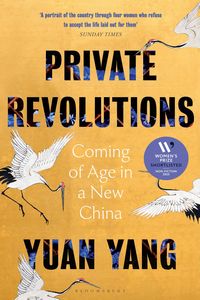 Private Revolutions: Coming of Age in a New China. By Yuan Yang. Bloomsbury £10.99.
The author was born in China but moved to the UK with her parents. She worked as a journalist for the Financial Times in London and Shanghai, and is now a Labour MP. Here she looks at the lives of four women born in China in the 1980s and 90s, their struggles with traditional ideas and the changes in Chinese society. In this review we will focus on the general points made, rather than discussing the individual cases.
One important issue is the hukou system, a household registration system related to a person’s place of birth. This enables them to access local services, such as education and healthcare, but without a local hukou they can face real problems. They may have difficulty getting their children into a suitable middle school, but can try relying on ‘friends of friends’ to influence headteachers to relax the rules. This system is presumably intended as a way of controlling workers, especially, but not only, those who move from the countryside to cities in search of work. Children are often sent to live with their grandparents and so gain access to a school that way.
The possibility of factory work did lead to many people migrating from rural areas, but the numbers often exceeded the jobs available and working hours could be very long. One factory was seen as improving conditions by capping overtime to 9pm and guaranteeing one day off a week. Many migrant workers preferred short-term contracts so they could avoid abusive bosses. But, partly because of Covid, the job market contracted, and by the middle of 2020 one-tenth of urban residents had lost their jobs. Yang says that southern China had industrialised and then de-industrialised within four decades.
The most common problems workers faced were ‘too much overtime, unpaid wages, workplace injuries and being without a labour contract’. There were no effective trade unions, but there were community-based ‘labour NGOs’, providing legal assistance and so on. But such NGOs could find themselves evicted from their offices, and activists were sometimes arrested; some responded by going abroad to study.
For a while, the online forum Utopia (sometimes seen as part of the Chinese ‘New Left’) supported the system under Mao Zedong, before the market reforms of Deng Xiaoping, a time when the welfare system was allegedly better. In 2018 fifty students who had supported workers in an electronics factory who wished to organise their own union were arrested: ‘China’s biggest student crackdown since Tiananmen Square’.
The book provides both general and particular views of what one document on social media in 2012 quoted here described as ‘China’s path towards globalised capitalism’.
Perhaps publishers these days find it hard to provide helpful things like a table of contents.
PB
Trotskyism regurgitated
 Why you should be a communist. By Fiona Lali. Wellred Books. £2. 2025.
Fiona Lali is a member of the Revolutionary Communist Party (ex-Socialist Appeal, the section of the Militant Tendency that stayed in the Labour Party after most left in 1991 until they were themselves finally expelled in 2021). She stood as their candidate in last year’s general election and has become their poster girl (literally as she appears on many of their posters). This pamphlet has been written as part of a recruitment drive by the RCP, at the moment the Trotskyist group that seems to have been the most successful in recruiting young people.
The pamphlet starts off with an attack on capitalism and is aimed at young people who realise that something is wrong with the world and want to do something about it. There is not much that can be objected to here. It’s the second part — about what is to replace capitalism and how — that is open to criticism. It starts off with the absurd claim that ‘the Russian Revolution of October 1917 — led by Lenin and Trotsky — was the greatest event in human history’. An important event in 20th century history perhaps, but in the whole of human history?
We are told that the regime it ushered in, while far from perfect (due to Stalin being in charge), was able, thanks to its ‘nationalised planned economy’, to industrialise the country and provide the workers with ‘extremely low rents’ that included ‘energy and phone services’ and retirement at age 55. The implication is that what happened in Russia in the last century is something to be emulated. But what the Bolshevik seizure of power in 1917 led to was a form of state-run capitalism that left the workers propertyless wage-workers, indeed forcibly changed the peasantry into these. It had nothing to do with communism or socialism. Lali is deceiving herself and misleading others in suggesting otherwise. It is not the path to go down.
She presents the Bolshevik seizure of power as the model for the future. In a section headed ‘need for a revolutionary party’, she tells us that ‘what is required is a party of trained class fighters — cadres — who dedicate themselves to the study of the class, its history, and the theory needed to liberate us’ and that:
‘In the not too distant future, Britain will be convulsed by revolutionary upheavals. It is essential that we build a revolutionary party in advance of these titanic events. This is what we are doing. And we appeal to you to join us in this effort.’
Apparently, hundreds of young people, of which Lali is one herself, have responded to this appeal. It’s the classic formula, successfully applied in the 1960s and 1970s by the founders of Trotskyist groups, to attract young people discontented with capitalism — promising them exciting times of ‘revolutionary upheavals’ and ‘titanic events’ in ‘the not too distant future’.
There are good opportunities to advance the socialist cause at the moment but to make extravagant promises like these can only lead to disillusionment when they don’t materialise. The only positive outcome would be that some will be able to sort the Marxist wheat, which they will have had to study, from the Leninist chaff.
ALB