
Proper Gander – Processing progress
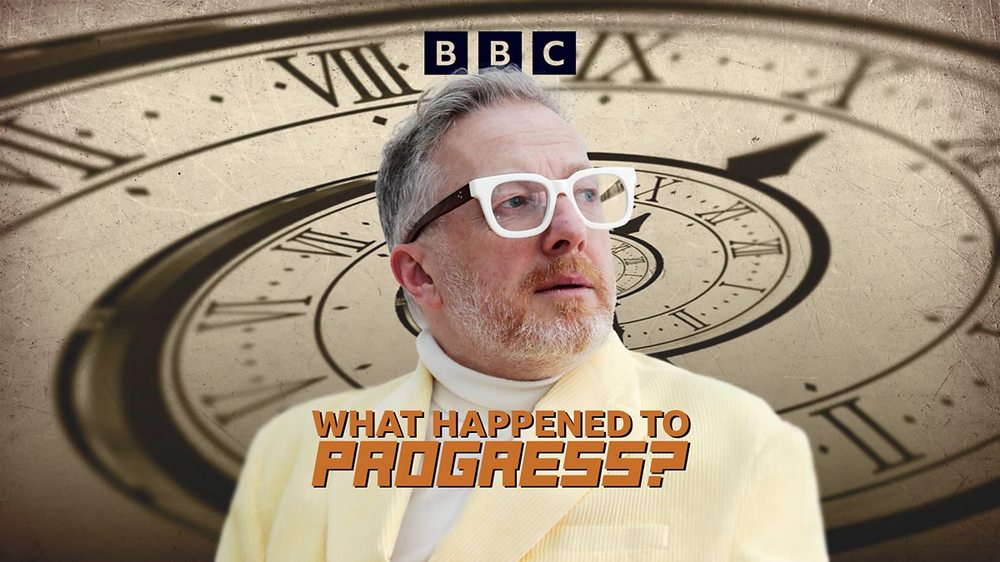
The 2020s is a particularly unsettling decade to be living in, and the whole of the 21st century so far hasn’t been the utopia which our forebears might have expected it to be. Cultural historian Matthew Sweet explores this current bleak mood by asking What Happened To Progress? in his BBC Sounds documentary series. The premise is that there is a ‘polycrisis’ in the realms of technology, the economy, the environment and global politics. As none of these are working in a way which benefits most people, our attitude towards progress has been affected. Sweet and other academics, writers and specialists give their views around how ‘one of the foundations of our economic system – progress understood as endless growth and rising prosperity – is looking pretty brittle right now’.
According to artist James Bridle, we have come to think of progress as being a line on a graph, swooping upwards and to the right. The background assumption has been that our children will inherit a better world where they can be happier, healthier, wealthier and wiser than ourselves. As other contributors explain, this concept of progress hasn’t always been part of our collective psyche. In previous societies, expectations for the future were more aligned with the cyclical patterns in nature, or had a ‘rise and fall’ narrative. Classicist Edith Hall reminds us that acquiring knowledge led to a fall in both the Adam and Eve story in Abrahamic religions and Pandora’s Box in Greek mythology. There’s a consensus among the contributors that our modern understanding of ‘progress’ emerged during the 17th and 18th centuries, through the philosophical works of figures such as Francis Bacon, Adam Smith and Immanuel Kant. Progress became more practical with the technical achievements of the 19th century. As author John Lanchester tells us, resources were seen as limitless as economies expanded through industrialisation.
There were improvements in many communities’ living standards, healthcare and literacy which carried on into the 20th century. Sweet says that the First World War ‘broke the link … between technological and moral advancement’, with the slaughter enabled by the knowledge to manufacture ‘tanks, submarines and razor wire’. As a response, multi-national institutions were formed, such as the League of Nations, the Non-Aligned Movement and the United Nations, although these haven’t led to world peace, and war is now more of a threat than ever. As well as weaponry, Artificial Intelligence is another instance of how the results of scientific progress prompt fears about their impact, although climate change is described as the ‘ultimate example’. Contemporary uncertainty around progress comes from the tension between realising it isn’t a simple upward curve and a need for its reassurance, as described by psychoanalyst Adam Philips. Philosopher John Gray expands on this with a lively definition of progress as ‘the crutch, … balm, … therapy, … talisman … to stave off dread or even despair’. Our expectation of progress, as writer Philip Ball says, is out of kilter with how the natural world and society function.
Karl Marx’s views about how society functions are cited occasionally through the series, such as his ‘rival proposal’ to Kant’s ‘fanciful’ idea about a peaceful coalition of states. Historian Margaret MacMillan promisingly describes Marx’s Capital as being about progress to ‘a world in which there are no national borders, no classes left’. But this is only briefly mentioned, confusingly (but predictably) alongside references to Lenin and the so-called ‘communism’ of the USSR and China which had different aims entirely. On the other occasions when Marx is discussed, he’s presented as a poet, with an evocative reading of the ‘all that is solid melts into air’ quote from chapter one of The Communist Manifesto.
What Happened To Progress? is edited so that each contributor only speaks a few lines at a time before the emphasis is changed by someone else. Although this means that a range of perspectives are given, there isn’t the space for explaining in much depth. As indicated by the disparate references to Marx, the fundamental role of the economic structure of society in creating the material conditions for ‘progress’ isn’t explored in any detail. Many of the contributors’ observations and stances would snap into place with the context that progress and our understanding of it are moulded by how capitalism has to function. Goods are produced, services are operated and governments are run according to what is advantageous to the minority who own industries and wield power. Profitability for the few is directly or indirectly the defining factor in whether an innovation takes hold. This means that progress is shaped by what is in the interests of the capitalist class rather than by what benefits humanity in general.
The consequences of this are shown by the ‘polycrisis’ in society and the weakening of our belief in progress. As this notion became established through the advancements of the Enlightenment and the Industrial Revolution, it came from an era when capitalism was a progressive force in developing society’s infrastructure. But we have already reached the point where technology and administrative structures can potentially provide a decent standard of living for everyone. The decline in a belief in progress reflects how capitalism is no longer progressive. The documentary winds down with the contributors considering whether we should reject, retain or reclaim the idea of progress, with John Lanchester wondering whether we’re now on a ‘shift to something else’. In our view, to get the world out of its current rut, this would have to be a collective shift to replace capitalism with a social system where progress can mean improvements for all.
MIKE FOSTER