
Life and Times – The World Unspun
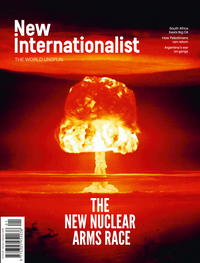 Ever since I can remember I’ve had a subscription to the New Internationalist magazine. Its watchword, ‘The World Unspun’, marks it out as a campaigning publication which aims to present matters of both local and global importance in as direct and straightforward a way as possible. Its main focus has always been what used to be called the Third World, now more commonly known as the Global South, but it also ranges more widely across issues it sees as vital to humanity as a whole. Its stance is supportive of what it sees as ‘progressive’ movements reflecting a will to see humans across the globe live in a more peaceful and united fashion than at present.
Even if I don’t always necessarily share its analysis of situations and developments, I’ve never found it anything less than a refreshing read with a lively Letters page that’s ready to publish readers’ views, even if in disagreement with its own stance. Over the years some of these letters have come from members of the Socialist Party, including myself. Its 80-odd pages always range widely over a variety of themes, normally of a topical nature, with a layout, presentation and illustrations which are always of the very highest professional standard.
The current edition (Jan-Feb 2026) has as its ‘Big Story’ a series of articles on nuclear weapons and the arms trade, while several short pieces look at, for example, the effects of Hurricane Melissa in Haiti, Malaysia’s round-ups of Rohingya refugees, plans to reinstate the death penalty in Kyrgyzstan, and Trump’s deportation drive in the US. There are reports from Ethiopia, Venezuela, Iran, Peru and India, and its ‘View from Brazil’ is an example of how, while broadly supportive of the more liberal government that recently came to power there, it does not fail to analyse and be critical of how the authorities’ war on drug gangs has led to the deaths of many innocent and poverty-stricken people. Its longest single feature, entitled ‘Neocolonialism in Gaza’ refers to what is happening there as ‘repackaged neocolonialism’ and provides powerful and dramatic descriptions of a war that has not yet fully abated and where ‘365 square kilometers … has been subjected to the equivalent of six times the atomic bomb that was dropped on Hiroshima’ and ‘the bodies of thousands of slain Palestinian are yet to be recovered’. It warns chillingly of a future in which ‘a site of mass killing’ is turned into ‘a stage for profit’.
And there is much else. For example, an informative and extremely well-formulated and designed 4-page ‘cartoon history’ of Christopher Columbus depicts the horrors that the explorer’s ‘discoveries’ inflicted on countless indigenous people. And there are several pages of book, film and music reviews, and even an ‘Agony Uncle’ column, which, in the current issue, tries to answer in an entirely serious and balanced way a reader’s ‘ethical’ dilemma about cat ownership in the face of the mass killing of birds and other mammals by domestic cats. The regular two-page ‘country profile’ in this issue is on Iran and provides a highly informative and objective sweep of that country’s history and its current situation complemented by interesting and statistical analysis, none of which is complimentary to the current regime there. The magazine also contains a certain amount of advertising, mainly for ‘ethically’ produced goods and services, some of them coming from the New Internationalist cooperative itself.
While the overall thrust of the New Internationalist is what socialists would see as reformist in its support for political and social reforms and gradual improvements in economic conditions for the working majority, it does not seem entirely antagonistic towards the more ambitious objectives of the Socialist Party. This is as instanced by its willingness to publish letters our members have sometimes sent pointing towards a more profound, indeed revolutionary, kind of social change, where the current system of individual states and production for profit would be replaced by a united world society of common ownership, democratic control and free access to all goods and services.
Indeed, I am waiting to see whether a letter I myself have recently sent to the magazine will be published. In it I’ve replied to another reader’s letter which expressed dissatisfaction with the suggestion made in an article that governments throughout the world could be divided into two types: ‘authoritarian regimes’ and ‘liberal democracies’. The reader saw that division as over-simplistic and suggested rather that states should be divided not into two types but into seven according to their political complexion. What I have suggested in my response is that, although such distinctions might be useful for some purposes, what’s far more significant – at least for those of us looking forward to fundamental social change – is not what divides countries and nations according to type of regime but rather the overarching economic system they are all part of (ie capitalism), with its characteristics of wage labour, buying and selling, and tiny minorities owning or controlling the vast majority of the wealth. And this was the case, the letter goes on, whether countries are run along totalitarian lines, or as so-called liberal democracies, or anything in between. It concludes that it’s the economic system as a whole that needs to be got rid of via majority global consciousness and democratic political action and replaced by a society of common ownership, free access to all goods and services and production solely for need.
As I’ve said, the New Internationalist is pretty good at publishing letters that don’t align with their own preoccupations. Will they publish this one? Let’s see.
HOWARD MOSS