
Book reviews – Davis, Klein/Thompson, Burgis
 Replace the State. How to Change the World when Elections and Protests Fail. By Sasha Davis. University of Minnesota Press. 2025. 175pp.
A book with a title like Replace the State cannot but catch the eye of an organisation like the Socialist Party that advocates a stateless system of society. Appearances can be deceiving of course. So to what extent does this book live up to the promise of its title?
The first thing to say is that, for the author of this book, replacing the state does not mean establishing a society without a state or states. What it means is small groups taking ‘direct action’ to manage or take over ‘contested sites’ where the existing system may be oppressing local communities and causing societal or environmental damage. Many of these sites referred to in this book are ‘indigenous’, that is to say they are what remains of the local original communities there before they were taken over by governments for use as part of the state and the capitalist juggernaut. The kind of action the writer is talking about is occupation of spaces (the term he uses for this is ‘counteroccupations’) in which, for example, excluded people can be offered sanctuary, or people can demonstrate their opposition to unwanted local projects (eg military or nuclear bases) and in so doing engage in mutual aid and what he calls ‘participatory governance’ and ‘inclusive and sustainable practices’. Specific examples of this would be, in his own words, ‘worker-run cooperatives, community land trusts and farm spaces dedicated to sustainable food systems and social justice’. And examples he gives of successes in this area are the civil rights movement in the US and the stopping of military training and bombing on one of the small islands of Puerto Rico. ‘Relational governance’ is the umbrella term used here to identify this way of operating, which, the author states, ‘arises from a worldview that recognises the fundamental interconnected and interdependent nature of our societies, ecologies, economies, political systems, bodies and minds’ and ‘contrasts sharply with the view many modern states conceptualize the world and act towards it’.
In terms of ‘worldview’, there is little here we would disagree with. But, given the overwhelming planetary presence of the capitalist system and the power of the national states that exist to administer it, we would have to regard the kind of action the author advocates as a drop in the ocean. He seeks to make a clear distinction between the activities and campaigns he would like to see undertaken and those protest movements that demand social change or reforms via petitions or demonstrations or support for one party considered more ‘progressive’ than others in elections. He refers to such activities (and quite rightly in our view) as ‘chasing our tails’ since, though they may sometimes have the effect of making life a little more bearable for wage and salary earners, they cannot change the fundamental nature of the system of massive wealth inequality we all live in. But it is hard to see how the kind of activity he does recommend – carving out small spaces in the existing system where he hopes things can be run more fairly, more justly and more sustainably – can make a great deal of difference either, or how any benefits arising from it can be more than short term. The writer himself seems to recognise this at one point when he states that, though in many places activists have managed to carve out ‘spaces of self-determination’, it is a strategy that rarely works meaningfully in the long-term and rather, as he puts it, ‘frequently succeeds only for a short period of time and/or in a relatively small space’. Even so, seeming to share the playbook of Trotskyist groups, he insists that workers’ experience of such struggle and striving is essential as it will build to a point of consciousness which will lead them to revolt and to bring in wholesale changes of a radical kind. It can cause, so the author tells us, ‘alternative ways of life to be practiced, modelled, and disseminated’. Yet nothing of this, it must be said, is borne out by examples of this happening in the real world.
We would not, of course, want to seem to be pouring cold water on what are clearly genuine and long-term efforts on the part of the author to propose and encourage ways of changing the world for the better in the face of what he rightly describes as ‘the cascade of catastrophic problems coming at us from every direction’ and of seeking the achievement of what he refers to as a system of ‘equality, inclusion and environmental protection’. He shows clearly too that he recognises the class-divided nature of capitalist society (‘owner vs wage earner’) and the role the state plays in preserving it (‘The State Won’t Fix Our Problems’ is the title of one of his chapters) and sees no mileage in trying to address social ills through the institutions that have caused them. But we would have to ask him to consider whether activity to secure real, widespread – in fact global – social change which he would no doubt wish to see doesn’t rather reside elsewhere. To be precise, whether it doesn’t reside in campaigning to change the outlook of the majority who, the world over, have to work for a wage or salary to survive, and to bring them round to the self-emancipatory consciousness that impels them to vote for an equal, inclusive and environmentally sustainable society of common ownership and democratic control, a society that will genuinely ‘replace the state’ and enable all to fulfil their potential both individually and collectively.
HKM
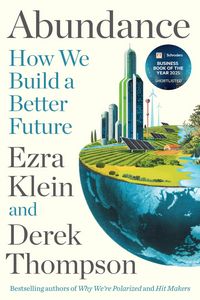 Abundance: How We Build A Better World. By Ezra Klein and Derek Thompson. ISBN 9781805226055
This book has caused quite a stir. It has even made Chancellor Reeves’ summer reading list, and been cited – in passing – by Robert Peston. It is part of the YIMBY (Yes In My Back Yard) trend. Its central theme is that government regulation is choking the capacity for effective action to generate wealth, and that instead the liberal left has been concentrating on the parcelling out of scarcity, rather than trying to improve the overall material wealth of society.
The authors mention the expensive failure to build a high-speed railway in California, citing environmental laws and litigation as the reason: alongside the excessive bureaucracy to plan the route. They also note California has higher rates of homelessness than comparable cities in Texas, and attribute the blame to zoning and to authorities loading environmental, building and labour standards into permissions, making building uneconomic for developers.
In their narrative, they do discuss the nature of landholding and the fact that residents’ houses are also financial assets, only to skip blithely over them to discuss bureaucratic complexity again. In so doing, and returning to their theme that it was the failure of efforts to restrict the power of public authorities that is to blame, they ignore the role of private property.
The state is restricted in order to secure the power of private property. The litigation is there to protect property rights. It’s there to protect economic interests (and some firms do benefit from regulation). The complex funding arrangements and financial regulations are there precisely to keep the interests of wealth superior to state power. This is a political choice, and one that those who fund the political parties will continue to demand.
At points, the authors seem to indicate that it would be better to allow constructors to build slum housing than to continue allowing homelessness. They also suggest reducing quality controls and demands on construction: in essence, they are allowing that the working class cannot afford decent housing. Although their ‘lens’, as they say, is increasing supply, they ignore the lack of effective demand for the majority.
They find time in their conclusion to reference Marx and Engels in The Communist Manifesto talking about unfettering productive forces to produce abundance. But they ignore what those fetters of capitalist society are: the law of no profit – no production, and the law of no profit – no employment. The growth of income streams alongside the capacity to produce so much that profit margins would be reduced to zero.
Absent an understanding of the role of private property and the class struggle from their narrative, they are reduced to a simple call for de-regulation coupled with bold state action. They do not see that the litigiousness they decry is meant to exclude a thorough-going democratic control that includes all voices. The abundance they seek can only come from the common ownership and democratic control of productive wealth.
P. S.
Deals and Lawyers
 Cuckooland: Where the Rich Own the Truth. By Tom Burgis. William Collins £10.99.
In December 2022 we reviewed Burgis’ Kleptopia, which examined the machinations of the super-rich to acquire and hide their wealth, with special attention to Kazakhstan. Here he looks at similar activities in a variety of countries. The idea behind the title is that a cuckoo has to get another bird to think that the cuckoo’s egg is its own, thus relying on an illusion, similar to the way in which some people present two versions of themselves.
Others are mentioned, but the focus is on Mohamed Amersi, who is a ‘dealmaker’ in the telecommunications industry. In an emerging market (which Burgis defines as a country where lots of poor people live) there are plenty of opportunities for selling mobile phones for the first time. In former USSR provinces, such as Uzbekistan, telecom licences can be obtained through contacts of various kinds, and Amersi charges a Swedish corporation a ‘success fee’ of half a million dollars. Never mind that the company later paid a massive fine because its partner in Uzbekistan was in fact the daughter of the country’s dictator (all hidden in a shell company in Gibraltar). Amersi did very well out of all this, as the company paid him $63m dollars over six years. As Burgis says, recessions do not happen to the rich.
The second part of the book deals with how the wealthy make and maintain links with politicians and other powerful people (‘access capitalism’). For instance, the Conservatives’ Leaders Group provides monthly lunches with ministers for a mere £50,000 a year. Or you could pay to attend a cheese-tasting session with Liz Truss (no longer available, perhaps). A company called Quintessentially satisfies the whims of the global elite, such as a football signed by Lionel Messi. But things do not always work out as planned. Amersi became involved in a dispute with Charlotte Leslie, a former Tory MP, over which organisation should be in charge of Conservative relations with the Middle East. He sued her for ‘disseminating false and misleading information’, but his suit was dismissed, the judge saying that his actions ‘give real cause for concern’.
This is an example of what is sometimes called ‘lawfare’: the rich and powerful intimidate those who write about them by means of lawsuits which may involve incredibly high legal fees. Even if the lawsuit fails, those who have been subject to it will have undergone a period of anxiety and stress, fearful of being bankrupted, and so may in future decide it is easier not to ruffle the feathers of the elite. Newspaper editors may prefer that their journalists not get involved in such cases. The term used is SLAPP (Strategic Lawsuits Against Public Participation). So, as in the book’s subtitle, the truth is a matter of legal and financial power rather than actual facts on the ground. (Another example would be Trump’s recent attempt to sue US newspapers for billions of dollars.)
A well-argued insight into some of the ways in which some rich people acquire and protect their wealth.
PB